
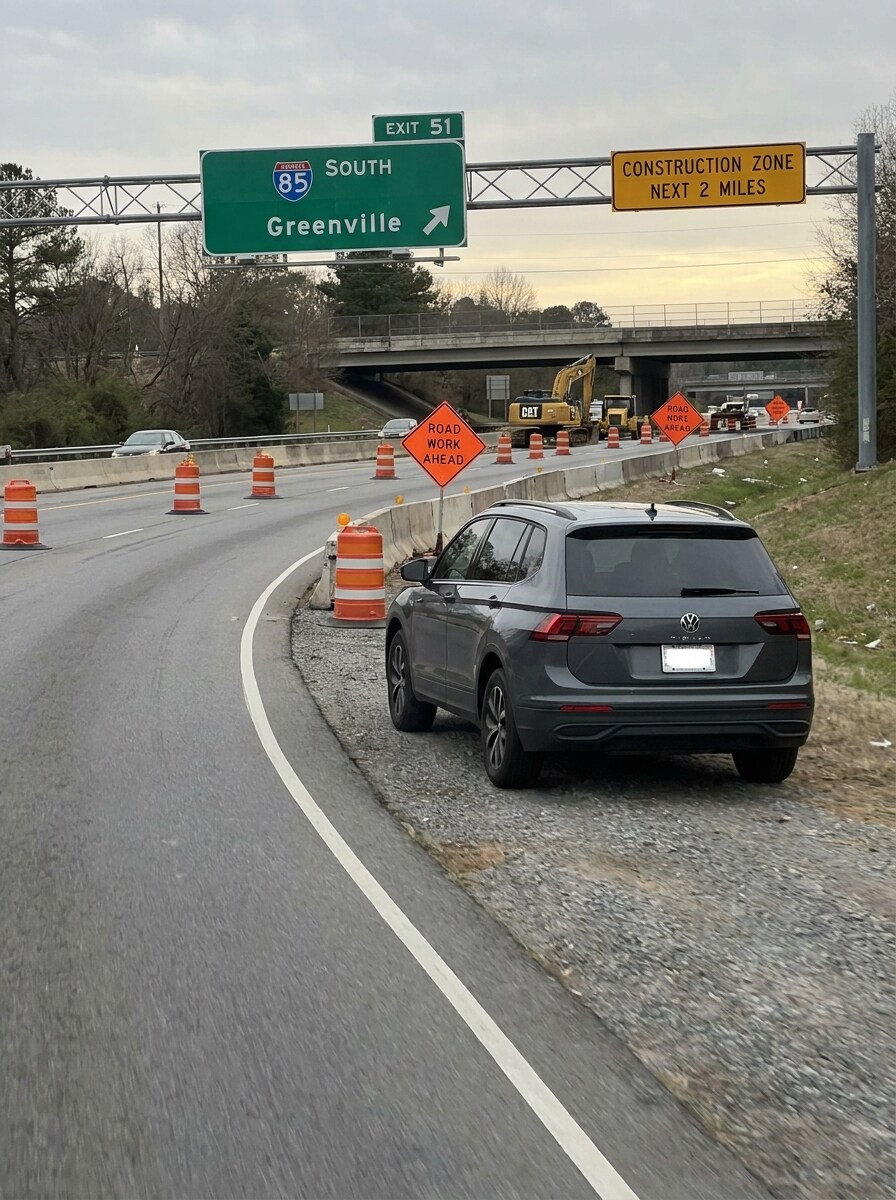
Right now, two of the busiest stretches of asphalt in Upstate South Carolina are working against your tires. The I-85 widening project between exits 40 and 69 is still in active work, so we're looking at years more of aging pavement, construction staging, and shed debris on the corridor that carries the bulk of Greenville's through-traffic. Meanwhile, the East Butler Road bridge over I-385 was closed for deck resurfacing this summer, pushing more vehicles into tighter lane patterns. Loose asphalt, wire strands, shredded truck retreads, and construction screws don't wait for good timing. Neither do blowouts.
Our service team at Steve White Volkswagen sees the aftermath on the lift. Working on Volkswagen models day after day has taught us the risk isn't random. It tracks back to five specific, fixable habits. The best move you can make today is a simple tire pressure check, and we'll walk through why that matters more than anything else below. Consider the 2026 Volkswagen Tiguan. Its entry trim runs 215/65 all-season tires on 17-inch wheels, while the SE steps up to 235/50 rubber on 19-inch wheels. That aspect ratio difference changes how each tire absorbs an impact edge. Knowing which profile you're running, and maintaining it right, is where real protection starts.
Your Ranked Tire Protection Checklist for I-85 and I-385
| Rank | Protection Action | Best For | Standout Fact |
|---|---|---|---|
| 1 | Maintain correct tire pressure | Every Volkswagen model, every commute | Per NHTSA, about 1 in 4 drivers has at least one underinflated tire; underinflated tires flex excessively, building heat and weakening structure |
| 2 | Inspect sidewalls visually before highway runs | Any Volkswagen with 19-in or lower-profile tires | NHTSA classifies sidewall bulges as grounds for immediate replacement; the sidewall cannot be patched |
| 3 | Rotate tires every 5,000 to 7,500 miles | High-mileage I-85 commuters | Uneven wear creates weak spots; NHTSA links improper inflation and wear to the leading causes of blowouts |
| 4 | Check tread depth with the penny test | Any Volkswagen approaching 30,000 to 40,000 miles | If Lincoln's head is fully visible above the tread, the tire is at or below 2/32-inch depth and far more vulnerable to puncture |
| 5 | Schedule a pre-trip inspection before long corridor runs | Upstate families heading to the coast via I-26, or the mountains via Cherokee Foothills | NHTSA reports tire-related crashes account for roughly 11,000 incidents per year nationally; blowouts are statistically more likely at highway speed |
1. Pressure Is the Foundation Everything Else Rests On
Correct pressure is the foundation because an underinflated tire flexes far more than it should as it rolls, and NHTSA data shows roughly one in four drivers has at least one significantly underinflated tire while only about 19 percent check and inflate regularly. Don't skip this one just because it sounds basic. That flexing generates heat that steadily degrades the rubber's internal structure. Overinflate and you push the problem the other way, since a tire at the top of its range has less give when it strikes debris.
Every 2026 Volkswagen comes with a Tire Pressure Monitoring System (TPMS) that warns you when pressure drops noticeably. But TPMS doesn't fire until the drop is significant. Check cold pressure monthly, before the car has been driven. Your door jamb sticker lists the exact figures for your trim. A Tiguan SE and a Taos have different specs, so getting that number right for your specific build beats a general estimate.
Schedule a Tire Pressure Check at Steve White Volkswagen
2. The Sidewall Check That Could Save You from a Blowout at 70 mph
A quick sidewall check matters most on low-profile tires, because the 2026 Tiguan SE's 235/50 profile on 19-inch wheels carries a shorter sidewall than the entry-level 215/65 on 17-inch wheels, and less rubber means less cushion between the wheel rim and whatever's sitting in your lane on I-85 at 5 pm. Low-profile tires look sharp. They're also less forgiving. When a tire drops into a pothole edge at speed, the sidewall can get pinched between the rim and the road surface. That pinch is what creates the bulge you find two days later.
NHTSA classifies a sidewall bulge as grounds for immediate replacement, and that's the point worth taking seriously. Full stop. The internal cords have been disrupted, and because the sidewall flexes continuously under load, any repair attempt will eventually fail under that stress, usually all at once. the Atlas Cross Sport families running 19-inch or 20-inch fitments on I-385 and I-85 should make a quick walk-around part of the routine before any significant highway drive. Run your hand along the sidewall and look for blistering, cracking, or that tell-tale bubble. Catching it in the driveway is a very different situation than catching it on the shoulder at mile marker 54.
Service caution: Any shop that tells you a sidewall bulge can be safely patched is handing you bad information. Replacement is the only correct call. Bring it to our service center and we'll verify the damage and fit the right tire for your model, no guesswork.
3. Tire Rotation Keeps Wear Honest on a High-Mileage Corridor
Rotation keeps wear even, which matters most for Jetta commuters running I-385 daily to Columbia and back, because front and rear tires wear at genuinely different rates and a set piling on that kind of mileage shows it fast. Front tires carry the steering and most of the braking load. On a front-wheel-drive Jetta, they also handle drive forces, so they tend to wear faster, especially at the shoulders. When one tire is measurably more worn than the others, it becomes the weakest point in the set. A nail or pothole that would've been a slow leak on a healthy tire can turn into a blowout on one that's already compromised.
Rotating your tires every 5,000 to 7,500 miles keeps wear even across all four, so no single tire becomes the vulnerability point on a debris-strewn interstate.
Industry guidance puts rotation intervals at 5,000 to 7,500 miles. Our service team can fold it into your oil change visit, so it doesn't need a separate trip. Rotation does more than keep wear tidy. Evenly worn tires give you a consistent, predictable contact patch at every corner when something unexpected shows up in your lane.
4. The Penny Test: One Habit That Takes 30 Seconds
Tread depth matters most when your tires already face an elevated-debris environment, and the penny test settles the question in about 30 seconds. The rule is simple. Stick a penny into your tread groove with Lincoln's head pointing down. If the top of his head is visible above the tread, your depth is at or below 2/32 of an inch. That's the legal minimum, and at that depth your tire is dramatically more vulnerable to a puncture from even a small object. Thicker tread acts as a buffer. Once you're close to worn out, a screw that a new tire might deflect becomes a puncture that can't be patched if it hits a bad angle.
The Upstate SC summer heat adds a layer to this. NHTSA's research notes that under extreme temperatures, tires face added stress on the sidewalls and greater potential for degradation. August on I-85 at 2 pm with pavement temperatures above 130 degrees is not the moment to discover a bald tire. Taos drivers on the entry 17-inch setup get a bit more sidewall cushion for pothole impacts, though worn tread erases that advantage quickly.
5. The Pre-Trip Inspection: What Our Service Center Actually Looks For
A pre-trip inspection covers the tradeoff at the center of tire protection, since most upkeep is maintenance you can handle yourself, yet a few failures simply can't be seen without the car up on a lift. Damage to the inner liner, slow bead leaks, cord separation starting from the inside out. Those are the ones that turn into a blowout on I-26 heading to the coast or on Cherokee Foothills toward Caesars Head, not in your driveway where you'd catch it.
NHTSA links roughly 11,000 tire-related crashes per year nationally to improper pressure, punctures, and road hazards. Blowouts are statistically more likely at highway speeds, which is exactly what I-85 and I-385 demand. A pre-trip inspection from our service center before any significant trip is the one check that catches what you'd otherwise miss. We mount the car, inspect all four tires on the lift including the inner sidewalls, verify pressure against your specific trim's spec, and assess tread depth at multiple points across the tread face. A short visit is all it takes. A tire failure on the interstate is not.
One caveat is worth stating plainly. Tire inspections won't prevent every road hazard event, but they do make sure your tires are as strong as they can be when a chunk of truck retread turns up in the middle of I-85 at mile marker 52.
The Bottom Line: Greenville's Road Conditions Make Tire Maintenance Non-Optional
Greenville's road conditions make tire maintenance non-optional because the I-85 corridor from Anderson to Spartanburg faces ongoing construction and resurfacing needs, and I-385 is running active bridge and deck work this year. None of these are complaints. They're conditions on the ground, and your tires deal with them every time you merge onto the on-ramp. Proper pressure is the single most effective protection you have. Sidewall inspection catches the damage that comes next. Rotation and tread depth checks keep the whole set even. And a periodic lift-and-look at our service center finds what you can't see yourself.
So is any of this complicated? Not really, it just takes doing it on a real schedule instead of waiting for a warning light to come on at 70 mph. Our team is here when you're ready.
Categories:
Social