
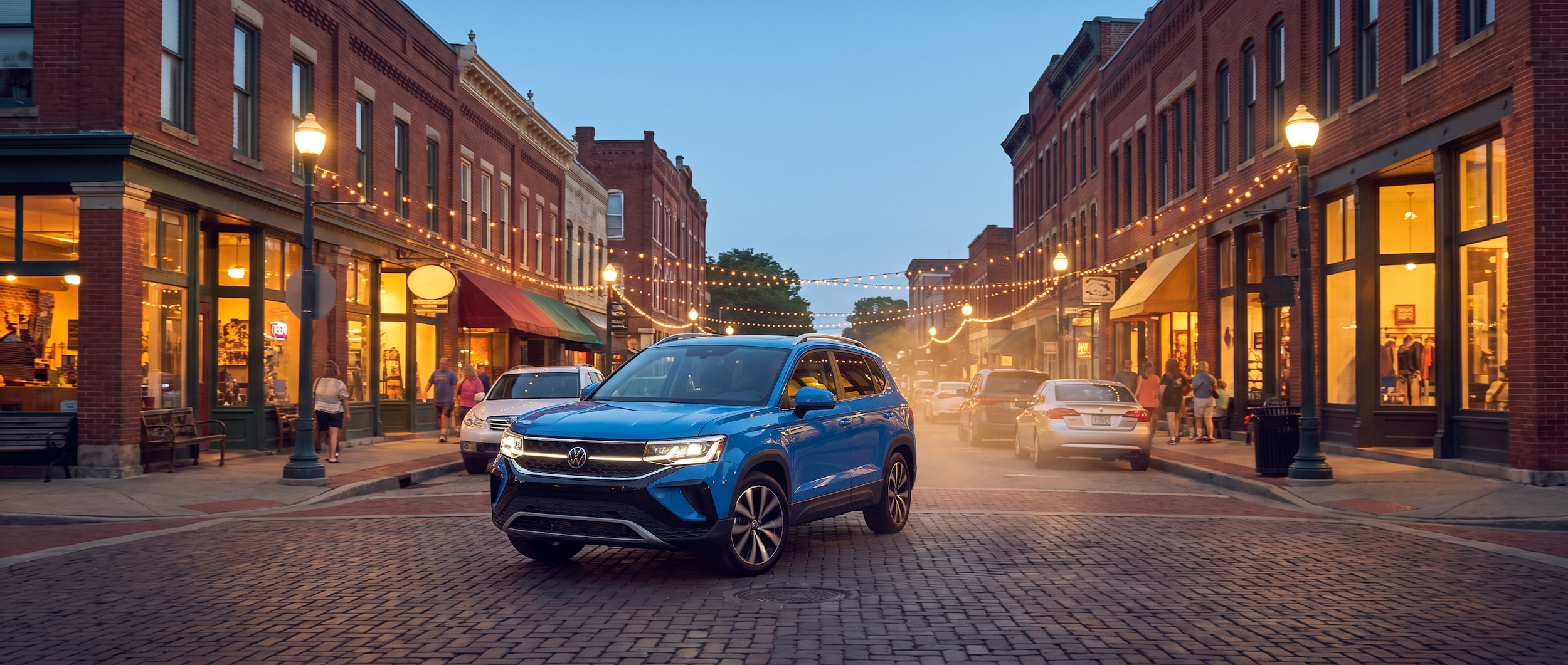
Holiday traffic in Downtown Greenville is not a theory this week -- it is a live condition. The Volkswagen Taos is built around exactly the kind of stop-and-go, tight-turn, park-and-walk driving the Fourth of July holiday demands, and the difference between a frustrating evening and a genuinely relaxed one often comes down to features you may not have thought to check.
The core answer: a Taos driver heading to Unity Park on July 2 or Fluor Field on July 4 has a suite of standard tools -- Adaptive Cruise Control with Stop-and-Go, automatic engine start-stop, a compact footprint that fits downtown garages, and Rear Traffic Alert for reversing out of crowded lots -- that most vehicles in this segment do not bundle at every trim level. Holiday traffic stress is real, but a lot of it is a vehicle problem, not a traffic problem.
What's Actually Going On with Holiday Traffic Stress?
The feeling of dread before you pull onto Main Street during a fireworks evening is not irrational. Greenville's July 4th weekend in 2026 stacks two distinct downtown events: the Clemson MBA Fireworks at Unity Park on Thursday, July 2 (fireworks at approximately 9:30 p.m.), and the Greenville Drive's Freedom Fest at Fluor Field on Saturday, July 4. Both events draw crowds into the same downtown corridor, and both empty onto the same surface streets when the shows end. Arriving, parking, and leaving -- especially if you wait until the fireworks fade before moving -- is where the stress concentrates.
The table below maps the specific moments that frustrate holiday drivers to their root causes, and to what a well-equipped compact SUV can actually do about each one.
| Traffic Stress Symptom | What Is Usually Causing It | How the Taos Addresses It |
|---|---|---|
| Creeping stop-and-go on Main Street post-fireworks | Constant brake/accelerate cycles exhaust the driver and burn extra fuel | Adaptive Cruise Control with Stop-and-Go maintains your gap automatically, smoothing out the pattern |
| Engine idling in long queues runs up fuel cost | Idling at a standstill wastes fuel with no forward movement | Automatic engine start-stop shuts off the engine at a full stop; the EPA notes start-stop can reduce urban fuel consumption by 3-5% |
| Reversing from a tight downtown garage spot with poor rear sightlines | Compact garages and pedestrian foot traffic create a genuine blind zone behind you | Rear Traffic Alert monitors cross-traffic and alerts you (or can apply the brakes) when something moves behind you while reversing |
| Lane changes feel nerve-wracking when other cars crowd in | Fatigue reduces a driver's ability to monitor adjacent lanes | Blind Spot Monitor warns of vehicles in adjacent lanes; Active Blind Spot Monitor can counter-steer to help avoid a lane-change collision |
| Circling blocks for parking adds 20+ minutes and frustration | Unfamiliar downtown layout, garages that fill after 7 p.m. | Compact 178-inch length fits standard downtown garages; wireless Apple CarPlay and Android Auto keep navigation live |
The Most Likely Culprit: Your Car Is Working Against the Conditions
Stop-and-go fatigue is the single biggest driver of holiday traffic stress, and it has a mechanical explanation. Most compact SUVs in the Taos's class ask the driver to manage every micro-decision manually: how much gap to leave, when to ease off the brake, when to creep forward. Multiply that over 45 minutes of post-fireworks egress and fatigue is the predictable result.
Volkswagen equips every 2025 Taos -- including the base S trim -- with the full IQ.DRIVE suite as standard. According to Volkswagen, this includes Adaptive Cruise Control with Stop-and-Go, which maintains a set following distance and can bring the vehicle to a complete stop in traffic, then resume when the car ahead moves. It also includes Travel Assist, Front Assist with Automatic Emergency Braking, Lane Assist, and Blind Spot Monitor with Rear Traffic Alert. None of these are upsell features on the Taos; they come on every trim.
The service center team at Steve White Volkswagen sees a related pattern: drivers who have owned vehicles without these systems often underestimate how much mental energy the manual version of these tasks consumes over a long evening. The features do not take control -- you remain the driver throughout -- but they redistribute the cognitive load in precisely the moments that wear you down.
The Taos also uses an automatic engine start-stop system. At a full stop (at a light, in a queue), the engine shuts off and restarts the instant you release the brake. The EPA notes that start-stop technology can reduce fuel consumption by 3 to 5 percent in urban driving with frequent stops -- exactly the conditions Downtown Greenville produces on a fireworks night.
Tip: If you find the start-stop feature unfamiliar the first time, it is easy to disable temporarily via the dashboard controls while you get comfortable with it. The system will not turn off the engine if the AC needs full output on a hot July evening -- it reads the cabin temperature and adjusts accordingly.
Next step: Before the evening begins, take five minutes to set your preferred following distance in the IQ.DRIVE menu. The Taos allows several gap settings; most downtown-traffic drivers prefer the closer "1" or "2" setting so the car does not leave excessive space that other drivers fill.
Handling It Yourself vs. Checking in with the Service Team
Most of what makes the Taos good in holiday traffic is factory-set and does not require any action from the driver. If you currently drive a Tiguan or another VW and have questions about which features are active on your specific trim, the fastest route is a quick visit to or call with the service center (888-475-6693) rather than navigating menus while parked downtown.
There are, however, a few things worth doing yourself before July 4th weekend:
- Charge your phone before you leave. Wireless Apple CarPlay and Android Auto are standard on the SE and above; having a full battery means uninterrupted navigation through downtown's one-way grid without fumbling with a cable.
- Check your tire pressure. Underinflated tires increase rolling resistance and reduce the EPA's estimated 28 city / 36 highway MPG (FWD) that the Taos achieves in normal conditions. A hot summer night already pushes the thermal envelope; starting with correct pressure keeps efficiency where VW designed it.
- Know your parking strategy in advance. The City of Greenville recommends parking in downtown garages and walking the Swamp Rabbit Trail (less than a mile) to Unity Park. The Augusta Street garage is close to Fluor Field and the West End. Pre-planning the garage means you arrive and park without circling, which is where downtown stress most often starts.
- Leave a 20-30 minute buffer after fireworks end. Local guides consistently note that traffic post-fireworks eases significantly if you wait rather than rushing out with the crowd. The Taos makes waiting comfortable -- the climate system holds the cabin temperature without the engine running (the start-stop system will keep it running as needed for AC).
If your current vehicle lacks these features, or if something in your IQ.DRIVE system does not seem to be responding correctly, that is a conversation for the Steve White VW team rather than a parking lot diagnosis. A quick pre-holiday service check takes less than an hour and rules out any sensor issues before they become a stress point on a busy night.
Frequently Asked Questions
Does the Volkswagen Taos fit comfortably in downtown Greenville parking garages?
Yes. The Taos measures 178.5 inches in overall length, which is compact enough to fit standard downtown Greenville parking garages without the maneuvering difficulty of larger SUVs. Rear Traffic Alert monitors cross-traffic when you reverse, and higher trims add front and rear park distance control. The tight turning radius and direct steering make threading into a city space straightforward.
Will the IQ.DRIVE features actually help with post-fireworks traffic on Main Street?
They are specifically useful for that scenario. Adaptive Cruise Control with Stop-and-Go takes over the gap-management task during slow-moving traffic, maintaining your following distance and stopping the vehicle automatically if traffic halts -- then resuming when it moves. You stay in control and keep your hands on the wheel throughout. The system reduces the repetitive brake/accelerate effort that makes post-fireworks egress fatiguing.
Categories:
Social