
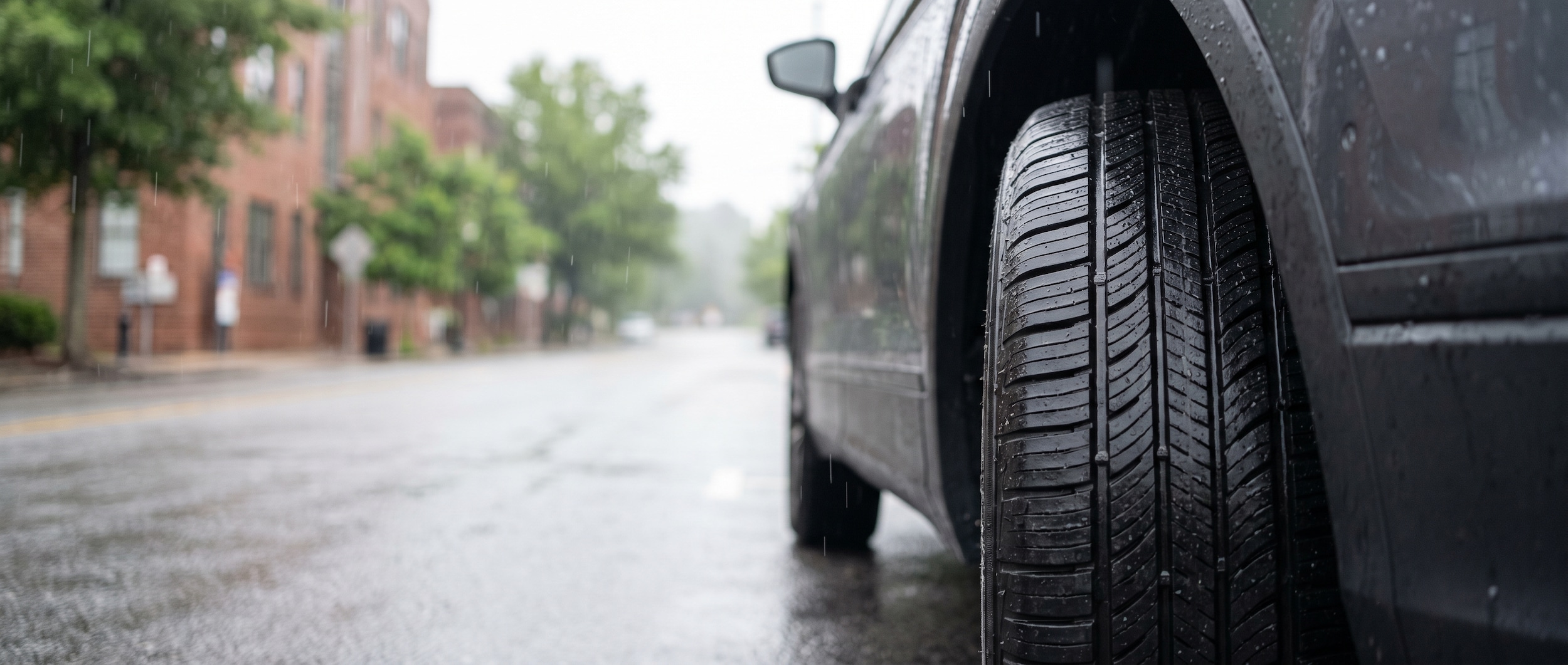
That low drone that crept into your cabin somewhere around the Mauldin Road interchange on I-385 probably isn't a bearing. It isn't a transmission problem, and it isn't your Volkswagen suddenly aging out on you. Here at Steve White Volkswagen, we see this pattern consistently: the culprit behind that kind of steady highway hum is almost always tires that have worn past the point where they ride quietly, often without the driver noticing how far the tread has actually gone down. Fresh rubber fixes it. And in Greenville, where summer rainstorms stack up fast on I-85 and I-385, that fix matters for more than cabin comfort.
The most common cause of a new, persistent drone in a Volkswagen is tires worn unevenly or past the 4/32-inch threshold (the point where wet-road grip and ride quality both start to degrade on Greenville's rain-soaked summer roads).
Why Does a Volkswagen Start Sounding Different on Greenville Roads?
Road noise in a Volkswagen almost never arrives all at once; it creeps in across thousands of miles, a little louder each month, until one day the highway just sounds wrong.
| Local Condition / Use | The Tire Factor That Makes It Loud | Why It Shows Up Here |
|---|---|---|
| Daily I-385 highway commute at 65-70 mph | Cupped or feathered tread creates a rhythmic drone at speed | Consistent highway speeds amplify the vibration pattern cupped rubber produces |
| Greenville's 50+ inches of annual rainfall | Tread worn below 4/32" can't channel water fast enough | Shallow grooves start making a hiss or slap on wet pavement |
| Summer pavement heat on I-85 | Heat-softened rubber accelerates uneven wear | July surface temps can spike tire wear rates if rotation is overdue |
| Stop-and-go on Woodruff Road / surface streets | Flat-spotting from hard braking wears the contact patch unevenly | Uneven patches create a thump-thump at low speed |
| Upstate weekend mountain runs (Cherokee Foothills Highway) | Performance-oriented tires wear faster from lateral loading | Cornering loads on SC-11 chew through shoulder tread before center tread |
Volkswagen suspension geometry, particularly on the Tiguan and the Jetta, holds precise alignment angles that distribute wear evenly when the tires are in good shape. When they're not, that same alignment precision works against you. The rear tires on front-wheel-drive Volkswagen models carry very little steering load, so they wear slowly and quietly. Then a rotation finally moves them to the front axle, and a dormant drone that was building for months becomes impossible to ignore overnight.
Tread Depth Is the Number That Actually Matters
New tires on a Volkswagen typically start life around 10/32 of an inch of tread depth. That's a lot of groove. The legal minimum in South Carolina, per NHTSA standards, is 2/32 of an inch. By the time you're there, you've already moved well past the noise problem and into a genuine safety issue. The practical replacement threshold is 4/32 of an inch.
Here's the honest tradeoff: a tire at 4/32" can still feel fine on a dry road. Dry pavement doesn't demand much from tread grooves. Greenville's summer rainstorms are a different story. July alone averages over 13 rainy days here, and when tread gets shallow, the grooves have less room to channel water away from the contact patch. That's exactly when a Volkswagen that felt planted starts to feel nervous.
Per NHTSA: "Tires are not safe and should be replaced when the tread is worn down to 2/32 of an inch." Stopping-distance data consistently shows that tires at 4/32" need an additional 87 feet to stop from 60 mph on wet pavement compared to new tires. That gap is nearly the length of nine car lengths.
That gap is worth sitting with. Road drone is usually what brings drivers in first, and that's actually useful. Think of it as an early-warning system: if your Volkswagen has developed a hum that wasn't there six months ago, check the tread depth before your next rainy highway run.
Tip for Upstate SC drivers: Greenville County sees more than 50 inches of rain per year, well above the US average of about 38 inches. If you commute on I-385 daily, wet-road performance matters for more months of the year than it does in drier parts of the country. Plan tire replacement around the 4/32" threshold, not the 2/32" legal minimum.
Not All Tire Noise Means the Same Thing
Knowing what kind of noise you're hearing saves you from replacing tires that aren't the problem, and from holding off when they are. Our service team sees both situations, so it's worth laying out the differences clearly.
A steady, rhythmic drone that changes pitch with vehicle speed but doesn't shift when you gently swerve left or right is almost certainly tires. What you're feeling is cupping, an uneven wear pattern where scalloped low spots around the tread's circumference create a repeating bump with every rotation. Cupping on Volkswagen models tends to develop when rotation intervals stretch past 7,500 miles or when alignment has drifted. Once it's established, the noise won't go away on its own. Those tires need to come off.
A noise that shifts noticeably when you ease the wheel left or right at highway speed points toward a wheel bearing. That's a different repair and a different conversation with our service team.
Tire choice itself matters too. Owners of the Golf GTI and the Golf R know this well. Ultra-high-performance summer tires deliver outstanding grip and handling feel, and they trade some of that against cabin quiet. A performance compound's aggressive tread pattern is inherently louder than an all-season design. If the noise on your GTI has always been there, it's probably the tire category. If it developed gradually over time, it's wear.
What Fresh Tires Actually Do to a Volkswagen's Ride
New tires change more than the noise, and drivers are often surprised by how much the whole car shifts. Steering feels more connected, the cabin is noticeably quieter on the I-385 on-ramp, and the car sits and handles with the confidence the suspension was actually designed to deliver.
Volkswagen's chassis tuning, on models from the Taos to the Atlas, is calibrated for tires in proper condition. Worn tires introduce compliance and play that the suspension geometry can't compensate for. Restore the contact patch the engineers assumed would be there, and the whole system comes back to what they intended. We'd put it this way from a service standpoint: the chassis doesn't change with age, but the tires do, and new rubber is often the single adjustment that brings everything back into sync.
The right time to schedule a tire inspection is before the drone becomes unavoidable. If it already has, it's not too late to fix it.
By the Steve White Volkswagen Team | July 2026
Categories:
Social