
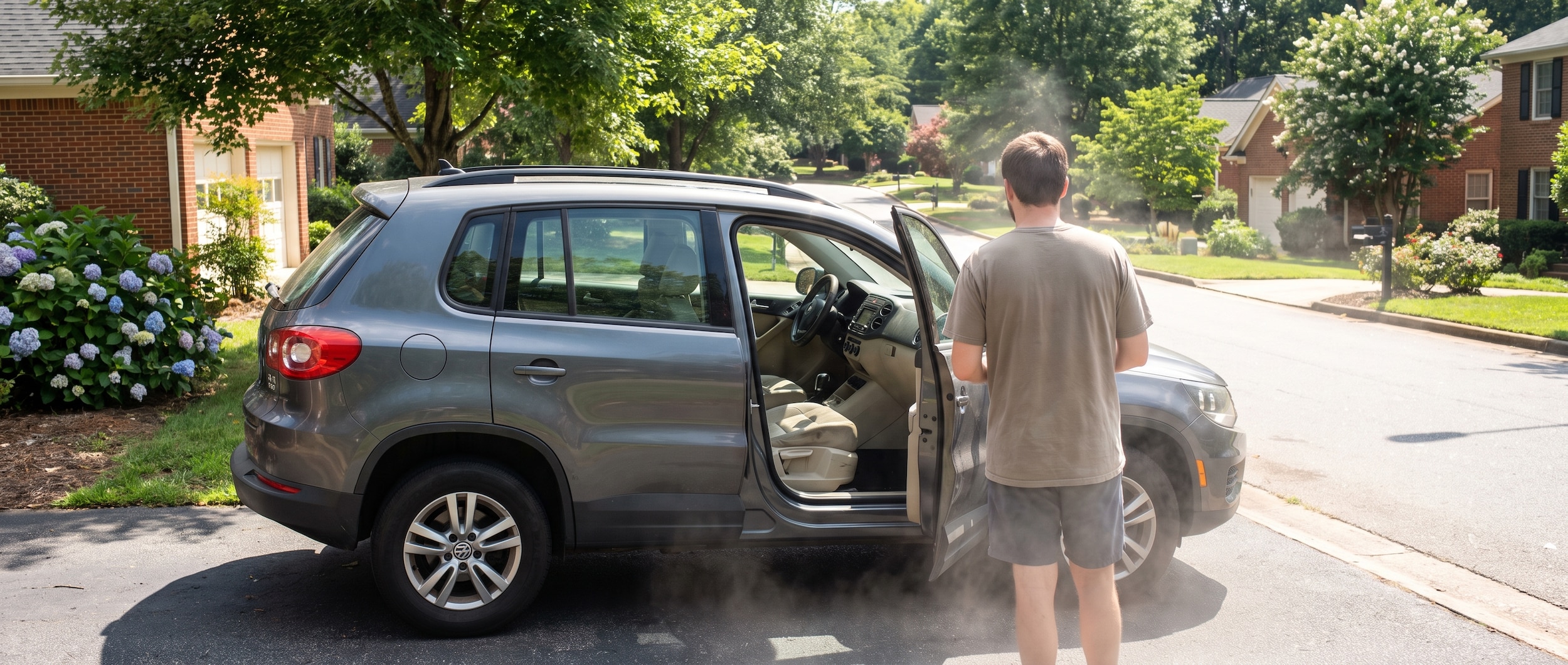
Shopping for a car in a July heat wave sounds miserable, and we'd argue the opposite is true. When Greenville's heat index climbs past 100 degrees, a used Volkswagen test drive stops being a formality and becomes a real diagnostic. The A/C either keeps up or it doesn't. A tired DSG will shudder at low speed where a healthy one shifts clean. The battery either holds its resting voltage or shows it's on the way out, if it's been baking on the lot. You'll learn more about a used car in 20 sweaty Upstate SC minutes than you would in an hour on a mild April afternoon.
After working with Volkswagen buyers in Greenville, we'd put it plainly. The model year you choose matters as much as the heat test itself, and some ranges are genuinely solid picks while others carry documented patterns worth knowing before you sign anything.
Browse our pre-owned Volkswagen inventory to see what's currently available while you read through the breakdown below.
The short version
- Sweet-spot years for a used Volkswagen Tiguan: 2020-2023 (second-gen maturity, fewer early-production issues)
- Sweet-spot years for a used Volkswagen Jetta: 2019-2022 (seventh-generation refresh, improved reliability profile)
- Sweet-spot years for a used Volkswagen Atlas: 2021-2023 (software and structural refinements over the launch generation)
- Years to approach carefully: 2018-2019 Tiguan (rear coil spring recall, early DSG calibration), 2018 Atlas (first-year launch model)
- Summer heat is your best diagnostic tool: run the A/C for the full drive, sit in traffic if you can, and feel for DSG shudder at low speeds
Which years are the sweet spot for a used Volkswagen in Greenville?
The best years depend on which model you're shopping, but one pattern holds across the whole lineup, since the sweet-spot years cluster right where a generation had enough production time for its early issues to get corrected, usually a couple of seasons after a redesign. Volkswagen moved through real generational changes in the late 2010s and early 2020s.
| Model | Sweet-Spot Range | Why It Works | Years to Watch |
|---|---|---|---|
| Tiguan | 2020-2023 | Second-gen matured past early coil spring and calibration issues; 2020+ has refined DSG tuning | 2018-2019 (see below) |
| Jetta | 2019-2022 | Seventh-gen refresh brought more reliable electrical architecture; A/C compressor complaints lower than older gens | Pre-2019 (older gen, more age-related wear) |
| Atlas | 2021-2023 | Software refinements addressed rearview camera eMMC infotainment recall; 2021+ benefits from production consistency | 2018-2019 (first-year launch, more first-gen variability) |
| Golf GTI | 2022-2023 | MK8 generation settled by 2022; early MK8 had touchscreen software issues | 2021 (first MK8 year, infotainment teething) |
| Jetta GLI | 2020-2022 | Wet-clutch DSG (DQ250) is the more thermally robust option; look for documented service history | Any year with no DSG service records |
Volkswagen rewards buyers who read the maintenance history. Whether a used Tiguan turns out great or frustrating comes down less to the year and more to whether the DSG fluid got changed on schedule.
Which years should you approach more carefully?
The 2018 and 2019 Tiguans carry the most documented concerns for Greenville buyers, though a well-kept example with its recalls closed can still be a sound buy, so treat this section as a homework list rather than a hard no. Two campaigns are worth knowing cold.
Per NHTSA records, Volkswagen issued a recall (campaign 42J5, effective April 12, 2019) on 2018-2019 Tiguan vehicles because the rear axle coil springs may prematurely fracture. A fractured spring can damage a rear tire and cause loss of vehicle control. The fix is a dealer-performed spring replacement at no charge, but before you buy, verify on the vehicle history report that the recall was actually completed. A recall issued isn't a recall completed.
A separate NHTSA recall (campaign 91DV) covered the 2021 Tiguan, certain 2022 Taos, and 2021-2022 Atlas vehicles, tied to the infotainment system's eMMC memory module, which could keep the rearview camera image from displaying. Per NHTSA, dealers update the infotainment software free of charge. Verify that one's closed too, rather than assuming.
Want to compare what's on our lot today? See our current Tiguan inventory.
For the Jetta, the 2019-2020 generation carries a documented TPMS recall (NHTSA campaign 22V815000) covering the tire pressure monitoring system's ability to detect simultaneous pressure loss across all four tires. The software update is straightforward, though it's one more box to tick on the history report.
Explore available Jetta options here.
Recall-verification tip: The NHTSA vehicle search tool (safercar.gov) lets you enter a 17-digit VIN and see every open or completed recall on that specific car. Run it before you show up for the test drive. An open recall on an otherwise solid Volkswagen isn't a dealbreaker, but it's a negotiating point and a transparency check.
How does Greenville's summer heat work in your favor during a test drive?
Greenville's July heat actually works in your favor on a test drive, since the same ambient stress that makes a parking lot miserable also loads every system a buyer needs to check, from the A/C to the DSG to the battery. Greenville's average July high sits at 89 degrees, and the NWS heat index at Greenville-Spartanburg has reached 106 degrees during summer heat events. All that heat puts real load on the parts you want to evaluate.
Use the heat on purpose during your drive.
1. Start with the A/C already off, cabin fully soaked. Don't let the seller pre-cool the car. Get in a hot cabin, turn the A/C to maximum, and drive. A healthy Volkswagen A/C should drop the cabin temperature noticeably within the first two to three minutes. If it's still blowing lukewarm air after five minutes, the refrigerant is low or the compressor is struggling. Owner experience reports on the 2020 Tiguan documented the blower motor intermittently failing when ambient temperatures exceeded 90 degrees. Summer in Greenville is the only time you can replicate that condition on a lot.
2. Test the DSG in slow, stop-and-go traffic. DSG behavior is where Volkswagen specifically rewards a careful drive. The 7-speed DQ200 (dry-clutch DSG), found on smaller-displacement Jetta and Tiguan models, is the variant more sensitive to heat and stop-and-go stress. The tell is a shudder or hesitation on low-speed 1-to-2 upshifts. According to DSG transmission specialists, DQ200 dry clutches are most vulnerable at 40,000 to 60,000 miles in hot climates and aggressive stop-and-go conditions. Pull out onto Woodruff Road or cut through any Greenville surface street during lunch hour. If the car shudders as it moves away from a light, that's a clutch friction issue, not a quirk.
3. Check battery resting voltage (or ask us to). Heat accelerates internal battery corrosion and shortens lifespan. A healthy 12-volt battery rests at 12.6V. If a vehicle has been sitting on the lot in direct Greenville sun and the battery reads lower than that after a full drive, it's already compromised. The 2019 Jetta generation had documented owner reports of charging system inconsistency. A battery that hides a problem in cooler months often gives itself away in July.
4. Watch the temperature gauge during the full drive. Coolant systems that are marginal in spring are clearly marginal in summer. Sit at a red light for a few cycles and watch. A used Volkswagen with a healthy cooling system holds a stable temperature even in static traffic. Any climb toward the high end of the gauge while idling is worth a question, though not a reason to panic. It just needs an explanation.
5. Feel the steering on highway ramps. I-85 and I-385 put real lateral load on suspension components. A fractured or weakened rear coil spring (the documented issue on 2018-2019 Tiguans before the recall was completed) can produce a vague, uneven feel in corners. Don't just park-lot test a used Volkswagen. Get it on a real ramp.
The single most important document on a used Volkswagen is the DSG service record. A wet-clutch DQ250 with a documented fluid change at 40,000 miles tells you more about the car's future than the odometer reading alone.
Which model year fits which Greenville buyer?
No single year range is right for every buyer, so the smarter move is to match a range to how you actually drive, whether that's a daily I-85 commute, a three-row family hauler, or a weekend back road toward the mountains. Here's how we'd line them up.
The 2020-2021 Tiguan is the move for Upstate SC families who want German interior quality, the optional 4MOTION AWD for fall trips up Cherokee Foothills National Scenic Highway toward Caesars Head State Park, and a generation that had the early production concerns addressed. The 2020 Tiguan runs the 2.0-liter TSI producing 184 horsepower paired with an 8-speed automatic (not DSG), which sidesteps the dry-clutch heat-sensitivity question entirely.
A 2019-2021 Jetta makes sense for a few specific Greenville buyers and priorities:
- It suits the commuter who runs I-85 or I-385 daily and wants German feel without German-SUV operating costs.
- It's a natural fit if you're buying around 40,000 to 70,000 miles.
- Look for documented evidence of the TPMS recall being completed and any A/C service history.
The 2021-2023 Atlas suits the buyer who needs three rows, occasionally loads the car for a weekend at Lake Hartwell or beyond, and wants the second-generation Atlas after Volkswagen had time to address the first-year software and recall items. The 3.6-liter VR6 in higher Atlas trims is a smooth, characterful engine that holds up well with regular oil changes.
A Jetta GLI from 2020-2022 is genuinely worth seeking out for the driving-focused Greenville buyer. The GLI runs the wet-clutch DQ250, which is the more thermally robust DSG variant. It handles stop-and-go heat better than the smaller DQ200. Budget for a DSG fluid service if the records don't show one, and you're looking at a fun, practical sedan with real German sport-sedan DNA.
The 2018-2019 Tiguan or 2018 Atlas isn't automatically off the table. A car with a completed recall history, documented DSG service, and a clean inspection is still a reasonable buy. It just requires more homework up front. We always recommend verifying every open recall is closed before finalizing anything.
Frequently Asked Questions
Is summer really a good time to buy a used Volkswagen in Greenville?
We think summer is one of the better windows, and here's why. The heat stress-tests A/C systems, DSG transmissions, and batteries in ways cooler months simply don't. A used Volkswagen that performs well on a 20-minute July test drive in Greenville has cleared hurdles a winter drive in a mild climate would never present. The discomfort of a hot parking lot is worth the diagnostic information you get.
How do I check whether a used Volkswagen's recalls have been completed?
Head to the NHTSA database at safercar.gov, enter the vehicle's full 17-digit VIN, and read the recall status for that specific car. A recall marked "completed" means the remedy was done, while "open" means it hasn't been. Bring the printout to the conversation. An open safety recall is a real issue worth raising.
What is the DSG transmission, and why does it matter on a used Volkswagen?
DSG (Direct Shift Gearbox) is Volkswagen's dual-clutch automated transmission, used across the Jetta, Tiguan, Golf GTI, Jetta GLI, and other models. There are two main variants. The 7-speed DQ200 (dry-clutch, used on smaller-displacement models) is one, and the 6-speed DQ250 (wet-clutch, used on higher-torque models like the GLI and some Tiguans) is the other. The DQ200 is more sensitive to heat and stop-and-go traffic and needs documented fluid service. A shudder or hesitation at low speed on a hot Greenville test drive is the primary warning sign. Ask for the service records specifically showing DSG fluid changes.
Categories:
Social