
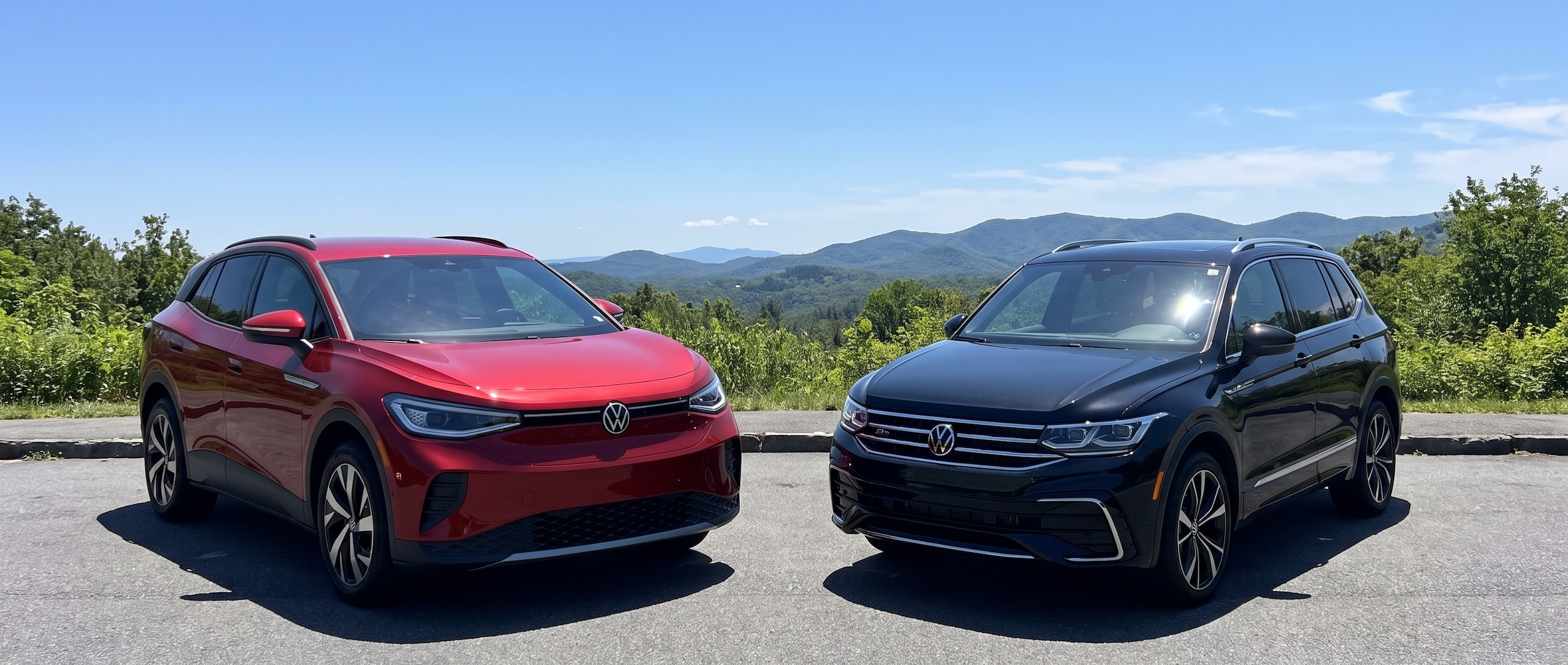
For most Upstate SC drivers, the 2026 Volkswagen ID.4 takes the daily-commute matchup. Its EPA-estimated 291-mile range covers even a generous Greenville round-trip several times over, and electricity costs less per mile than gas. The 2026 Volkswagen Tiguan earns the nod if your life includes frequent long hauls down I-26 to the coast or spontaneous weekend runs with no charging stop planned. It all pivots on one question. Do you have a place to plug in at home or at work?
Which one actually fits a Greenville commute?
For a typical Greenville commute the ID.4 wins comfortably, since most I-85 and I-385 round-trips run 20 to 50 miles and barely dent its 291-mile battery, though the Tiguan still helps drivers who can't plug in overnight. The EPA rates the rear-wheel-drive 2026 ID.4 at 291 miles of range per charge, so a normal Upstate workday pulls about a tenth of the battery. Start every Monday at a full charge from your garage outlet, and the math gets almost embarrassingly comfortable.
The Tiguan tells a different story with its own strengths. Volkswagen rates the 2026 Tiguan S at 26 city / 34 highway / 29 combined (FWD), and a full tank of regular fuel takes you around 400 miles before you even think about stopping. The flexibility is real, especially if your schedule's unpredictable and you can't always count on plugging in overnight.
Our team pulls up one comparison when a customer stands between the two.
| Decision factor | 2026 Volkswagen ID.4 (RWD Pro) | 2026 Volkswagen Tiguan (S FWD) |
|---|---|---|
| EPA range / fuel range | 291 miles per charge | ~400 miles per tank (est.) |
| City efficiency | 122 MPGe (EPA) | 26 mpg city (EPA) |
| Highway efficiency | 104 MPGe (EPA) | 34 mpg highway (EPA) |
| Horsepower | 282 hp | 201 hp |
| Torque | 402 lb-ft | 207 lb-ft |
| DC fast charge speed | Up to 175 kW (10-80% ~30 min) | Not applicable |
| Cargo behind rear seats | 30.3 cu ft | 33.8 cu ft |
| Cargo seats folded | 64.2 cu ft | 69.8 cu ft |
| Seats | 5 | 5 |
| Best daily fit | Home/workplace charging available | Unpredictable schedule, long road trips |
The tradeoff is real and worth naming plainly. When you can charge where you sleep, the ID.4 is a clearly superior urban and suburban commuter. The Tiguan flips more flexible the moment your week involves a last-minute overnight trip or a stretch where charging logistics feel like homework.
What does the road-trip and charging reality look like in Upstate SC?
For road trips out of the Upstate both cars deliver, though the Tiguan handles long highway days without a plan while the ID.4 asks for one charging stop on the way to the coast. Greenville is not a charging desert. There's an Electrify America station on Woodruff Road at Sam's Club with four CCS fast chargers rated up to 350 kW, available 24/7. The ID.4 accepts DC fast charging at up to 175 kW, which Volkswagen rates at 10%-to-80% in roughly 30 minutes. Call it a reasonable pit stop, not a crisis.
Where the Tiguan earns its keep is the open highway. Push south on I-26 toward Charleston and you're looking at about 230 miles one way, enough that the ID.4 AWD's EPA-rated 263 miles has you arriving close to empty if you held highway speeds. You'd want to plan a charge. The Tiguan just runs it straight through.
The same math applies on Cherokee Foothills Scenic Highway (SC-11). That road climbs through the Blue Ridge toward Asheville.
Our team's honest take: The charging stop is real, not imaginary. But context matters. If 95 percent of your driving is Greenville-area errands and a daily commute, you'll almost never see the inside of a charging station except by choice. The one week a year you drive to the Outer Banks, plan a stop. Call that a fair trade for a quieter, smoother ride every other day of the year.
The practical dividing line is simple. If you drive more than 200 miles in a single day at least twice a month, the Tiguan's unlimited-range flexibility has real daily value. If you don't, the ID.4's home-charging convenience wins on most mornings.
Does the Tiguan still have a third row, and how does cargo compare?
No, the 2026 Tiguan no longer offers a third row, and that change is exactly why its cargo numbers climbed, giving you a roomier two-row hauler even as the ID.4 stays a touch tighter behind its rear seats. The dropped seat catches a lot of returning Volkswagen owners off guard, so let's state it clearly. Volkswagen dropped the optional third row for the 2026 Tiguan generation entirely. The new Tiguan is a five-passenger, two-row SUV, full stop. If you're cross-shopping because you need seven seats, the Volkswagen Atlas is the right conversation to have instead.
What Volkswagen traded the third row for is genuinely useful. The 2026 Tiguan now carries 33.8 cubic feet behind the second row (Volkswagen's official figure) and expands to 69.8 cubic feet with the seats folded flat. The load floor sits nearly level when folded, which helps when you're sliding in a cargo carrier after a Lake Hartwell weekend.
The ID.4 runs marginally tighter on cargo. Volkswagen lists 30.3 cubic feet behind the rear seat and 64.2 cubic feet with the seats folded. Meaningful? For a dog crate or a double stroller, yes. For a weekly grocery run, no. Both cars carry a Paris Mountain State Park day pack, a cooler, and four people's gear without drama.
Interior feel is where some buyers land unexpectedly on the Tiguan. Its redesigned cabin brings a 12-inch center display standard (15-inch on upper trims), physical shortcut buttons that survived the latest update, and 30-color ambient lighting on the SEL R-Line Turbo. The ID.4 goes more minimalist and digital. Both feel plenty nice inside. Which you prefer is worth an in-person visit. Browse our current Volkswagen inventory to see what trims are on the lot right now.
Which one fits your Greenville routine better?
The better fit comes down to your driveway and your calendar more than any spec sheet, with the ID.4 rewarding anyone who can charge at home and the Tiguan suiting an unpredictable schedule or a household that can't plug in overnight. Our team at Steve White Volkswagen spends real time on this question with customers, and it almost always comes down to two things, charging access and trip patterns.
If you have a garage, a carport, or even a standard 120V outlet at home, the ID.4 rewards you immediately. You wake up to a full "tank" every morning. You'll likely spend less per mile than you do on gas. The quiet, instant-torque drive character is something people notice on that first Verdae Boulevard stretch at a stoplight. The downside is real. A last-minute coast run without a charging plan creates mild friction that a Tiguan driver never feels.
If your household can't reliably charge at home (an apartment without a dedicated outlet, a spot where you park on the street, or a schedule with frequent 300-plus-mile days), the Tiguan's conventional gas tank is a legitimate advantage. It fills in three minutes, anywhere. The 2026 Tiguan is also a more polished daily driver than its predecessor, with a calmer ride and a cabin that most of our customers find immediately familiar.
One honest note from our side of the counter. The ID.4 is a better fit for a primary vehicle in a two-car household than a solo car with truly unpredictable mileage. If you and a partner share vehicles and one of them runs on gas, the ID.4 becomes a lot easier to live with.
Think you've found your answer? Start a financing application whenever you're ready, and our team will handle the paperwork side so the visit stays focused on the drive.
Frequently Asked Questions
Is the 2026 Volkswagen ID.4 practical for daily driving in Greenville without a home charger?
Much depends on how close you are to a public charger. Greenville has an Electrify America fast-charging station at Sam's Club on Woodruff Road with four DC fast chargers rated up to 350 kW, available 24 hours a day. The 2026 ID.4 can charge from 10% to 80% in roughly 30 minutes on that network. If that station sits on or near your regular route, the ID.4 stays practical. If your commute takes you away from charging access and you park on the street overnight, the Tiguan is the more friction-free daily choice.
Did the 2026 Volkswagen Tiguan drop the third row?
Yes. Volkswagen removed the optional third-row seat from the 2026 Tiguan and made it a five-passenger, two-row SUV only. The change improved rear-seat comfort and boosted cargo space to 33.8 cubic feet with the second row upright and 69.8 cubic feet with it folded. Customers who need seven seats should look at the Volkswagen Atlas, which offers standard three-row seating for up to seven or eight passengers.
How does summer heat in Greenville affect the ID.4's real-world range?
Heat has a smaller negative effect on lithium-ion EV range than extreme cold does, but running the air conditioning at full blast on a Greenville July afternoon does draw from the battery. Volkswagen's precondition feature (which cools the cabin while still plugged in) helps offset that. The EPA rates the 2026 ID.4 RWD at 291 miles, and real-world summer range in moderate heat tends to stay within 10 to 15 percent of that figure, well above what any Greenville-area commute needs.
Categories:
Social