
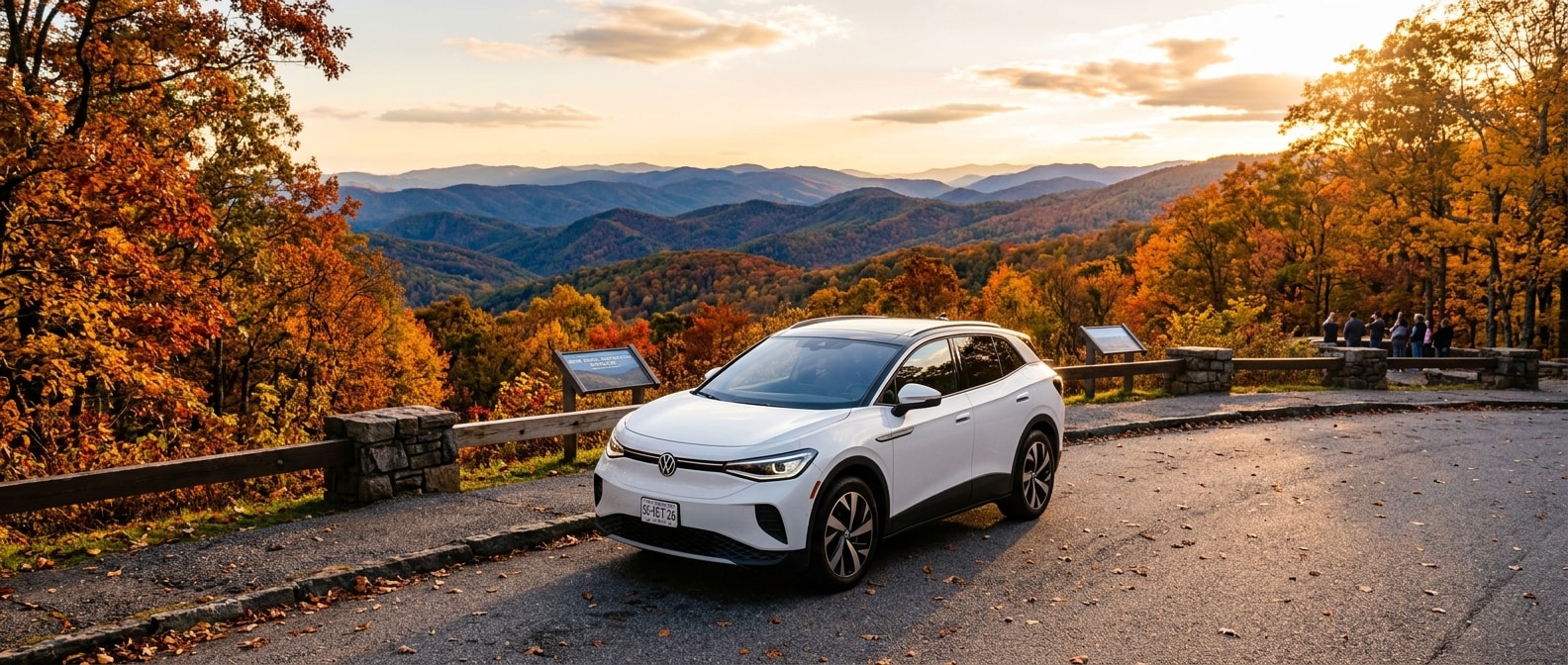
October in Upstate South Carolina is one of the better times to own a Volkswagen EV, and we'll stand behind that. Mild temperatures sit right in the battery's sweet spot. Before you head toward Caesars Head or SC-11, here's the honest picture. Plan your charge stops around elevation gain and highway speed, since that's what actually moves range this time of year, and a fall trip from Greenville into the Blue Ridge is completely manageable with either Volkswagen EV we carry.
The 2026 Volkswagen ID.4 is where fall-trip planning tends to start, so that's where we'll dig in first. We'll cover the 2026 ID. Buzz separately, since that van's range profile is a different conversation.
How far will it really go on an Upstate route?
The EPA rates the 2026 ID.4 Pro at 291 miles of range in rear-wheel drive with the 82 kWh battery, and 263 miles for the AWD configurations, but those are lab numbers from a controlled cycle, so on a real Greenville-area fall run two things push harder on actual range than the sticker does. Watch sustained highway speed and elevation change.
Cruising at 75 miles per hour on I-85 drops real-world efficiency to roughly 2.8 to 3.0 miles per kilowatt-hour, which puts practical range closer to 230 to 250 miles before you'd want a charge stop. Turn off I-85 and climb toward Caesars Head State Park at 3,208 feet, and the sustained grade pulls harder on the battery than flat highway does. Regenerative braking claws back part of that on the descent, though you won't recover everything. Plan conservatively on the way up.
The temperature piece is good news. Greenville's October days run mid-60s to low 70s, and nights drop into the upper 40s. Testing data shows the real range penalties hit hardest at temperatures well below freezing, somewhere around 16 degrees Fahrenheit and colder. The mild conditions the Upstate sees through most of October stay well clear of that. So this fall, you're planning around the grade, and the thermometer barely enters into it.
| Route / Leg | Model | EPA Range | Estimated Real-World | Charge Stop Needed? |
|---|---|---|---|---|
| Greenville to Caesars Head and back (90 mi round trip) | ID.4 Pro RWD | 291 mi | 240-250 mi practical | No, leave full |
| I-85 Greenville to Spartanburg and back (60 mi) | ID.4 Pro RWD | 291 mi | 240-250 mi practical | No |
| Greenville to Charleston via I-26 (220 mi one way) | ID.4 Pro RWD | 291 mi | 230-245 mi practical | One fast-charge stop |
| Cherokee Foothills Scenic Highway loop (120 mi) | ID.4 AWD Pro | 263 mi | 215-225 mi practical | No, leave full |
| Greenville to Charleston via I-26 (220 mi one way) | ID. Buzz 2026 RWD | 234 mi | 190-210 mi practical | Yes, plan one stop |
| Greenville to Caesars Head and back (90 mi round trip) | ID. Buzz 2026 RWD | 234 mi | 190-210 mi practical | No, leave full |
*EPA range figures: 2026 ID.4 Pro RWD 291 miles, ID.4 AWD 263 miles per Volkswagen and the EPA. 2026 ID. Buzz RWD 234 miles, AWD 231 miles per Volkswagen of America. Real-world estimates account for highway speed and Blue Ridge elevation gain.*
Schedule a Pre-Trip Service Check
Where do you charge in the Upstate?
Charging around Greenville has come a long way, and for interstate travel it's genuinely ready even if the scenic back roads still run thinner, so you'll want to plan around that split before you leave, especially on the SC-11 legs where public fast chargers get sparse. The Greenville-Anderson-Mauldin corridor is one of the densest clusters in the state.
South Carolina now has over 650 public charging stations statewide, including 173 DC fast chargers. The I-85 corridor through Upstate SC meets the federal 50-mile charging station spacing standard.
The 2026 ID. Buzz and the 2026 ID.4 both support DC fast charging, with peak rates that bring the battery from 10 to 80 percent in roughly 26 to 28 minutes at a properly rated station, per the published specifications of Volkswagen. That's a lunch stop, not a delay (you'll have time to eat and check your messages). The 2026 ID.4 also comes standard with an NACS port, which gives you access to the Tesla Supercharger network on top of ChargePoint, EVgo, and other networks spread along I-85 and around the Greenville metro.
The honest gap is SC-11. The Cherokee Foothills National Scenic Highway is spectacular, and the fast-charging network along the highway itself runs thinner than what you'll find on the interstate. For that loop, our advice is easy. Leave Greenville with a full charge. At 263 miles of EPA range in the AWD ID.4, the roughly 120-mile loop back home doesn't call for a stop, and the ID. Buzz handles it the same way with comfortable margin.
For I-26 toward the coast, the route-planning tool of the ID.4 flags fast chargers along the corridor. One stop is enough, and it's there when you need it.
Charging caution for mountain legs: DC fast charging is quickest between 10 and 80 percent state of charge. Above 80 percent, the charge rate tapers off sharply by design. For a Blue Ridge day trip, aim for 80 to 90 percent at departure instead of waiting on 100 percent. Chasing a full charge at a public station costs you time for very little added range.
- Use the in-car route planner before you leave, not once you're on the road
- Target 80 to 90 percent state of charge at departure for long legs
- On mountain routes, budget generously for the climb; the descent recovers some but not all of it
- Level 2 overnight charging at hotels covers most of what a multi-day trip needs
- On a Level 2 station at 11 kW, the ID.4 adds roughly 37 miles of range per hour
Plan the trip this way
Late September through mid-October is one of the easiest windows to run an EV road trip out of Greenville, mostly because the weather works in your favor on both ends of the day, though the Blue Ridge climbs still deserve a little planning of their own. You're not fighting cabin-heat battery draw the way you would in January. You're not running the air conditioning hard the way you would in August. Both of those loads matter for real range, and fall mostly sidesteps them.
The practical playbook for Upstate fall travel is straightforward. Charge the night before, use the I-85 and I-26 fast-charge network on the longer legs toward the coast, and keep the SC-11 scenic loops under 120 miles, where both Volkswagen EV models return to Greenville comfortably. The elevation change on the Blue Ridge climbs is the one thing worth planning for specifically. It's not a problem, just a number to know before you go.
Have you had your ID.4 or ID. Buzz in for a pre-fall check yet? If not, now's a good time. Tire pressure drops faster on cold October mornings than it did all summer, and underinflation is a real drag on range, so check it cold in the garage before you pull out. A software update, a battery conditioning check, and a tire inspection take about an hour and set you up clean for the season. Our service team is scheduling those now.
By the Steve White Volkswagen Team | September 2026
Frequently Asked Questions
Does cold weather seriously hurt my Volkswagen EV's range in the fall?
Not in Upstate South Carolina's fall, no. Cold-weather range penalties get most severe at temperatures well below freezing, in the range of 16 degrees Fahrenheit and colder, and Greenville's October temperatures stay comfortably above that. On an Upstate fall run, elevation matters more than the thermometer. The climb toward Caesars Head State Park at 3,208 feet draws on the battery more than a flat highway leg does. Regenerative braking recovers some energy on the descent, so budget for a bit more on the way up and the round trip works out fine.
How long does a fast-charge stop take on a fall road trip?
At a DC fast charger, both the 2026 ID.4 and the 2026 ID. Buzz go from 10 to 80 percent in approximately 26 to 28 minutes at their respective peak charge rates, per published specifications. In practice, that's a coffee stop. Here's the detail worth knowing. DC fast charging slows sharply above 80 percent state of charge, so don't wait for 100 percent at a public station. Leave at 80 to 85 percent and top off overnight at your hotel on Level 2. That rhythm makes road trips feel normal again.
Is the Upstate SC charging network ready for fall road trips?
For routes along I-85 and I-26, yes, comfortably. South Carolina has over 650 public charging stations statewide, with 173 DC fast chargers, and the I-85 corridor through Upstate meets the federal 50-mile spacing standard. The Greenville metro sits inside one of the state's densest charging clusters. Standard on the 2026 ID.4, the NACS port adds Tesla Supercharger access on top of ChargePoint and EVgo. The honest caveat is the scenic SC-11 corridor, where public fast chargers run sparser than on the interstate. For that route, start with a full charge in Greenville, and the 120-mile loop back doesn't require a stop.
Categories:
Social