
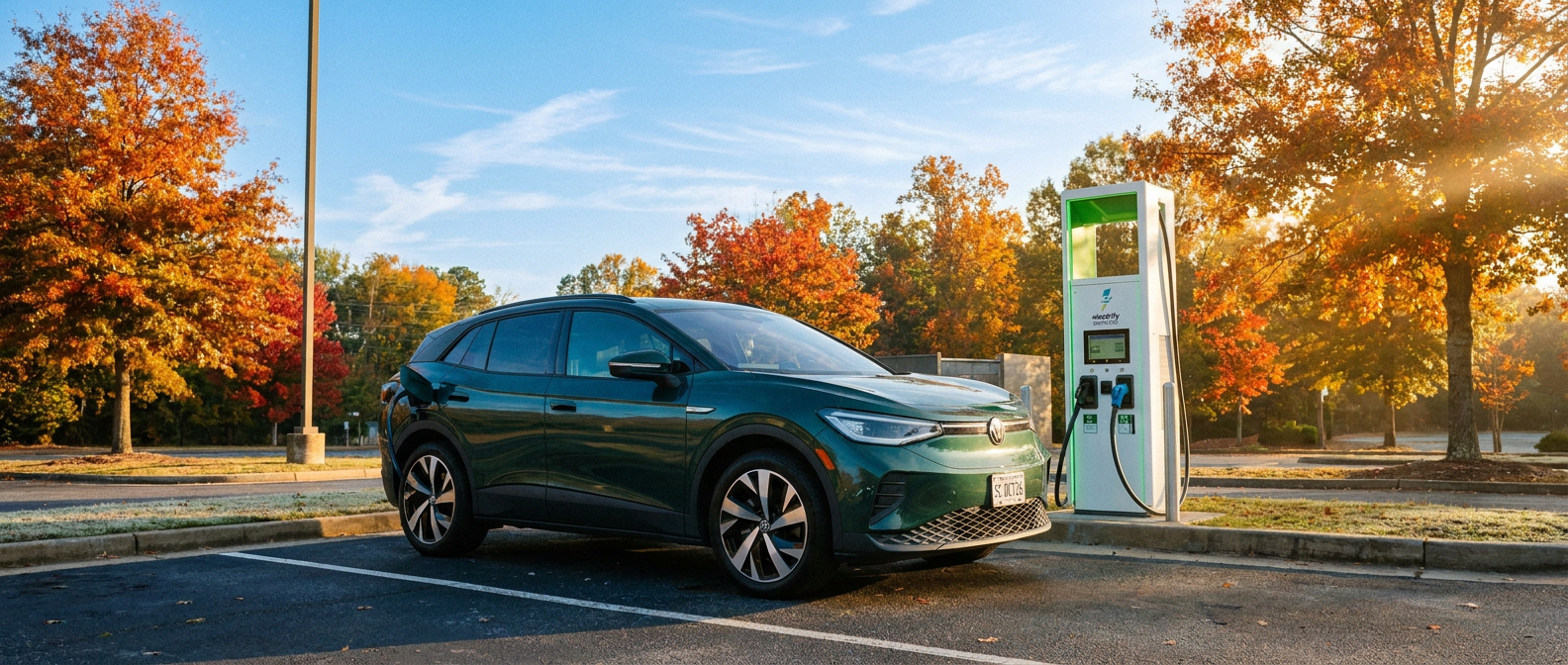
Every October, a 2026 Volkswagen ID.4 owner in Greenville fields the same thing from a neighbor or coworker: "Doesn't your range drop a lot now that it's getting cold?" Sometimes nobody even bothers to phrase it as a question. You get a knowing nod instead, as if the car quietly turned unreliable the moment the leaves started changing on the Cherokee Foothills.
We'll walk you through what we actually see at our service center and what the verified numbers say. Some of these myths carry a grain of truth. Others are just plain wrong. All of them are worth sorting out before you either panic-charge every single night or skip maintenance you genuinely need.
How Far Will the ID.4 Really Go in October Upstate SC Weather?
The EPA rates the 2026 Volkswagen ID.4 RWD (Pro and Pro S trims) at 291 miles of range and the AWD Pro at 263 miles, and those are peak-condition figures that assume a warm battery and an easy load. The fair question is what October looks like right here, not in a lab.
Greenville's October overnight lows sit in the 45-to-65 degree Fahrenheit range, with afternoons climbing into the low-to-mid 70s. Those temperatures land well above the point where cold genuinely starts eating into lithium-ion performance. The threshold is the thing to understand. According to AAA's research on EV range in temperature extremes, the severe range reduction (AAA measured an average 41 percent drop) kicks in when HVAC runs hard against freezing temperatures. Upstate October isn't anywhere near that. You're not driving through a South Carolina January. You're driving through a pleasant fall.
What you'll notice is a modest efficiency dip on cooler mornings, when the battery management system warms the pack before you lean on it. The ID.4 handles that part on its own. On a crisp 48-degree commute to Spartanburg, plan on real-world range closer to 250-265 miles on the RWD trim. Lower than 291, sure, but nothing to lose sleep over.
| Driving Scenario | Connector / Speed | Est. Dwell Time | Range Note |
|---|---|---|---|
| Daily Upstate commute (45-65 F morning) | Level 2 home, 11 kW | 8 hrs overnight (near-empty to full) | 250-265 mi real-world on RWD; 230-245 on AWD |
| Quick top-up, Woodruff Road Electrify America | DC fast, up to 350 kW at stall | 28-30 min (10-80%) | Adds roughly 150-175 mi from low state |
| I-85 road trip leg (Greenville to Charlotte, ~95 mi) | Electrify America en route or Tesla Supercharger | 15-20 min if starting above 50% | No stop needed from a full charge on RWD |
| Level 1 emergency (standard outlet) | AC 1.2-1.9 kW | Overnight adds 5-8 mi | Fine for short local days only |
EPA range figures per the official product page of Volkswagen for the 2026 ID.4. Charging times per the published specifications of Volkswagen: 10-80% in approximately 28 minutes at 175 kW DC fast charge, full charge from empty in approximately 8 hours on 11 kW Level 2.
Where Do You Charge Locally in the Upstate?
The Electrify America station at Sam's Club on Woodruff Road (1211 Woodruff Road, Greenville) is the anchor DC fast charger for the metro, with four stalls running up to 350 kW and 24-hour access. Keep that one in your back pocket for quick top-ups before a longer I-85 run. For Level 2 options, browse what's in our lot and ask our team about ChargePoint locations near downtown Greenville, which ChargeHub lists among Greenville's 217 public charging ports within the metro area.
One 2026 upgrade genuinely changes the picture. Every 2026 Volkswagen ID.4 now ships with a built-in NACS port, which is the Tesla connector standard. That means access to more than 25,000 Tesla Supercharger DC fast-charging locations nationwide, per Volkswagen of America's official announcement. No adapter required. For Upstate owners running the I-85 corridor or heading up to Spartanburg, that's a real expansion of your options and not just a press-release talking point.
Charging caution worth knowing: The NACS adapter on the 2026 ID.4 is for DC fast chargers only. It does not work with Level 1 or Level 2 AC equipment, including home chargers and Tesla Destination Chargers. Volkswagen confirmed this clearly. Plan your overnight home setup on a separate Level 2 installation or the included mobile charge cable.
- [ ] Confirm your home outlet situation (Level 1 standard outlet adds 5-8 mi/hr; a dedicated Level 2 adds about 20 mi/hr and takes you from near-empty to full overnight)
- [ ] Download the Electrify America app and set up payment before your first week with the car
- [ ] Download the Tesla app and create an account if you plan to use Superchargers on road trips
- [ ] Set Battery Care Mode to cap daily charging at 80%; override to 100% only before a long trip
- [ ] Know your nearest DC fast charger before you need it: Woodruff Road Sam's Club is your Greenville anchor
What Does October Maintenance Actually Look Like for an ID.4?
October maintenance for an ID.4 is lighter than a gas car's but it's not nothing, and this is where myth and reality split the hardest. Let's walk through what we see at our service center and what the facts support.
Myth: "EVs don't need maintenance." Wrong, but in an instructive way. The ID.4 has no oil to change, no spark plugs, no timing belt, and that part's real. What it does need is tire rotations (the instant torque of the electric motor speeds up front-edge wear), cabin air filter replacement, brake fluid checks, and tire pressure monitoring, which matters in October when Upstate mornings drop and cold air contracts what's in the tire. AAA confirms EV maintenance requirements run meaningfully lower than internal combustion vehicles, though not to zero.
Myth: "The brakes on an EV will last forever because of regen." Closer to true than most myths you'll hear. Regenerative braking does cut brake wear substantially, since the motor handles most of the slowing in normal driving. The 2026 ID.4 offers two regen modes: a coasting setting (B-mode off) that lets the car freewheel, and a mild regen setting for moderate deceleration. Schedule a brake fluid inspection annually regardless. Brake fluid absorbs moisture over time, and that moisture reduces braking effectiveness in any vehicle.
Myth: "You should charge to 100% every night to be ready." This one can work against the battery over the long haul. The Battery Care Mode of Volkswagen exists for a reason, and daily charging to 80% is gentler on the lithium-ion cells. Save the 100% charge for days you're heading out on a longer run, say a trip down I-26 to the coast. The car's software manages it. You just set the limit.
Myth: "October cold will kill your range." Greenville's October temperatures don't trigger severe lithium-ion degradation. The AAA finding of severe range drops applies to sustained freezing temperatures with heavy HVAC load. Upstate fall stays mild enough that you're managing a modest efficiency dip, not a crisis. The battery management system pre-conditions the pack on its own.
Myth: "The ID.4 needs warming up before you drive in the fall, like an old gas car." No. There's no cold-start enrichment cycle, no carburetor, no reason to sit in your driveway idling. The thermal management of the ID.4 takes care of itself. If you're using Battery Care Mode and your car is on a charger overnight, the system can pre-condition the cabin while still plugged in, which draws from the wall instead of the battery.
Schedule Your October EV Service Check
Frequently Asked Questions
Does the 2026 Volkswagen ID.4 lose a lot of range in October in South Carolina?
Greenville's October temperatures, averaging in the mid-40s overnight and low-to-mid 70s by afternoon, sit well above the sustained freezing range where EV range drops sharply. The EPA rates the 2026 Volkswagen ID.4 RWD at 291 miles and the AWD at 263 miles under optimal conditions. In Upstate SC fall temperatures, expect real-world range in the 250-265 mile zone on the RWD trim. This is not the severe range reduction that cold-climate EV owners see in January; it is a modest, manageable efficiency shift.
Where can I charge a Volkswagen ID.4 in Greenville, SC?
The primary DC fast charger in the metro is the Electrify America station at Sam's Club, 1211 Woodruff Road, Greenville (four stalls, up to 350 kW, open 24 hours). For Level 2 options, ChargeHub lists 217 total public charging ports within 15 km of Greenville. Every 2026 Volkswagen ID.4 also ships with a built-in NACS port, giving access to Tesla Supercharger locations on the I-85 and I-26 corridors. No adapter required for DC fast charging.
Does the Volkswagen ID.4 really need less maintenance than a gas car?
Yes. The ID.4 has no engine oil, no spark plugs, no timing belt, and regenerative braking reduces brake pad wear noticeably in normal driving. AAA confirms that EV maintenance requirements are substantially lower than for internal combustion vehicles. That said, the ID.4 still needs tire rotations, tire pressure checks, cabin filter service, and annual brake fluid inspection. Skipping those because "it's electric" is the maintenance myth most worth correcting.
Plan It This Way for Fall Driving in the Upstate
October is genuinely the best time of year to drive an ID.4 in the Upstate, because the temperatures land right in the sweet spot for lithium-ion efficiency. Cool enough that the pack isn't fighting heat, warm enough that you're not seeing meaningful cold-weather loss. If you're eyeing runs to Paris Mountain State Park (six miles from downtown Greenville) or up the Cherokee Foothills National Scenic Highway on SC-11, the real-world range at these temperatures covers a full day of Upstate driving with charge to spare.
Use this practical fall checklist. Rotate your tires (the weight and torque delivery of the ID.4 make this non-negotiable), check tire pressure (cold mornings shrink it), inspect the cabin air filter, and confirm your home charging setup is dialed in before the real cold lands in December and January. That's it. That covers what an ID.4 needs in our climate this time of year.
Check with us if you're still sorting out the purchase or thinking about adding an ID.4 to your household. Our team on Duvall Drive will give you the straight ownership picture, the honest range numbers, what charging looks like locally, and what you can skip from the dealer-service mythology that gas cars piled up over a century.
Categories:
Social