
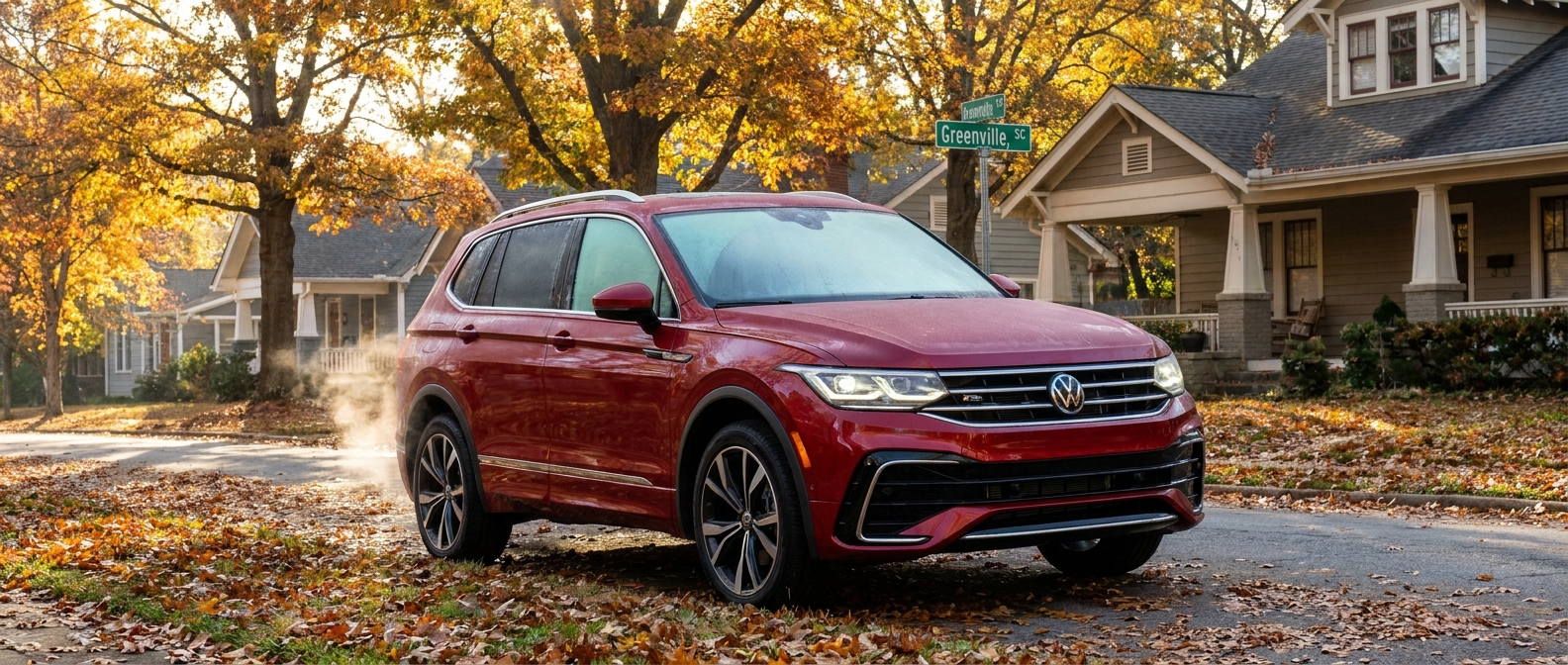
Noticed extra noise and a higher idle at startup this week? On a Volkswagen TSI engine, most of that is the car doing exactly what it was built to do. We'll walk you through how to tell engineered cold-start behavior apart from something that actually needs a look.
The short version
- Greenville overnight lows are running in the mid-40s to low 50s this month, which is cold enough to trigger the full cold-start warm-up routine of your Volkswagen every single morning.
- A slightly elevated idle (around 1,000 to 1,400 RPM) and a brief whirring or buzzing from the engine bay for the first 30 to 60 seconds are normal TSI cold-start behaviors, the engine is heating its catalytic converter and circulating oil.
- A steady check engine light that appeared at startup alongside rough running is a signal to have us look at it soon. A flashing check engine light means stop driving and call us.
- Persistent misfires, a metallic rattle right after the key turns, or roughness that doesn't smooth out within a minute or two are the warning signs that separate "the car is warming up" from "the car needs service."
- When in doubt, our service center can run a full Volkswagen diagnostic. It takes about the same time as an oil change.
When mornings cool off, the questions start, and our Tiguan inventory brings owners our way asking what that noise is. It's a fair question to ask before winter settles in.
What's the Real Difference Between Normal and Not Normal?
Usually the difference comes down to two things, how long the odd behavior lasts and whether a warning light shows up alongside it, and those two together tell you most of what you need to know. A TSI that sounds different for 30 to 90 seconds, then smooths out and drives perfectly, is healthy. An engine that keeps acting up past that window, or pairs the noise with a warning light, is telling you something else.
| Behavior | Cold Start: Normal | Cold Start: Not Normal |
|---|---|---|
| Idle RPM at startup | ~1,000 to 1,400 RPM, drops within 60-90 sec | Stays above 1,000 RPM for several minutes |
| Engine sound | Brief buzzing/whirring from engine bay; slightly "diesel-y" for ~10-15 sec | Metallic rattle that lasts more than a few seconds after startup |
| Roughness/vibration | Mild, smooths out as engine warms | Persistent, or getting worse, not better |
| Check engine light | Off, or briefly illuminated then off | Steady on, or flashing |
| Exhaust | Light steam/condensation puff | Blue smoke, strong fuel smell |
| How long it lasts | Under 90 seconds, then completely normal driving | Continues through the drive or returns at next start |
The single deciding question: does it smooth out completely within 90 seconds and drive normally after that? If yes, the engine is running its designed warm-up sequence. If no, it's time for a diagnostic scan.
Why Does a Volkswagen TSI Engine Act Differently When It's Cold?
The short version is that the engineering asks it to, because the EA888 TSI family (the 2.0-liter turbocharged four-cylinder at the core of the Jetta, Tiguan, Golf GTI, Atlas, and Taos) runs a deliberate cold-start fuel and emissions routine that looks and sounds rougher than a warm idle, yet stays well within normal operation. It's intentional, not a malfunction.
A few things are happening in those first 60 seconds.
Elevated idle RPM. On a cold start, the engine management system raises idle to roughly 1,000 to 1,400 RPM. The purpose is twofold, circulate oil to all moving parts before putting them under load, and build enough exhaust heat to bring the catalytic converter up to temperature faster. On mornings where Greenville overnight lows have been sitting in the mid-40s to low 50s, right where we are now, that warm-up period runs longer than it does in July.
Secondary air injection. A secondary air pump forces fresh air into the exhaust manifold during cold start. That speeds up catalytic converter light-up, which matters for meeting emissions standards on a cold engine. You may hear it as a faint high-pitched whirr or buzz under the hood. It usually runs for 30 to 60 seconds and then shuts off. The 2.0T in the Golf GTI and the 2.0T in the Tiguan both use this system, and it sounds odd enough to surprise owners who've never heard it before.
Brief roughness from dual-pulse injection. According to NHTSA documentation on Volkswagen TSI cold-start strategy, a dual-pulse injection sequence runs for approximately 60 seconds at cold start to rapidly heat the catalytic converter. During this sequence, the injector pulse width is nearly double normal idle. The engine may show a slightly rough idle or minor stumbles during this window, and the service guidance of Volkswagen calls it normal operation.
Port wash on Gen 3. The later EA888 Gen 3 engine (found in current Tiguan, Jetta, and Golf GTI models) added a combined port and direct injection system. On cold starts, it occasionally routes fuel through the port injectors specifically to keep intake valves cleaner. You might notice a slightly different fuel delivery sound on the first startup. That's normal.
Service Center Note: One pattern we do see on the Tiguan in our service bay is worth flagging. When a customer describes roughness that's noticeably worse on their first cold start of the season compared to last year, that's a useful data point. It often points to intake valve carbon deposits that have been building up gradually. It reads as a maintenance item, not a cold-start quirk. The EA888 Gen 3 engine's direct injection still accumulates deposits on the intake valves over time, even with the port-injection addition, and symptoms tend to surface or worsen when the engine is cold and oil viscosity is higher.
What Does "Not Normal" Actually Look Like?
Not normal shows up as behavior that outlasts the warm-up or arrives with a warning light, and Golf GTI owners and Tiguan drivers tend to pick up on it fast, since both give a slightly firmer connection to engine feel. Still, the pattern holds across the TSI lineup.
A metallic rattle immediately after startup. On EA888 Gen 1 and Gen 2 engines, a brief metallic rattle right at cold start can point to a stretched or loose timing chain. The sound usually shows up for a few seconds and may fade once oil pressure builds. Don't ignore it. A stretched timing chain is a known, documented failure mode on earlier EA888 engines, and a brief rattle after years of cold-start cycling earns a professional inspection, not a wait-and-see.
Rough running that doesn't resolve. If roughness or misfires are still there after 90 seconds of idling, especially alongside a check engine light, the engine isn't finishing its warm-up sequence the way it should. Common causes include a failing ignition coil, worn spark plugs, or carbon buildup on the intake valves. The coil packs on the EA888 are documented failure points after high mileage from heat cycling. Fault codes P0301 through P0304 map to cylinder-specific misfires. Any of those stored codes will tell the diagnostic scan exactly where to look.
A flashing check engine light. A flashing light is the one that needs immediate action. A steady check engine light means something is logged and should be checked soon. A flashing light means an active misfire bad enough to damage the catalytic converter, so that's a stop-driving situation. On an EA888 engine, a flashing check engine light during or after cold start frequently traces back to an ignition coil pack that failed under the thermal stress of startup.
Blue exhaust smoke or a strong fuel smell. Light steam or condensation from the exhaust on a cold morning is completely normal, just water vapor. Blue smoke is burning oil. A rich fuel smell that lingers past warm-up suggests the engine isn't finishing combustion properly. Both are worth a visit to our service center.
Schedule a service appointment online and tell us exactly what you noticed, what the sound was, how long it lasted, and whether any lights came on. Giving us those notes helps our technicians pull up the right diagnostic path before your car even arrives.
The Intake Valve Carbon Question (the One Every TSI Owner Hits Eventually)
The EA888 TSI is a direct-injection design, which means fuel enters the cylinder right at the point of ignition and never flows across the intake valves, and that single detail explains why carbon shows up here more than it does on an older port-injected engine. In a traditional port-injection engine, fuel and its detergent additives wash the back of the intake valves with every cycle. In direct injection, the valves sit exposed to oily blowby gases recirculated through the PCV system, and those vapors bake onto the hot metal over time.
The result is a gradual carbon deposit that restricts airflow. Cold starts are where it shows up most clearly. When oil is thick and the engine is running its richest fuel mixture, even a moderate carbon restriction on the valves throws off the airflow balance across cylinders.
What makes this easy to confuse with normal cold-start behavior is that the symptoms often DO smooth out once the engine warms, at least early on. A cold-start rough idle that clears completely at operating temperature and never trips a light isn't necessarily carbon buildup. Roughness that's clearly worsened over a year of driving is a different story. So is a rough patch that now takes several minutes instead of 60 seconds to resolve.
Around the Upstate, the Tiguan and Jetta on the EA888 platform are common, so they're the ones this tends to surface on. A walnut-shell blast of the intake valves is the fix, an abrasive media cleaning that lifts deposits without harming the valve surface.
The Gen 3 EA888's combined injection system slows the buildup rate compared with earlier generations, though it doesn't eliminate it.
So Which Behavior Should You Act On?
The right move depends on how long the behavior lasts and whether a warning light rides along, so sort it by what you're actually seeing on a given morning. Match your symptom to one of the cases below and you'll know whether to watch, book, or stop.
If the behavior resolves in under 90 seconds with no lights: You're watching the car do its job. On a 45-degree Greenville morning, that warm-up sequence works harder than usual, and that's fine. Let the engine reach operating temperature before pushing it, and don't idle it for long stretches. Modern turbocharged engines warm up faster through gentle driving than they do sitting still.
If there's a steady check engine light plus roughness: Book a diagnostic. It isn't an emergency, but it shouldn't sit for weeks either. A steady light with a stored misfire code is the engine asking for a coil pack or spark plug inspection.
If there's a flashing check engine light: Stop driving. Call us at (888) 475-6693. A flashing light means active catalytic converter risk, and continuing to drive can turn a coil pack replacement into a much larger repair.
If cold starts have gotten worse over the past year but lights are staying off: Ask us about intake valve cleaning. There's a window where addressing carbon buildup stays a routine maintenance item. Past that window, it starts affecting drivability at all temperatures.
Atlas owners with the EA888 engine, the same framework applies to you. The platform stays consistent, and that's one of the things that makes Volkswagen vehicles diagnostic-friendly, since the fault codes map cleanly to the system involved.
Frequently Asked Questions
Is it normal for my Volkswagen to idle at high RPM on cold mornings in Greenville?
Yes, with limits. The TSI engine management system raises idle to approximately 1,000 to 1,400 RPM at cold start to circulate oil, generate exhaust heat, and bring the catalytic converter up to operating temperature. On Greenville mornings in the mid-40s to low 50s, where we've been through much of October, the warm-up sequence runs longer than in summer. The elevated idle should drop to normal operating idle (roughly 600 to 800 RPM) within 60 to 90 seconds. If it's still elevated after several minutes of idling, that's worth a diagnostic scan.
My Volkswagen sounds a bit rough and buzzy for the first minute at startup. Should I be worried?
Probably not, if it smooths out completely. The TSI runs a dual-pulse injection strategy and a secondary air pump at cold start, both designed to heat the catalytic converter quickly. These create a slightly rough, buzzy quality to the idle that owners sometimes describe as "diesel-like" for the first 10 to 15 seconds. That goes away. What doesn't go away on its own is a misfire from a failing ignition coil, carbon buildup on the intake valves, or a stretched timing chain rattle. The tells: the roughness lasts more than 90 seconds, it's gotten noticeably worse this season compared to last, or a check engine light came on with it. Any of those, bring it in.
Categories:
Social