
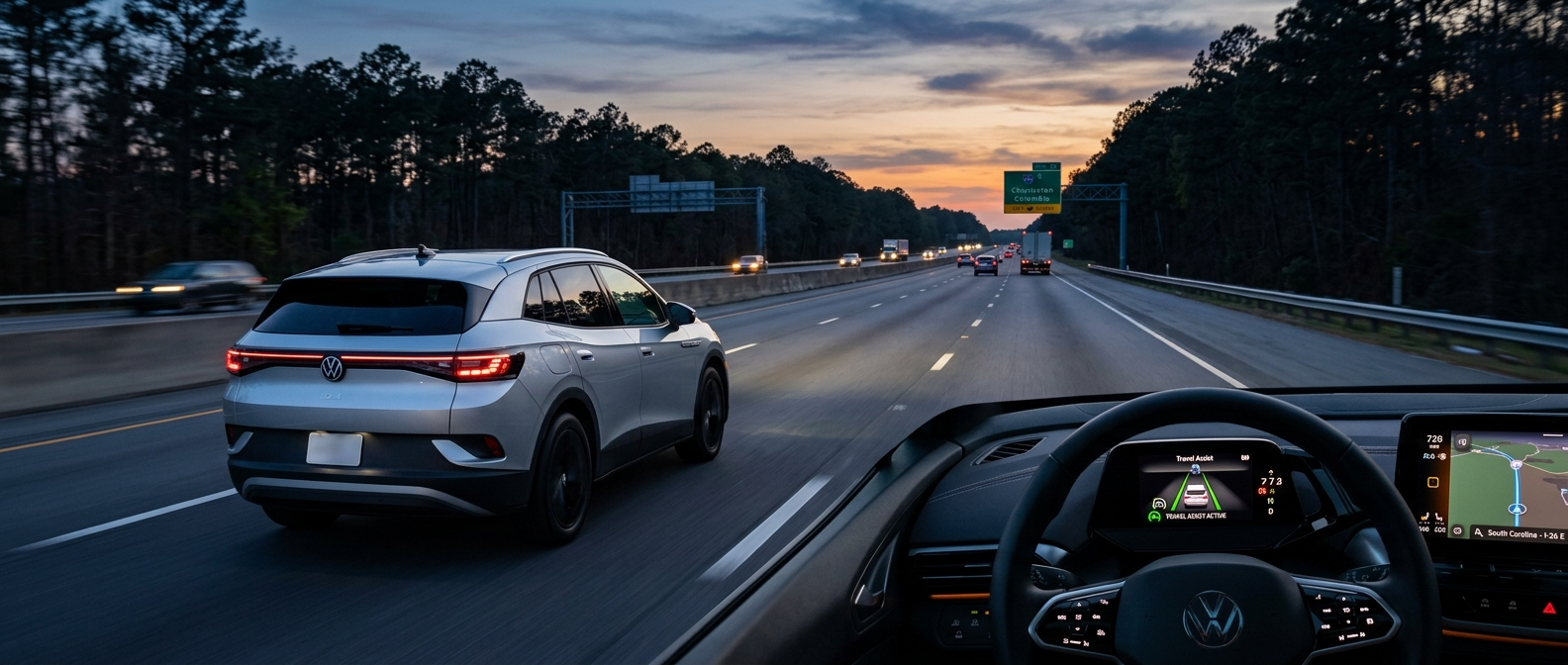
We'll be straight with you. The 2026 Volkswagen ID.4 carries one of the more capable driver assist suites in its class, and it's easy to leave at factory defaults and wonder why it keeps disengaging. I-85 through Upstate South Carolina is a specific road with specific quirks. There's a well-documented unlit stretch between Greenville and Anderson, active construction zones where temporary lane markings confuse camera-based systems, and weekend merge traffic near the I-385 interchange that can punish a tight following-distance setting. The IQ.DRIVE system is designed for exactly this kind of driving. You just need to configure it for this road, not for a generic highway.
Below is what to set, where to use it, and where to take over yourself.
How Does Travel Assist Actually Work on I-85?
Travel Assist is not autonomous driving, and treating it like one will get it canceled at the worst moment. Volkswagen's 2026 Quick Start Guide describes it precisely. Within system limits, Travel Assist combines Adaptive Cruise Control and Lane Assist to help keep you centered in your lane and maintain a preset distance from the vehicle in front of you. You stay responsible for every driving decision. The system handles the repetitive parts.
The setting that's easy to miss is the Distance Control button. On the left side of the steering wheel, it steps your following gap through five levels, from very short to very long. The gap setting is not cosmetic. A tight gap at level 1 or 2 feels fine at highway speed in open traffic. It turns genuinely uncomfortable in the stop-and-go that backs up past the I-85/I-385 interchange on Friday afternoon, when merging traffic keeps cutting in and the system overcorrects to hold the gap. Set it to level 3 for typical mixed Upstate conditions. Bump to level 4 or 5 when traffic thickens. The speed management smooths out noticeably, and that's exactly where Travel Assist earns its keep on a long weekend run.
One more thing is worth knowing before you set out. When you cancel Travel Assist, by tapping the brake or pressing the steering wheel button, the ID.4 stores your previously set distance level. It stands ready to resume when you press the RES button. You don't have to reconfigure after a merge or exit.
| I-85 Condition | Suggested Distance Level | What IQ.DRIVE Handles | Know This Limitation |
|---|---|---|---|
| Open highway, Anderson to Spartanburg | Level 2 or 3 | Speed hold, lane centering | Dusk glare can affect lane detection |
| Weekend merge near I-385/Greenville | Level 4 or 5 | Wider gap, gentler speed modulation | Aggressive mergers may need a brake tap |
| Active construction zone (shifted lanes) | ACC only, Travel Assist off | Speed and gap management | Volkswagen lists unclear lane markings as a Travel Assist limitation |
| Unlit segment (Greenville-Anderson corridor) | Level 3 or 4, reduced set speed | Extra gap extends reaction window | Reduced visibility is a listed system limitation |
| Heavy afternoon rain (summer storm) | ACC only or manual | (unavailable) | Poor weather degrades camera-based lane assist |
That rain row matters in Upstate SC. Summer afternoon storms come fast on I-85, and heavy precipitation sits on Volkswagen's own list of conditions where Travel Assist may not engage or may disengage. Switch to ACC-only and you keep speed and gap management while you steer yourself. Let the weather make that call.
Where Do You Charge Before and After an I-85 Run?
The 2026 Volkswagen ID.4 carries an 82-kWh battery on every trim. The EPA rates the RWD version at 291 miles of range and the AWD at 263 miles. For most Upstate SC weekend drives, that's more than enough without a charge stop.
The honest caveat is highway speed. EPA range figures reflect mixed-cycle driving. At sustained 70-75 mph on I-85, real-world range comes in below those figures. None of that is unique to the ID.4. Call it physics.
Set the destination before you leave, and Predictive ACC pays you back. You'll find it within the ACC settings menu. When you enter a destination in navigation, Predictive ACC reads the route and anticipates speed changes, which means smoother deceleration and less energy waste compared to manual throttle management in flowing traffic (skip navigation and the extra throttle work tends to leave you more fatigued over a long run). It makes a real difference.
When a charge stop is needed, Volkswagen estimates the ID.4 goes from 10 percent to 80 percent on a DC fast charger in about 30 minutes. A Level 2 home or public charger brings a full charge in approximately 8 hours overnight.
| Drive Segment | Approx. Round Trip | Charge Stop (RWD, 291 mi EPA) | Charge Stop (AWD, 263 mi EPA) |
|---|---|---|---|
| Greenville to Charlotte and back via I-85 | ~170 mi | Not needed | Not needed |
| Greenville to Columbia via I-385 and I-26 | ~200 mi | Not needed | Not needed |
| Greenville to Atlanta and back via I-85 | ~320 mi | One stop recommended | One stop recommended |
| Day trip to Lake Hartwell and return | ~80 mi | Not needed | Not needed |
| Day trip to Caesars Head State Park and return | ~60 mi | Not needed | Not needed |
Book a pre-trip service check if you're heading into peak fall travel season. Tire condition is worth confirming before any long interstate run. The ID.4's regenerative braking reduces brake wear relative to a conventional vehicle, but tires don't get the same break.
Before a long I-85 weekend run: check that the front sensors and cameras are clear of road grime, bugs, or debris. Volkswagen's documentation specifically lists blocked, damaged, or misaligned sensors as a condition that can disable driver assistance features. A 30-second wipe-down at the pump is legitimate pre-trip maintenance, not overengineering.
Plan It This Way: Your I-85 IQ.DRIVE Checklist
The IQ.DRIVE suite is genuinely well-matched to Upstate SC interstate driving. Travel Assist handles lane centering and gap management on the open marked stretches. Front Assist monitors for objects ahead and can support braking when needed. Side Assist lights up the mirror yellow when a vehicle sits in your blind spot, and blinks if you signal toward a detected vehicle, which helps when the I-85 weekend crowd is moving between lanes.
What it doesn't do is replace your judgment on the specific conditions this road presents. The unlit corridor between Greenville and Anderson has been without overhead lighting since 2017 per SCDOT's own documentation, so that stretch deserves your full attention at night. Active construction zones with temporary lane markings are listed in Volkswagen's Quick Start Guide as a condition where Travel Assist may not engage. Know those two stretches, configure around them, and let the system handle the rest.
- [ ] Enter your destination in navigation before merging onto I-85 (enables Predictive ACC)
- [ ] Set following distance to level 3 or higher for weekend traffic (Distance Control button, left steering wheel)
- [ ] Confirm Lane Assist is active (Travel Assist requires it to function)
- [ ] Press the Mode button to step from ACC to Travel Assist once you're at highway speed
- [ ] Switch to ACC-only through active construction zones where lane markings are disrupted
- [ ] Return to Travel Assist on clear, marked stretches after the work zone
- [ ] Use ACC-only or manual driving in heavy rain (camera-based lane detection degrades)
- [ ] Check sensors and camera lenses are clear of debris before departing
AWD vs. RWD is worth a mention here, since it affects range planning. The AWD ID.4 adds a second motor for 335 horsepower and confident wet-road traction, but gives up 28 miles of EPA range compared to the RWD. For most Greenville-area I-85 weekend runs, that range gap doesn't force a charge stop. For anyone who regularly runs I-26 toward the coast in fall storm season, the AWD's traction and stability advantage may be worth the trade. Our financing team at Steve White Volkswagen can walk you through the trim comparison if you're still deciding.
Come by 100 Duvall Drive in Greenville when you're ready to walk through the settings in person. We'll put you in the driver's seat and show you exactly how the mode button cycles between ACC, cruise control, and Travel Assist before you head out on I-85 with it for the first time.
By the Steve White Volkswagen Team | September 2026
Frequently Asked Questions
Is Travel Assist standard on every 2026 Volkswagen ID.4?
Yes. Volkswagen includes the full IQ.DRIVE suite as standard equipment on every 2026 Volkswagen ID.4 trim. That suite includes Travel Assist, Adaptive Cruise Control, Lane Assist, Front Assist, and Side Assist, among other features. No upgrade package is required.
Will Travel Assist stay engaged through the construction zones on I-85?
Not reliably, and that's working as designed. Volkswagen's documentation specifically lists unclear or missing lane markings as a condition where Travel Assist may not engage or could disengage. Shifted lanes and temporary markings in active construction zones fall into that category. Our recommendation is to step down to Adaptive Cruise Control only through the work zone, which keeps speed and following-gap management active while you handle steering, then re-engage Travel Assist on the other side where markings are clear.
How does the 2026 Volkswagen ID.4's range hold up on I-85 highway speeds?
The EPA rates the 2026 Volkswagen ID.4 RWD at 291 miles and the AWD at 263 miles on the 82-kWh battery. At sustained interstate speeds of 70 to 75 mph, real-world range will run below those EPA figures, which reflect mixed-cycle conditions. For most Greenville-area weekend drives, whether that's Greenville to Charlotte, Greenville to Columbia, or a Lake Hartwell day trip, the range is comfortable without a charge stop. A Greenville-to-Atlanta round trip at approximately 320 miles benefits from one DC fast-charge stop, which Volkswagen estimates takes about 30 minutes from 10 to 80 percent.
Categories:
Social