
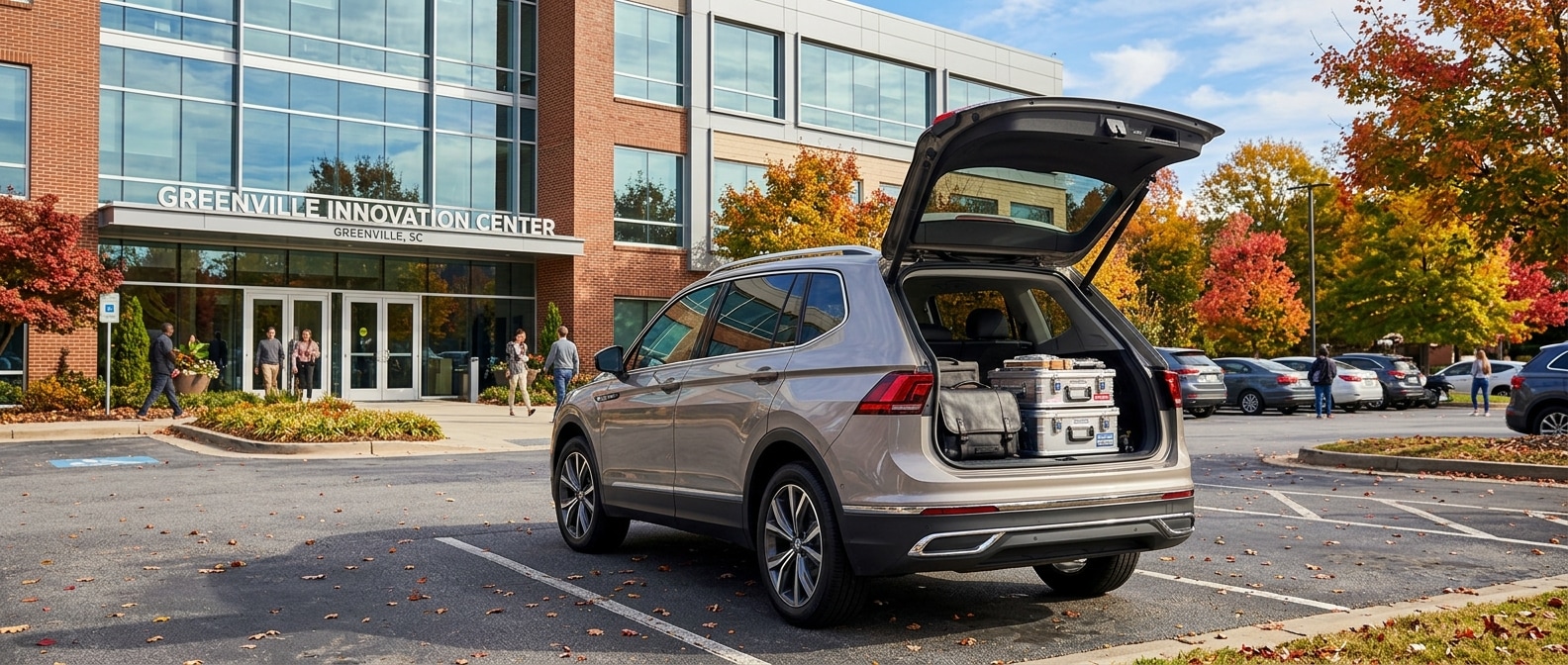
If you're running a business in the Upstate and you need one vehicle that commutes, carries gear, and still looks the part when you pull up to a client meeting, the 2026 Volkswagen Taos and the 2026 Tiguan are the two names that keep coming up. The right choice depends entirely on what your Tuesday actually looks like, not what you imagine it might look like.
The short version
- The 2026 Taos delivers EPA-rated 31 mpg combined (FWD) and a shorter 175.9-inch footprint that parks easily in downtown Greenville. It's the efficiency pick for solo operators with light loads.
- The 2026 Tiguan carries 69.8 cubic feet of maximum cargo (vs 65.9 in the Taos), comes standard with wireless charging and four USB-C ports, and is the only one of the two rated to tow (up to 1,800 lbs with factory hitch).
- Choosing AWD in the Taos shrinks its cargo floor from 27.9 to 24.9 cubic feet behind the rear seats. That's a tradeoff worth knowing before you spec it.
- If you do multi-stop client days on I-85 with heavy samples, tools, or a trailer, the Tiguan earns its step up. If you run downtown loops and park on the street, the Taos is sharper.
- Both seat five, both share the same Volkswagen German-engineering DNA, and both are available now at Steve White Volkswagen on Duvall Drive.
What's the Real Difference Between These Two?
On a spec sheet these two read almost like twins, but they solve different problems the moment you load them for work. The Taos runs 8.5 inches shorter than the Tiguan (175.9 inches vs 184.4 inches) and rates better on fuel economy, while the Tiguan goes bigger where a working vehicle counts. That means more cargo volume, a factory tow rating, more standard tech, and a longer range between fill-ups on highway-heavy routes.
Look at how they stack up on the axes that matter most to someone using the vehicle for work.
| Axis | 2026 Taos (FWD) | 2026 Tiguan (FWD S) | Who wins for business use |
|---|---|---|---|
| City/hwy/combined MPG | 28/36/31 (EPA) | 26/34/29 (EPA) | Taos (saves fuel on stop-and-go loops) |
| Cargo behind rear seats | 27.9 cu ft | 37.6 cu ft | Tiguan (10+ extra cubic feet for sample cases, equipment) |
| Max cargo (seats folded) | 65.9 cu ft | 69.8 cu ft | Tiguan |
| Tow rating | None | 1,800 lbs (w/ factory hitch) | Tiguan (light trailer, equipment) |
| Length (parking footprint) | 175.9 in | 184.4 in | Taos (tighter downtown spots) |
| Standard USB-C ports | 2 | 4 | Tiguan (charge phone + tablet simultaneously) |
| Wireless charging pad | Not standard (varies by trim) | Standard (S trim) | Tiguan |
| AWD cargo penalty | -3 cu ft (27.9 to 24.9 behind seats) | Minimal | Taos buyers: check your trim |
The cargo space of the Tiguan exceeds that of the Taos by 10 cubic feet behind the rear seats. If you're loading product samples, a rolling bag, and an equipment case at once, that gap is the whole decision.
Which One Handles the I-85 Grind More Efficiently?
On pure efficiency the Taos takes this one, though the gap is smaller than the raw numbers suggest once you drive a full mixed week of Upstate miles rather than a single clean highway stretch, and that changes how much it should weigh on your decision. Upstate operators know this run well. You leave Greenville, you hit Spartanburg for a client, you come back down I-385, maybe a stop in Mauldin on the way home. That's a real daily pattern for consultants, real estate agents, trade service companies, and mobile professionals across the area.
The EPA rates the 2026 Taos (FWD) at 28 city and 36 highway mpg. The 2026 Tiguan S (FWD) comes in at 26 city and 34 highway. The gap is real but not dramatic. Over a 200-mile week of mixed Upstate driving, you'll feel the difference at the pump, but it won't make or break a business decision on its own.
What changes the math is AWD. If you're eyeing 4MOTION all-wheel drive on the Taos because Upstate winters can put ice on the Blue Ridge foothills roads, know that the EPA rates that configuration at 25 city and 33 highway. You'll also lose three cubic feet of cargo behind the rear seats, down to 24.9 from 27.9. Adding 4MOTION to the Tiguan costs fuel economy too, dropping it to 22 city and 30 highway on the standard trims. The cargo space of the Tiguan barely moves with drivetrain choice, since the AWD hardware is packaged differently.
For a service professional who runs the Greenville-Spartanburg stretch on I-85 several times a week and almost never needs to tow, the Taos FWD is genuinely the more efficient daily tool. We'd point you there.
Browse current Volkswagen inventory at Steve White Volkswagen
Cargo and Connectivity: The Practical Business Case
For anyone hauling more than a laptop bag the Tiguan pulls clearly ahead here, though that extra room only earns its keep if you actually fill it week to week. Once you carry product, cases, and tools together, the space gap stops being a number and starts being a daily convenience.
The 2026 Tiguan offers 37.6 cubic feet of cargo space with the rear seats up. The 2026 Taos offers 27.9. That difference is roughly the size of a large wheeled duffel bag. For a photographer, a healthcare sales rep, an HVAC service tech who drives a car instead of a van, or anyone who regularly loads and unloads physical product, that gap shows up in a tangible way every time you open the liftgate.
The Tiguan also comes standard at the S trim with underfloor cargo storage, four USB-C ports, a wireless charging pad, and a 12.9-inch infotainment touchscreen. The Taos S starts with two USB-C ports and an 8-inch screen, with wireless App-Connect standard across all trims as of the 2026 update. For a business owner juggling a phone, a tablet, and a hotspot, four ports against two adds up over a long day. You stop rationing outlets.
Per the EPA, the 2026 Volkswagen Taos (FWD) earns 28 mpg city and 36 mpg highway. The 2026 Volkswagen Tiguan S (FWD) earns 26 mpg city and 34 mpg highway.
Only the Tiguan carries a factory tow rating. At 1,800 pounds with the factory-installed hitch, it's no heavy hauler, but it comfortably handles a small enclosed trailer, a landscape trailer, a jet ski, or a display setup for a trade show. The Taos has no tow rating. No knock on the Taos, which was built for efficiency and agility. But if you occasionally need to move equipment on a trailer, the Tiguan is the only answer between these two.
Parking Downtown Greenville: Does Size Actually Matter Here?
Yes, size matters here, though only a little and only in the densest parts of town. The Taos at 175.9 inches slides more confidently into the tighter parallel spots on Main Street and the older surface lots around downtown Greenville, while the Tiguan at 184.4 inches is not large by any modern standard yet still adds about half a car-length to the mental parking math.
Picture your week in the West End, around Falls Park, or making deliveries to shops and restaurants in downtown Greenville's denser blocks. If that's your beat, the smaller footprint of the Taos is a genuine daily convenience. The Taos is agile, lighter, and easier to thread into a spot without a second thought.
The Tiguan feels perfectly comfortable in suburban Greenville, in office park parking decks, and on I-85 or I-26. It just asks for a bit more situational awareness in tight urban situations. Call it a tradeoff rather than a flaw.
So Which Should You Pick for Your Business?
Both are right for someone, so the pick comes down to how heavy and how urban your typical day runs. For light, downtown work the Taos wins on efficiency and parking, and for loaded, corridor-driving days the Tiguan carries the weight without complaint.
Pick the Taos if:
- You run mostly downtown Greenville or short Upstate loops under 60 miles
- You carry light loads (a laptop bag, a sample kit, a cooler)
- Tight urban parking is part of your daily routine
- You prioritize fuel economy above cargo capacity
- You never tow anything
Pick the Tiguan if:
- You make the I-85 corridor run to Spartanburg or Anderson regularly with equipment
- You need to seat two or three colleagues in addition to hauling gear
- You carry bulky physical product, presentation equipment, or service tools
- You want a factory tow rating for occasional trailer use
- You value wireless charging and four USB-C ports standard from the base trim
We see both vehicles working well for Upstate professionals, but once your work needs more than a light-load commuter, the Tiguan earns its place. It grows with your business without asking you to compromise on the days when the load is heavy.
Explore the 2026 Tiguan at Steve White Volkswagen
Frequently Asked Questions
Does the Volkswagen Taos have enough cargo space for a small business?
For solo operators with light daily loads, yes. The 2026 Taos offers 27.9 cubic feet of cargo space behind the rear seats (FWD trim), which handles a laptop bag, a rolling carry-on, and a couple of boxes of samples without issue. Fold the rear seats and that opens to 65.9 cubic feet. One caveat is worth flagging. Add 4MOTION AWD and the cargo space behind the rear seats drops to 24.9 cubic feet. If cargo capacity matters, the FWD Taos is the smarter configuration.
Can the Volkswagen Tiguan tow a trailer?
Yes. The 2026 Tiguan is rated to tow up to 1,800 pounds when equipped with the factory-installed towing hitch. That covers a small enclosed cargo trailer, a landscape trailer, a jet ski, or a light equipment haul for a trade event. The Taos carries no tow rating, so if towing is any part of your business use, the Tiguan is the only option between these two.
Which vehicle is better for downtown Greenville parking?
The Taos at 175.9 inches fits more confidently into tighter parallel spots and older surface lots downtown. The Tiguan at 184.4 inches is not large by modern standards, but the additional length asks for slightly more situational awareness in dense urban areas. For downtown deliveries and Main Street stops, the Taos has the advantage.
Categories:
Social