
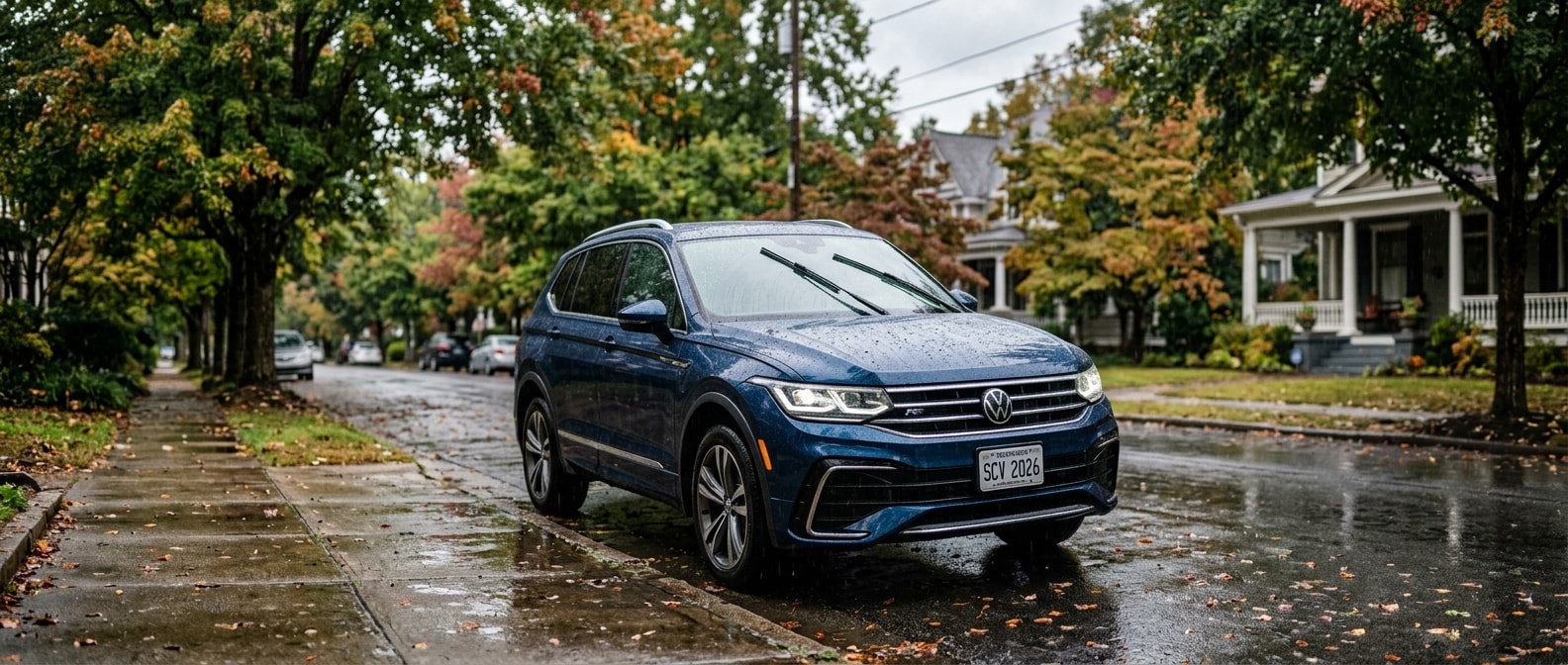
You hit the first heavy September shower on I-85 and reached for the wiper stalk. The blades moved. They just didn't clear. What looked like a maintenance-free summer on a tidy Volkswagen turned out to have a catch hidden in plain sight.
That smear across your windshield isn't random. It's predictable, and our service team at Steve White Volkswagen sees it reliably as Greenville shifts from summer into early fall. The cause is almost always the same. A summer's worth of Upstate heat and UV cooked the rubber before the rain ever had a chance to test it. Fix it now, before the season really opens up.
What's Actually Going On With Your Blades?
The short version is that an Upstate SC summer hardens your wiper rubber long before you notice a thing, because the blades look perfectly fine sitting still and only give themselves away the moment you spray fluid and ask them to work against real water. The look at rest is what fools you.
| Symptom you notice | What's actually happening | What to do |
|---|---|---|
| Streaking (a band of uncleared water) | Rubber edge rounded from UV hardening and heat exposure | Replace both front blades |
| Smearing (greasy haze across the glass) | Oily road film plus degraded rubber spreading instead of lifting | Replace blades; clean windshield with glass cleaner |
| Chattering or skipping | Blade developed a permanent curve from prolonged disuse in dry spells | Replace; also check wiper arm tension |
| Squeaking on wet glass | Surface hardening; rubber lost flexibility | Replace blades |
| Splitting or visible cracking | UV broke down the rubber compound at the surface | Replace immediately |
Greenville averages about 3.4 inches of rain across roughly 10 rainy days in September. A single week of fall showers is enough to reveal every failure mode in the table above. The SC State Climatology Office records the city's annual rainfall at 50.24 inches. The full-year total is spread across a climate that bakes rubber all summer and then asks your blades to work hard again right now.
The mechanism isn't mysterious. Rubber degrades the moment it's exposed to atmosphere and UV, even without use. Industry guidance uniformly puts the replacement window at six to twelve months, because the blade's precise wiping edge rounds before you can see it. In a high-UV market like the Upstate Piedmont, where August regularly runs into the upper 80s, that six-month end of the window is the realistic one for most drivers.
Why the Upstate Summer Does the Damage
The Tiguan, the Atlas, the Jetta, and the Taos all run wiper blades cut from the same family of synthetic rubber compounds, and those compounds are engineered to flex tightly against the windshield curve, which is exactly why sustained UV and heat hit every one of them the same way. The chemistry doesn't play favorites.
Prolonged UV exposure and sustained heat accelerate the breakdown of that rubber. The blade stiffens. It loses the flexibility it needs to conform cleanly to the glass. The precise wiping edge goes round. It doesn't snap or tear visibly. It just stops working.
Why September specifically? Your blades survived July and August because the dry heat barely asked them to do anything, and then the first real rain turns September into the audition they fail.
Blade sizing also matters when you go to replace them, because Volkswagen models don't share a universal size across the lineup. The chart below covers the vehicles we see on the lot most. Always verify against your owner's manual or ask our parts team, since sizes can vary by trim.
| Model | Driver blade | Passenger blade | Rear blade |
|---|---|---|---|
| 2026 Volkswagen Atlas | 26 in | 22 in | Confirm in manual |
| 2026 Volkswagen Jetta | 24 in | 20 in | Confirm in manual |
| 2026 Volkswagen Taos | 26 in | 18 in | 11 in |
| 2026 Volkswagen Tiguan | 24 in | 21 in | Confirm in manual |
One pattern our team notices holds steady. Drivers replace the driver-side blade and leave the passenger blade alone. The passenger blade ran through the same summer UV cycle. It will streak into your field of vision before the season ends. Replace them as a pair.
Maintenance note: Wiper arms can lose spring tension after years of Upstate heat cycles. If new blades still chatter on a clean windshield, have the arm tension checked before assuming the blades are the problem.
Next step: If you're not sure which size fits your specific year and trim, the size printed on your current blade is the fastest reference. If the blade is already damaged, the owner's manual has the specs in the maintenance section. Our parts team can also look it up by your VIN in about thirty seconds.
The Washer Fluid Piece That Most Guides Skip
The fluid swap matters just as much as the blades, and generic wiper articles tend to leave that part out entirely, which is a shame, because new blades sitting on a reservoir full of summer bug-remover only gets you a partial fix. The two work together or not at all.
Summer washer fluid is formulated for warm-temperature road grime and bug splatter. It isn't built for the oily road-film mix that builds as fall traffic patterns shift.
It also isn't rated for the occasional overnight cold snap that comes with October and November in the Upstate. Here's what plain water does when some drivers use it as a top-off:
- It freezes at 32 degrees Fahrenheit
- It leaves mineral deposits in the reservoir and nozzles over time
The Taos owner who filled up with summer formula in May and hasn't thought about it since is heading into fall rain with the wrong fluid. That formula will smear cooler-temperature road film rather than lift it.
The switch to make right now is an all-season washer fluid rated to at least negative 20 degrees Fahrenheit. That rating isn't about Greenville getting serious winters (it rarely does). An all-season formula carries the surfactant concentration to cut through road oil in cooler air, and it shrugs off the occasional Upstate freeze without any trouble. One additional note is worth knowing. High-methanol budget fluids can accelerate rubber degradation in the blade itself over time, so if you're putting new blades on, don't undercut them with the wrong fluid in the reservoir.
Fill it completely, then run the washer system for a minute to flush the old formula through the lines and nozzles. Two-minute job.
Schedule a Wiper and Fluid Inspection
DIY vs. Letting Our Service Team Handle It
Wiper blades are a genuine DIY task on most Volkswagen vehicles, and plenty of owners handle the swap in their own driveway, though a handful of situations are worth bringing to us instead of risking an ill-fitting blade lifting at highway speed. Here's how we'd sort it out.
Handle it yourself if:
- You have the correct blade sizes confirmed for your model year and trim
- The wiper arms look straight and hold firm tension at the pivot
- The windshield has no chips or cracks
- You're comfortable with the hook or pin-style connector on your specific Volkswagen
Bring it to our service center if:
- You're not certain of the sizes and don't want to risk an ill-fitting blade lifting at highway speed
- New blades still chatter or streak after installation (usually a glass cleaning or arm tension issue, not the blade)
- The washer nozzles spray to the side or produce almost no stream
- You want it done while you wait without sorting through a parts store
Our service team stocks Volkswagen-spec blades and handles this as a quick visit. We can also top off the reservoir with the right all-season formula at the same time. If this check-in is part of a broader look at your vehicle heading into fall, our service center is the right stop.
Frequently Asked Questions
Do I really need to replace wiper blades every year?
The general industry guideline from manufacturers and service professionals is every six to twelve months, with the shorter interval applying in high-UV, high-heat climates. Greenville's Upstate summers run hot through August. By September, blades installed in the spring have had a full summer of UV and heat exposure, and the rubber degrades chemically before you see physical cracks. In this climate, annual replacement is the minimum sensible interval. Inspecting at the six-month mark lets you catch a failing blade before the first hard rain of the season does.
Can I just top off the washer fluid with water?
In a genuine emergency, water works. As a routine practice, it isn't a substitute. Plain water freezes at 32 degrees Fahrenheit, which matters during Upstate SC fall and winter nights, and it has no surfactants to cut through oily road film. Mineral deposits from tap water also accumulate in the reservoir and nozzle openings over time. An all-season formula rated to at least negative 20 degrees Fahrenheit handles Greenville's winters, lifts fall road grime more effectively than a summer bug-wash formula, and is the right fluid for the season you're driving into.
Categories:
Social