
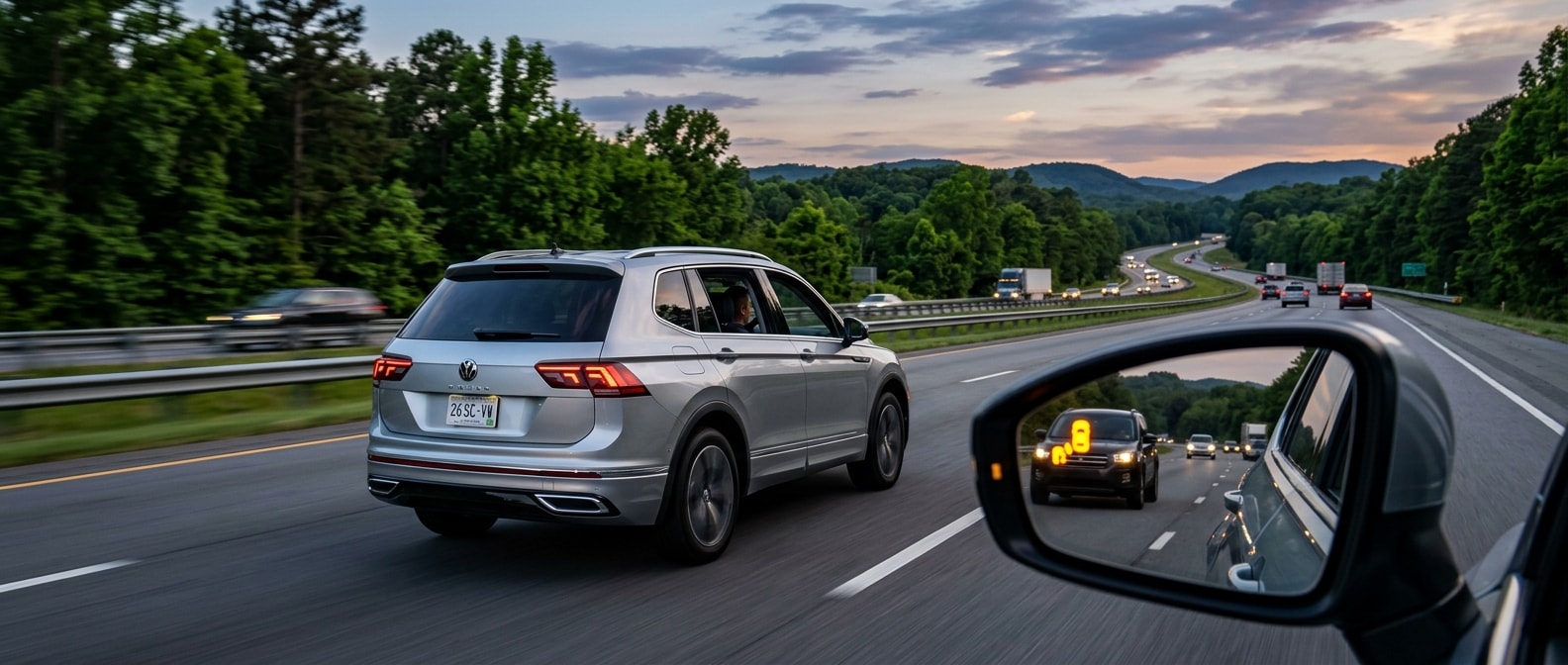
Every 2026 Volkswagen on our lot comes with blind spot monitoring standard. Full stop. No trim shopping required.
Between a system that only flashes a yellow light and one that gently steers you away from a car you missed, there's a real gap. That distinction matters far more on I-385 between the I-185 merge in Mauldin and the Haywood Road interchange than it does on a quiet Sunday drive. We sell all three of the models people commute in (the Tiguan, the Taos, and the Jetta), and each one handles the "cars hiding in your blind spot at highway speed" problem in ways that look similar on the surface and play out differently in practice.
The short version
- All three 2026 models (Taos, Jetta, Tiguan) include blind spot monitoring as standard equipment through Volkswagen's IQ.DRIVE suite. No trim upgrade needed.
- The Tiguan's system goes furthest: when Lane Assist is active, it can apply a steering correction, not just warn. The Jetta and Taos warn; they don't intervene.
- Best for I-385 commuters who want the most safety tech: Tiguan, any trim.
- Best for fuel economy plus solid blind spot coverage on a commuter budget: Jetta.
- Best for a compact SUV footprint with all-around assist: Taos.
How Do These Three Models Actually Compare?
On all three models the blind spot answer begins the same way, with a rear-facing radar sensor watching the lane beside you and an amber LED in the mirror lighting up when something's there, and the meaningful difference only shows up at the top of the Volkswagen range where one system adds a steering layer the other two skip. If you activate the turn signal while a vehicle is detected there, the LED flashes urgently. That's the baseline, and it rides on every trim of every model listed here.
The Tiguan goes one step further. Volkswagen's Side Assist uses two radar sensors at the rear of the vehicle to scan approaching traffic and warn drivers of vehicles in adjacent lanes; if the driver uses the turn signal while a vehicle is detected, the LED in the mirror housing flashes. And when Lane Assist is active, blind spot monitoring becomes Active Blind Spot Monitor. The system not only warns with the flashing LED but can also apply a steering correction if the driver begins to change lanes toward a vehicle it has detected. The Jetta and Taos don't have this active steering-correction layer.
| Model | Blind Spot System | Active Steering Correction? | Rear Cross-Traffic Alert | Body Style | Best For |
|---|---|---|---|---|---|
| 2026 Volkswagen Taos | IQ.DRIVE Side Assist (standard all trims) | No | Yes (standard) | Subcompact SUV | Entry-level SUV commuters |
| 2026 Volkswagen Jetta | IQ.DRIVE Side Assist (standard all trims, incl. GLI) | No | Yes (standard) | Compact sedan | Budget-conscious, fuel-focused |
| 2026 Volkswagen Tiguan | IQ.DRIVE Active Side Assist (standard all trims) | Yes (with Lane Assist active) | Yes (standard) | Compact SUV | Highway commuters wanting max assist |
The "best for" column is the one to read closely. None of these is a bad choice. Every trim clears the bar that matters for merging traffic. The tradeoff is real, though, because you pay more to move up to a Tiguan, and part of what you're buying in that delta (among other things) is a blind spot system that can act rather than just alert.
Does the Type of Monitoring Matter on I-385?
I-385, along with other key Upstate corridors, carries heavy commuter and through traffic. Merging and weaving at interstate on- and off-ramps (especially around Exit 23) creates documented conflict points and reported collisions. That's the road a lot of people who walk into our store commute on daily. The weave between the I-185 merge near Mauldin and the Haywood Road interchange is exactly the kind of multi-lane, variable-speed environment where blind spot monitoring earns its keep.
Research by the Insurance Institute for Highway Safety found that vehicles equipped with blind spot monitoring show a 14% reduction in lane-change crashes compared to vehicles without it, and when blind spot monitoring is combined with rear cross-traffic alert, lane-change crash rates can drop by up to 23%. All three Volkswagen models we're discussing come with both systems standard.
You're getting a real, documented safety benefit at the base trim of any 2026 Volkswagen you choose, and that's not marketing language.
So does the type matter? Yes, with context. In stop-and-go weave traffic at 40 to 60 mph (the I-385 reality for a lot of Greenville commuters), the difference between a warning and an active correction is the difference between "I was told there was a car there" and "the car helped me not drift into it." For a commuter doing that stretch twice a day, five days a week, the active system on the Taos's smaller sibling and the Tiguan carries real daily value. For a commuter doing lighter highway miles (running from Anderson into Greenville on I-85, say), the Jetta's warning-based system is genuinely sufficient.
The 2026 Volkswagen Tiguan's blind spot system is the only one of the three that can apply a steering correction (not just flash a warning) when Lane Assist is engaged. This is a meaningful distinction for high-frequency I-385 commuters.
On our lot: When customers ask about blind spot monitoring, the follow-up that tends to change the answer is simple. "Do you change lanes a lot on the highway, or mostly just cruise in one lane?" A Jetta or Taos commuter who stays in the center lane for most of I-385 gets every bit as much protection from the warning-based system as they need. A commuter who weaves between Woodruff Road exits and I-85 daily might genuinely benefit from the Tiguan's active layer. That pattern shows up in how people describe their drives to us, and it's worth thinking about before you pick a trim.
Which Volkswagen Fits Your Greenville Commute?
These three models suit three different commuter profiles, and the good news is that the safety floor doesn't change between them, so you can choose on body style and driving habits rather than agonizing over which one protects you more on the merge. Don't overthink the safety tier. All three pass the basic bar that Greenville commuters should care about. The choice comes down to what you're doing the rest of the time.
You want the Tiguan if: your I-385 commute involves the Mauldin interchange weave daily, you're driving in mixed freight and commuter traffic regularly, or you want the active steering-correction layer in addition to the warning. The 2026 Tiguan is available in four trims (S, SE, SE R-Line Black, and SEL R-Line Turbo) and is powered by a turbocharged 2.0-liter four-cylinder. Most trims produce 201 horsepower. You get the full IQ.DRIVE active system on every single one of them.
You want the Taos if: you want a compact SUV footprint, occasional AWD availability matters for weekend Blue Ridge trips, and you're comfortable with a warning-based (not correction-based) blind spot system. The 2026 Taos runs a turbocharged 1.5-liter four-cylinder producing 174 horsepower. NHTSA rates the 2026 Taos four out of five stars in overall safety, and it didn't receive any rating lower than four stars in any individual NHTSA test.
You want the Jetta if: your commute is highway-dominant but you want a sedan, fuel economy is a priority, and you want a Volkswagen entry point without the SUV footprint. The 2026 Jetta is powered by a turbocharged 1.5-liter four-cylinder producing 158 horsepower and 184 lb-ft of torque, paired with an eight-speed automatic and front-wheel drive. Standard across all four trim levels is the IQ.DRIVE suite, bringing blind-spot monitoring without requiring a trim upgrade. The Jetta also logs the best highway fuel economy of the three (a real consideration if your I-385 or I-85 commute is long).
Here's the blunt part worth saying plainly. None of these systems replaces attentive driving, and Volkswagen is straightforward about that in the owner documentation. They're assist systems, not autopilot. The Jetta and Taos warn you; the Tiguan can help correct. Neither one removes the driver from the equation.
Browse our current Volkswagen inventory to see which trims and configurations are available on the lot right now.
Frequently Asked Questions
Does Volkswagen blind spot monitoring come standard, or do I need to buy a higher trim?
On every 2026 Volkswagen model at Steve White Volkswagen (the Taos, the Jetta, the Jetta GLI, and the Tiguan), blind spot monitoring is standard equipment on every trim through the IQ.DRIVE driver assistance suite. You don't need to select a package or upgrade a trim to get it.
What is the difference between Volkswagen's "Active" blind spot monitoring and the standard version?
The standard Side Assist system on the 2026 Taos and Jetta monitors adjacent lanes using rear-facing radar sensors and illuminates an amber LED in the affected side mirror when a vehicle is detected. If you signal while a vehicle is there, the LED flashes more urgently. The "Active" version on the 2026 Tiguan does all of that and adds one further layer. When Lane Assist is engaged at the same time, the system can apply a gentle steering input to help prevent the vehicle from drifting into a detected vehicle in the adjacent lane.
Categories:
Social