
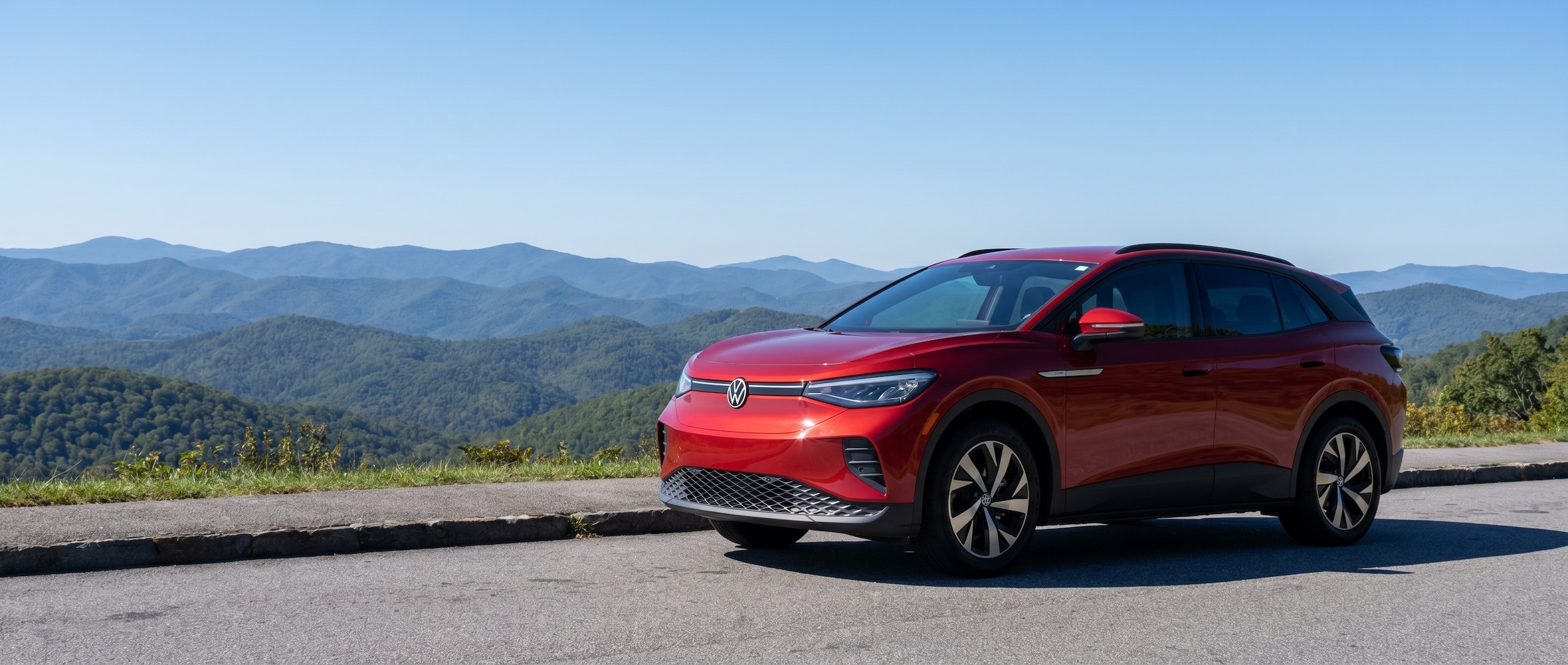
Electric vehicle batteries lose about 2.3% of their capacity per year on average - but that number tells only part of the story for used ID.4 buyers in Greenville, SC. Understanding how the Upstate's moderate climate, your daily driving patterns, and charging habits affect a pre-owned electric Volkswagen® can transform your ownership experience from uncertain to confident. This guide breaks down the essential battery, charging, and range considerations specific to our area, helping you evaluate whether a used ID.4 fits your lifestyle.
How the Upstate Climate Affects Your ID.4's Battery Performance
South Carolina's mild winters give ID.4 batteries a significant advantage over northern states - you'll typically see only 10-15% range reduction on our coldest January mornings versus the 35% loss common in freezing climates. The real consideration for Greenville drivers comes during our humid summers when running the air conditioning continuously can reduce your range by 17% on those sticky August afternoons.
Our location between the Blue Ridge Mountains and the rolling hills means elevation changes impact your efficiency differently depending on your route. Driving up Highway 25 toward Travelers Rest will consume more battery, but you'll regenerate power coming back down toward downtown. The ID.4's regenerative braking system actually performs exceptionally well on routes like Highway 11 through the foothills.
Did you know? The ID.4's battery management system pre-conditions the battery pack when you set departure times, optimizing range whether you're parked at Falls Park or heading to work on a chilly morning.
Temperature swings between day and night in spring and fall have minimal impact on battery longevity. The thermal management system in Volkswagen's MEB platform keeps the battery within optimal temperature ranges, protecting long-term health even when your ID.4 sits in a Furman University parking lot all day.
Understanding Battery Health in Pre-Owned ID.4 Models
Battery degradation in used ID.4 models follows predictable patterns that favor second owners - the steepest capacity loss happens in the first year, then levels off to about 1-2% annually. When evaluating a pre-owned ID.4, focus on the battery's state of health (SOH) percentage rather than just mileage or age.
| Battery Age | Typical SOH | Real-World Range Impact |
|---|---|---|
| 1 Year | 95-97% | 5-10 miles less |
| 2 Years | 93-95% | 10-15 miles less |
| 3 Years | 91-93% | 15-25 miles less |
| 4 Years | 89-91% | 25-35 miles less |
A three-year-old ID.4 with 92% SOH still delivers approximately 240 miles of range in mixed Upstate driving conditions. That easily covers a round trip to Charlotte or Atlanta with charging margin to spare. The key is understanding that "degraded" doesn't mean "degraded badly" - even at 85% SOH, you're looking at over 220 miles of capability.
Volkswagen's 8-year/100,000-mile battery warranty transfers to subsequent owners, protecting your investment. The warranty guarantees at least 70% capacity retention, though real-world data shows most ID.4 batteries far exceed this threshold. Check our pre-owned inventory to see specific battery health reports on available models.
Request a battery health report during your pre-purchase inspection. This report shows not just current capacity but charging patterns and cell balance - indicators of how well the previous owner maintained the vehicle.
Real-World Charging Patterns for Greenville Drivers
Your daily charging routine matters more than maximum charging speed - most ID.4 owners in the Upstate charge at home overnight and rarely need public fast charging except for road trips. The sweet spot for battery longevity is keeping your charge between 20% and 80% for daily use, which translates to about 180 miles of available range.
Ideal Weekly Charging Schedule:
- Sunday evening: Charge to 80% for the work week
- Wednesday evening: Top up to 60-70% if needed
- Friday evening: Charge to 90-100% only if weekend travel planned
- Daily charging isn't necessary unless you drive over 60 miles per day
The Greenville area offers excellent charging infrastructure with stations at Haywood Mall, along Woodruff Road, and throughout the downtown district. However, relying primarily on DC fast charging can accelerate battery degradation. Think of fast charging like fast food - convenient occasionally but not ideal as your primary option.
Pro tip: Set your ID.4's charging limit to 80% in the vehicle settings. You can override this for long trips, but it helps preserve battery health during regular use.
Level 2 home charging adds about 25 miles of range per hour, meaning a typical overnight session fully replenishes your daily driving. Installing a 240V outlet in your garage costs between $500-1500 depending on your electrical panel location - a worthwhile investment that pays off in convenience and lower electricity rates during off-peak hours.
Matching Your Upstate Lifestyle to ID.4 Range Capabilities
The ID.4's EPA-rated 260-mile range translates differently across Upstate driving scenarios - highway cruising at 75 mph reduces efficiency while stop-and-go traffic through Simpsonville actually improves it through regeneration. Understanding these patterns helps you plan confidently.
Common Upstate Routes from Greenville:
- To Clemson University: 30 miles each way, uses 25% battery
- To BMW Plant in Greer: 12 miles each way, uses 10% battery
- To Table Rock State Park: 35 miles each way, uses 30% battery (elevation gain)
- Downtown to GSP Airport: 15 miles each way, uses 12% battery
Highway 385 and Interstate 85 driving at typical speeds (70-75 mph) consumes battery faster than the same distance on Highway 29 at 55 mph. Wind resistance increases exponentially with speed, so you'll see about 15% better efficiency maintaining 65 mph versus 75 mph on longer trips.
The ID.4 excels at daily commuting patterns common in the Upstate:
- Suburban drivers shuttling between Mauldin and Greenville see minimal range anxiety
- Rural residents near Landrum or Marietta gain confidence from the larger battery buffer
- City dwellers maximize efficiency in downtown traffic and shorter trips
Weekend adventures to Paris Mountain State Park or the Swamp Rabbit Trail barely dent your battery reserves. Even a spontaneous trip to the Peace Center followed by dinner on Main Street uses less than 10% of your charge. This changes the ownership experience from calculating every mile to simply enjoying the drive.
Evaluating Charging Infrastructure for Your Daily Routes
Greenville's charging network continues expanding, but understanding where stations exist along your regular routes provides peace of mind. The Upstate's infrastructure particularly shines along major corridors and shopping districts.
| Location Type | Charging Availability | Typical Speed |
|---|---|---|
| Shopping Centers | Widely available | Level 2 (6-8 hours full) |
| Hotels | Growing rapidly | Level 2 overnight |
| Interstate Corridors | Every 50-70 miles | DC Fast (30-45 min) |
| Downtown Greenville | Multiple options | Mixed Level 2/DC Fast |
| Workplace Parking | Varies by employer | Usually Level 2 |
Major employers like Michelin, GE, and Fluor provide workplace charging, while retail destinations from Whole Foods to Target increasingly offer charging. The ChargePoint and Electrify America networks dominate locally, so downloading both apps covers most situations.
Consider your typical week: If you shop at Publix on Pleasantburg, catch movies at Regal Cherrydale, or work out at the Kroc Center, you're passing multiple charging opportunities. This redundancy means you're never far from a backup option, even if your primary charging happens at home.
Rural Upstate areas like Travelers Rest and Greer show growing infrastructure too. Brewery visits, hiking excursions, and family gatherings rarely strain your range when you understand the charging landscape. Planning becomes second nature - much like knowing which gas stations have the best prices, you'll quickly memorize convenient charging spots.
Making Your Used ID.4 Decision with Confidence
Evaluating a used ID.4 comes down to matching battery health with your driving reality - if the vehicle shows 90% SOH and you drive 40 miles daily around Greenville, you're looking at a week of driving between charges. Factor in these final considerations:
Signs of a Well-Maintained Used ID.4:
- Consistent charging history (not always at 100%)
- Battery SOH above 90% for 2-3 year old models
- Regular service records including software updates
- Clean charging port with no corrosion
- Previous owner in similar climate (avoid extreme cold regions)
Red Flags to Avoid:
- Excessive DC fast charging history (more than 50% of charges)
- Battery SOH below expected degradation curve
- Missing service records or software updates
- Signs of accident damage near battery area
- Unusually low mileage (batteries need regular use)
Did you know? The ID.4's battery warranty remains valid even if you charge exclusively at DC fast chargers, though this practice isn't recommended for longevity.
Test drive any used ID.4 on your actual commute route. Pay attention to the efficiency display and projected range - these real-world numbers matter more than EPA ratings. Schedule your test drive during typical traffic conditions to see actual consumption patterns.
The transition to electric driving in the Upstate proves easier than most expect. Between our mild climate, growing infrastructure, and the ID.4's generous range buffer, battery anxiety quickly fades. Smart charging habits and understanding your actual needs versus maximum capabilities leads to years of efficient, enjoyable driving.
Common Questions About Used ID.4 Ownership in Greenville, SC
How does Greenville, SC's summer heat affect ID.4 battery longevity?
Greenville's summer heat has minimal impact on ID.4 battery longevity thanks to active thermal management that keeps cells cool. The liquid cooling system maintains optimal temperatures even during 95-degree days, though you'll see 15-20% reduced range when running AC continuously. Park in shade when possible to reduce thermal stress.
What's the typical battery degradation for a 3-year-old ID.4 driven in South Carolina?
A 3-year-old ID.4 in South Carolina typically shows 7-9% degradation, retaining 91-93% of original capacity. Our moderate climate helps batteries last longer than in extreme temperature regions. This translates to approximately 235-240 miles of real-world range, easily handling daily Upstate driving needs.
Where can I reliably fast charge between Greenville and Columbia?
Reliable DC fast charging stations exist at Newberry (Electrify America at Walmart) and Clinton (ChargePoint at Love's Travel Stop) along I-26. Both locations offer 150kW+ charging speeds, adding 100+ miles in 20-30 minutes. Additional Level 2 options exist at hotels in Clinton and Laurens for overnight stops.
Does the Volkswagen ID.4 handle well on mountain roads near Greenville?
The ID.4 handles mountain roads exceptionally well thanks to its low center of gravity and instant torque delivery. Routes like Highway 11 through the Blue Ridge foothills showcase smooth acceleration and confident cornering. Regenerative braking on descents toward Greenville actually recovers significant energy, offsetting uphill consumption.
How much does home charging cost compared to gas for typical Greenville driving?
Home charging in Greenville costs approximately $7-9 to fully charge an ID.4 during off-peak hours, providing 250+ miles of range. Compared to a gas SUV getting 25 mpg at $3.20/gallon, you'll save about $25 per 250 miles driven. Duke Energy's time-of-use rates can reduce costs further.
What battery warranty coverage transfers to used ID.4 buyers?
Volkswagen's 8-year/100,000-mile battery warranty fully transfers to subsequent owners, guaranteeing at least 70% capacity retention. This coverage includes battery defects, excessive degradation, and related components. Most ID.4 batteries significantly exceed the 70% threshold, providing peace of mind for used buyers.
Your Next Step Toward Electric Driving in the Upstate
A used ID.4 opens up efficient, quiet, and surprisingly capable transportation throughout the Greenville area and beyond. Understanding battery health, establishing smart charging routines, and matching range capabilities to your actual driving patterns removes the guesswork from electric vehicle ownership. With the Upstate's mild climate working in your favor and expanding charging infrastructure supporting longer journeys, the practical barriers to EV adoption continue falling away. The team at Steve White Volkswagen can show you specific battery health data on our used ID.4 inventory and help you experience these capabilities firsthand on local roads you drive every day.
Categories:
Social