
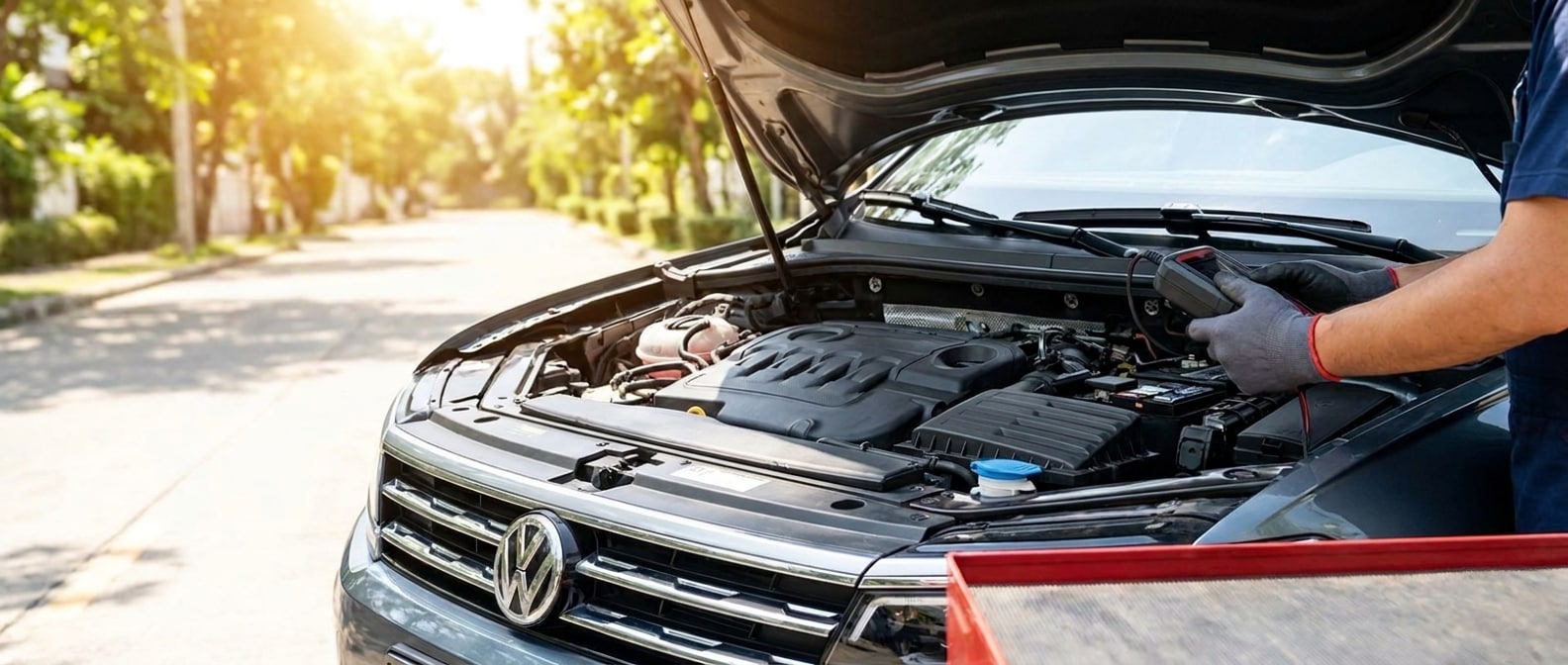
Blame winter for a dead battery and you'll miss where the damage actually starts. Around Greenville, the harm is mostly done long before October. It happens in August, on a Tuesday, while your Volkswagen Tiguan or Jetta sits in a parking deck off Main Street. You turn the key, and something feels off. Maybe the crank drags, or the interior lights dim for half a second. Those are the early signals, and they usually mean one thing. Your battery's chemistry has been quietly breaking down since June, and Greenville heat is why.
Schedule a battery check with our service center before a symptom turns into a stranded car.
What's Actually Going On Inside That Battery?
Heat speeds up every chemical reaction your battery uses to start the car, which helps in the short run but eventually burns through the reserve those same reactions depend on, so the very warmth that makes an August start feel fine is quietly draining what you'll need later. A standard car battery performs best at around 77 degrees Fahrenheit, according to AAA. On a Greenville August afternoon, under-hood temperatures can exceed 200 degrees Fahrenheit. The gap between those two numbers is what does the damage.
Below are the five warning signs we watch for in our service center, what's likely behind each, and what to do next.
| Symptom you notice | What's likely happening | What to do |
|---|---|---|
| Engine cranks slowly, especially on hot afternoons | Battery can't deliver enough current; capacity has dropped | Get a load test, not just a voltage check |
| Headlights dim when idling, brighten when you rev | Battery is weak; alternator is compensating but barely | Test battery AND alternator together |
| Electrical gremlins: glitchy radio, sluggish windows, flickering display | Voltage dropping below the threshold your Volkswagen's systems need | Schedule service; Volkswagen electronics are sensitive to low voltage |
| Visible white or blue-gray crust on the terminals | Corrosion accelerated by heat and humidity; raises resistance | Terminal cleaning may buy time, but test the battery too |
| Battery light on the dashboard | Could be the battery, could be the charging system | Don't ignore it; these can look identical without a scan |
One caveat is worth flagging. None of these symptoms is conclusive on its own. A slow crank could point to a weak battery or a failing starter, and the battery light nearly always needs a scan tool to read properly. A load test at a Volkswagen service center is the only way to know for sure. Voltage checks alone won't catch it.
Why Greenville's August Heat Hits Volkswagen Batteries Harder Than You'd Expect
Greenville heat shortens battery life more than the mild climate might suggest, because AAA's research shows batteries in hot southern climates last around three years against five or more up north, and the Upstate sits closer to that hot end than the mild summers make it look. Greenville isn't Phoenix, but it's no mountain town either. August high temperatures here average 88.5 degrees Fahrenheit with a heat index that regularly climbs past 100 degrees. The humidity compounds everything. Your Volkswagen's battery isn't just fighting the air temperature. It sits in an engine bay where temperatures can push well above 140 degrees even on a day you'd call "not that bad."
A timing pattern catches a lot of Upstate SC drivers off guard. The battery takes its worst invisible damage in summer, but the failure usually shows up in fall or early winter.
Heat does the internal work, evaporating electrolyte fluid, speeding up sulfation (the buildup of lead sulfate crystals on the battery plates), and driving corrosion. By the time cooler weather arrives and asks more of the battery on cold starts, there's nothing left to give. If your battery is three years old and you haven't had it tested since you bought the car, now's the moment.
Volkswagen Atlas owners with start-stop systems should pay extra attention here. Modern Volkswagen models equipped with start-stop technology use AGM batteries, short for Absorbent Glass Mat, instead of conventional lead-acid units. Battery specialists who work on this generation of Volkswagen vehicles note that AGM batteries handle the constant discharge-recharge cycle of start-stop driving well, though a depleted or heat-damaged AGM can fail faster under that cycling stress. There's also a registration step. When a Volkswagen's AGM battery is replaced, the car's battery management system usually needs to be coded to the new unit, and skipping that step can shorten the replacement battery's life significantly.
Short city trips make this worse. If your I-385 or I-85 commute runs mostly stop-and-go with trips under 15 minutes, the alternator may not fully recharge the battery between cycles. That chronic undercharge accelerates sulfation, which is essentially irreversible.
Next step: If your Volkswagen has 30,000 miles or more on it and you haven't had the battery load-tested, call our service center at 888-475-6693. A load test takes about 15 minutes and tells you whether the battery still has the reserve capacity it needs. Voltage alone won't catch a battery that's fading under heat stress.
DIY Check vs. Letting Our Service Team Handle It
You can safely check a few things yourself today with no tools at all, though a home inspection has a real limit and won't tell you what a load test will, so treat the DIY pass as a first look rather than a diagnosis you can bank on. A few things are easy to eyeball right now.
- Look at the terminals. White, blue-gray, or greenish crust around the battery posts is corrosion. A little is normal; heavy buildup raises electrical resistance and can cause symptoms that mimic a dying battery even when the battery is still okay.
- Check the case. A swollen or visibly bulging battery case means the battery has overheated internally. That battery should come out. Do not jump-start a swollen battery.
- Note when the symptoms happen. Slow cranking on a hot afternoon after the car has baked in direct sun is a different pattern than slow cranking on a cool morning. The former is almost always battery stress; the latter can be a starter or a colder-weather capacity issue.
A safe DIY inspection stops about there.
Skip the "I'll just jump it and see what happens" routine. A jump-start tells you almost nothing about remaining battery health. A battery that recovers from a jump on a hot day can fail completely within a week. The one test that matters is a load test, which mimics the actual current draw of starting the engine and measures whether the battery can sustain it.
Volkswagen's electrical systems carry one extra wrinkle worth knowing about. The vehicle's battery management electronics track the battery's health over time. When the battery gets replaced by a shop that skips the registration coding step, the system keeps charging the new battery as if it were the old, depleted one, which can undercharge a fresh AGM and shorten its life noticeably. Our service team handles that registration step as part of any Volkswagen battery replacement.
Frequently Asked Questions
Does heat or cold do more damage to a car battery?
Heat does. Cold weather makes a failing battery harder to start, which is why so many battery deaths seem to land on cold mornings. But AAA's research is clear that heat is the primary source of battery degradation, especially in southern climates like Greenville's. The heat does the damage over summer, and the first cold snap simply reveals it.
How do I know if I need a battery or an alternator?
Both can cause nearly identical symptoms, from slow starts to dim lights to electrical gremlins, so you often can't tell them apart from the driver's seat without testing. A rough gauge helps, though. If the car starts fine when the engine is cool but struggles after a hot soak, the battery is the more likely culprit. If the battery warning light comes on while you're driving with the engine running, suspect the alternator, since it isn't charging the battery while the car runs. The most accurate answer comes from a shop that tests both components with dedicated equipment at the same time, because a bad battery can mask an alternator problem and the reverse is just as true.
Categories:
Social