
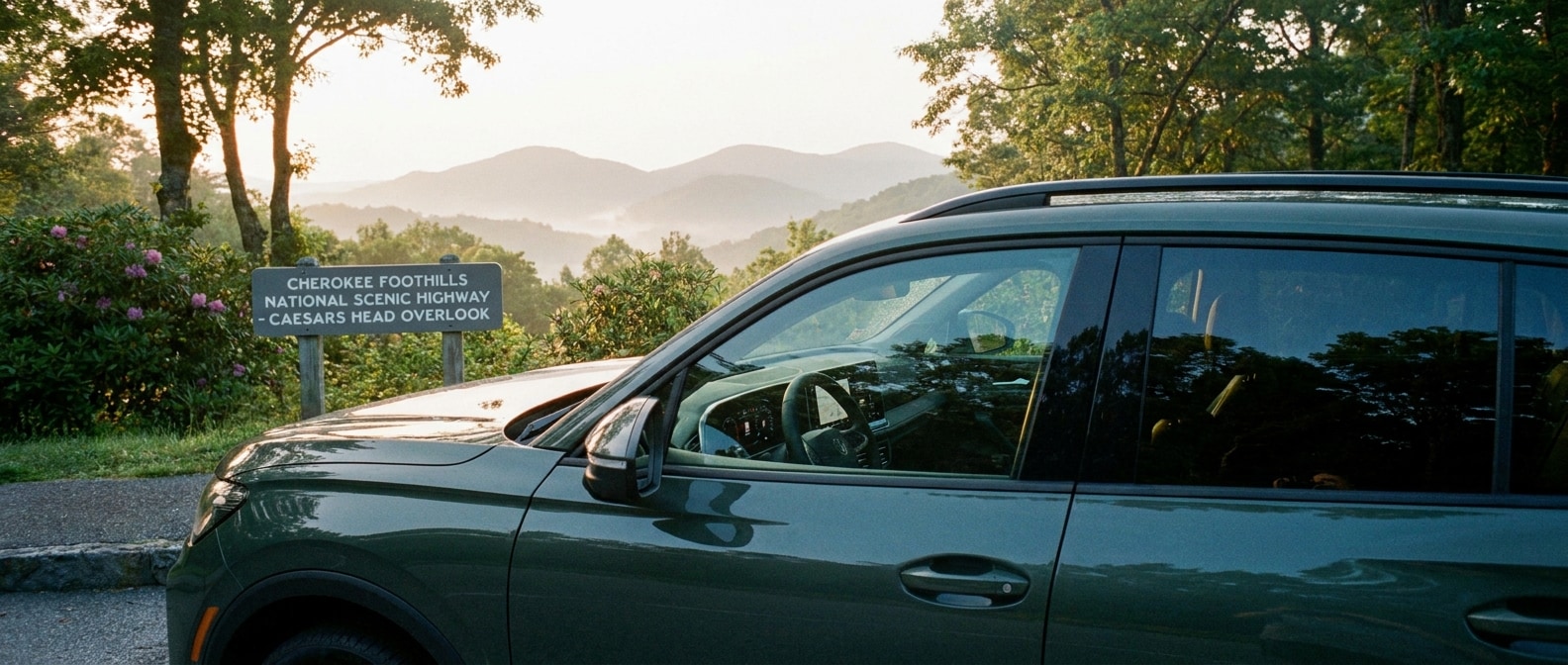
August in Greenville is relentless. Relative humidity sits around 70% for much of the year, and July alone brings an average of thirteen rainy days to the Upstate. You climb into your Tiguan after a late-afternoon thunderstorm, crank the AC to max cool, hit the recirculation button, and you're watching the windshield fog over anyway. None of that is a defect. Physics is just using your good intentions against you.
More AC won't solve it. What solves it is understanding how Volkswagen's Climatronic system is actually designed to manage humid air, plus a few habits specific to this climate that make the difference between a clear, comfortable cabin and one that smells like a wet dog two months into summer.
In Upstate SC's humid subtropical climate, Volkswagen's Climatronic automatically overrides recirculation when the defroster activates, because pulling in outside air is what actually clears fog. Learning to work with that logic, not against it, is the whole game.
The 2026 Tiguan starts every trim with Climatronic Touch dual-zone automatic climate control as standard equipment, which means it's already handling a lot of the humidity management for you. You barely notice.
Why Does Upstate Humidity Hit So Hard Inside the Cabin?
Greenville sits in a humid subtropical climate zone, and the numbers leave little room for argument, with relative humidity running roughly in the 70% range across the year and summer air holding more moisture per cubic foot, so the cabin loads up fast even though the AC can strip most of that back out. Every time a passenger gets in from the heat, every bag of wet groceries from a rainstorm on I-85, every breath your kids take on the way home from Paris Mountain State Park, it all adds up. All of that moisture goes into the cabin air. Close the doors, run recirculation, and you're just recycling an increasingly damp cloud.
Local conditions here line up with specific Climatronic features, and you'll see the pairing below.
| Upstate Condition | The feature that handles it | Why it matters here |
|---|---|---|
| High ambient humidity (avg ~70% RH) | AC compressor runs during Climatronic auto mode, dehumidifying as it cools | Outside air in Greenville is already saturated; the AC strips moisture before it hits your face |
| Summer thunderstorms on I-85 and I-385 | Defrost function automatically disables recirculation and dehumidifies air | Recirculating humid interior air after rain makes fogging worse, not better |
| Multiple passengers adding moisture | Tri-zone Climatronic (Atlas standard; Tiguan SEL R-Line Turbo) gives rear occupants independent control | Kids and cargo can't raise overall humidity when rear airflow is controlled separately |
| Post-hike or lake gear (Lake Hartwell, Lake Keowee trips) | Fresh-air mode draws outside air through cabin air filter before it reaches passengers | Wet gear off-gasses; fresh-air mode dilutes interior humidity over time |
| Parked in direct sun, Upstate summer | Ventilation before you close the doors briefly flushes superheated, moist air | A quick open-door ventilation drops the thermal load the AC has to fight |
The Climatronic System Is Built for This, If You Use It Right
Locking recirculation on and blasting cold air feels right in heavy humidity, since sealing out the saturated Greenville air seems like the smart move, but recirculation actually traps the moisture your passengers keep generating inside the cabin, so the air only gets damper the longer you're driving. Breathe in a sealed car for twenty minutes and humidity climbs. Fog follows.
The 2026 Atlas carries Climatronic three-zone automatic climate control as standard equipment across its entire lineup, giving front and rear passengers independent temperature management. The third zone does more than keep everyone comfortable. When the third row is occupied on a run up to Caesars Head State Park or across to Lake Hartwell, separate rear airflow prevents the back-seat humidity buildup from migrating forward and fogging the windshield while you're navigating a mountain road.
The setting logic that works in Upstate SC weather isn't complicated.
Per Volkswagen's own Climatronic documentation, the defrost function dehumidifies the air and drops recirculation on its own, because pulling in outside air is what clears fog. The choice is deliberate engineering. Fighting it by keeping recirculation on when the windows fog up won't help; you're working against the system's design. Set the fan to a moderate speed, let the temperature stabilize at a comfortable setting (rather than pinning it to max cold, which forces the compressor to cycle on and off and reduces consistent dehumidification), and let the Climatronic work through its logic.
Upstate tip: On rainy drives along the Cherokee Foothills National Scenic Highway, keep fresh-air mode active instead of recirculation. The mountain air at that elevation carries less absolute humidity than the valley air you started with, and you'll find the system exchanges cabin air more effectively than it can with recirculation sealed.
Schedule a service check before the next weather swing if your HVAC airflow feels weaker than it used to, or if there's any mustiness from the vents. Both are early signs of a cabin air filter that Greenville's conditions have caught up with.
- 2026 Tiguan: Climatronic Touch dual-zone standard on S trim and above
- 2026 Atlas: Climatronic three-zone automatic standard across all trims
- Tiguan SEL R-Line Turbo: tri-zone climate control, ventilated front seats
- Defrost function on all Climatronic models automatically disables recirculation per Volkswagen owner's manual documentation
- Ventilated front seats (available on Tiguan SE R-Line Black and above; standard on Atlas): pull warm, moist air away from the seat surface instead of letting it accumulate under you
Schedule a Service Appointment
The Cabin Air Filter Is the Part Humidity Quietly Ruins
The cabin air filter is the part that's easiest to ignore until the airflow drops or a musty smell shows up, and by that point the HVAC system has already been working harder than it should, though catching it early keeps the fix quick and simple. A clogged cabin air filter restricts airflow through the entire climate control system. Reduced airflow means the blower motor strains, moisture lingers in the HVAC passages longer, and musty odors start pushing through the vents. In a dry climate, a filter might go a long time before it's a noticeable issue. In Greenville, with its roughly 51 inches of annual rainfall and continuous pollen load from February into May, the filter earns its retirement faster.
Volkswagen's general service guideline for cabin air filter replacement is every 20,000 to 30,000 miles under typical driving conditions. Greenville doesn't present typical conditions. The combination of year-round humidity, heavy pollen, and particulates from I-85 corridor traffic means our service team recommends checking the filter at or before 15,000 miles. A clogged filter doesn't just smell; it also cuts the Climatronic system's ability to dehumidify the cabin, because dehumidification depends on adequate airflow through the evaporator. Less airflow, less moisture removal, more fog.
The Taos and other compact Volkswagen models share this maintenance need, and if you're covering high-mileage Upstate commutes, you'll reach the shortened interval sooner.
How to Keep the Whole Cabin Fresh Through a Greenville Summer
Managing cabin humidity in the Upstate runs on a small set of consistent habits, and none of them takes much effort once they become routine, though skip them across a full Greenville summer and you'll find moisture settling into the fabric and the carpets. The habits break down by timing, and they're easy to keep.
Before you drive: If the car has been sitting in the heat, open the doors for thirty seconds before starting. Letting superheated, moisture-laden air exit before the Climatronic takes over means the system isn't fighting as hard from the start.
On the road: Use fresh-air mode as your default, not recirculation. Reserve recirculation for the first few minutes after a scorching start when you're after rapid initial cooling, then switch back to fresh air. Extended recirculation in Greenville's humidity will raise interior moisture levels and fog the glass.
After rain or a hike: Wet shoes, wet jackets, and wet kids all keep off-gassing moisture into the cabin after you park, and they'll keep at it until you air the car out. Cracking a window for a few minutes after parking lets that moisture escape instead of settling into fabric and carpets and eventually into the HVAC passages.
Annual service habit: Cabin air filter, AC system inspection. South Carolina's climate works the compressor harder than moderate climates, and an annual look before summer is smarter than waiting for a symptom, and it's easier on the system over time.
The 2026 Volkswagen lineup's Climatronic systems are genuinely well-matched to a climate like Greenville's. They're designed around precise dehumidification logic, not just temperature control. The question is whether you're using the settings the way the engineering intends, and whether the filter behind the glove box is clean enough to let the system do its job.
If you're unsure about either, we're on Duvall Drive and happy to walk through it with you.
By the Steve White Volkswagen Team | August 2026
Categories:
Social