
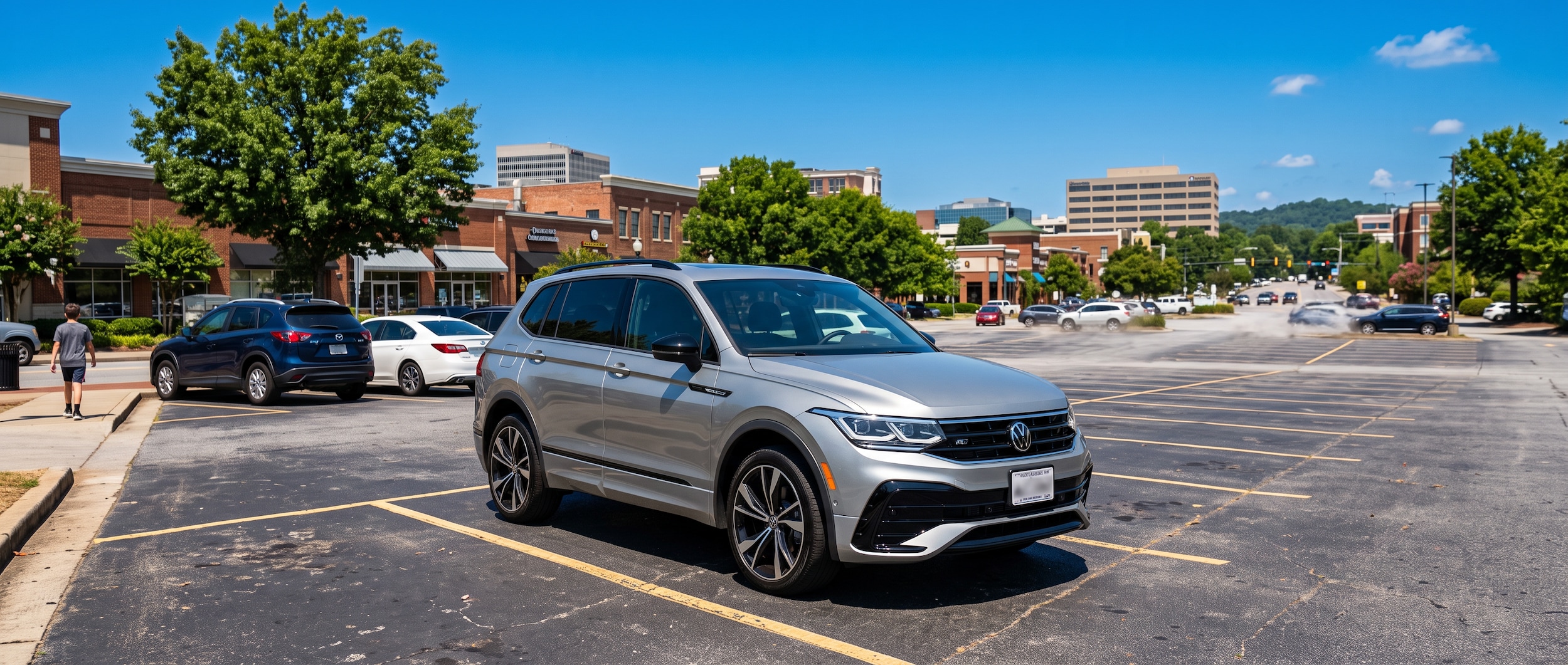
August in Greenville means the asphalt on I-85 isn't just warm. That dark surface is actively working against your tires. When air temperatures hit the high 80s and low 90s, pavement surface temperatures push past 140F, because dark asphalt absorbs solar radiation directly rather than reflecting it. That heat quietly changes two things you lean on every day (the firmness of your tire's rubber compound and the size of its contact patch). Both affect how quickly you stop. Both are easy to manage once you know what to check and when.
The 2026 Volkswagen Tiguan and every other vehicle in our lineup ships with one authoritative reference, the cold-inflation PSI printed on the driver's door jamb. That number anchors everything that follows.
What Do You Actually Get at Each Level of Summer Brake Readiness?
Your braking hardware handles August fine, but your tires are where summer heat does its damage, since rubber compound, inflation pressure, and tread depth each play a distinct role in stopping grip and heat moves all three variables at the same time. So the readiness level you're sitting on decides how the car stops. Below, each readiness level maps to what happens on Upstate South Carolina pavement.
| Readiness Level | What You Actually Have | What It Means on a 140F Road | Who It Applies To |
|---|---|---|---|
| Optimized | Cold PSI matched to door placard; tread at 6/32" or better | Maximum contact patch, predictable ABS response, full grip reserve | Drivers who checked pressure before today's first drive |
| Acceptable | Cold PSI within 2-3 PSI of placard; tread at 4/32" | Slight contact-patch reduction; stopping reliable in most conditions | Most attentive Volkswagen owners with recent service |
| Compromised | Overinflated from a post-drive hot-check; tread at 3/32" | Shrunk contact patch, reduced wet-weather grip, longer dry stops | Drivers who released air right after a highway run and called it done |
| Unsafe | Underinflated 5+ PSI cold; tread at or below 2/32" | Rubber softens past grip threshold in heat; stops stretch significantly | Anyone who hasn't checked in months, or who ignored a TPMS warning |
The entry that catches people off guard is "compromised by overinflation." NHTSA defines correct tire pressure as the vehicle manufacturer's recommended cold inflation pressure, found on the driver's side door jamb label or in the owner's manual. Pull off I-385 after a 20-mile run and check pressure while the tires are still hot, and the gauge will read higher than your placard number. Physics, not a fault. Release air at that moment and you'll leave the tire underinflated once it cools overnight, which is the exact condition you were trying to avoid.
Summer Heat Attacks Braking From Two Directions at Once
Summer heat comes at your braking from two directions at once, so low pressure isn't the only failure mode worth worrying about in August, and the opposite problem is every bit as real once the road and the air push your pressure the other way. Both risks land together this month.
Tire pressure rises roughly 1 PSI for every 10F increase in temperature. On a Greenville August afternoon, the combined heat from the air, the road surface, and highway friction can add 4 to 6 PSI on top of whatever cold pressure you set that morning. A correctly inflated tire at 7 a.m. may read several PSI over spec at 2 p.m. That reading isn't a problem requiring action. What does require action is the other direction.
Per NHTSA, under-inflation leads to longer stopping distances and increased stress on tire components. In summer heat, underinflated rubber softens past its optimal operating range. When softened tread contacts pavement at highway speed during a hard brake, it squirms against the surface aggregate instead of biting into it. NHTSA estimates tire failure contributes to approximately 11,000 crashes per year, with incidents peaking from May through October. The TPMS warning in your Volkswagen triggers at roughly 25% below the placard pressure. By the time that light shows up, per NHTSA's own guidance, you're already in the structural damage range.
The 2026 Volkswagen Taos carries TPMS as standard. Treat it as your last line of defense, not your maintenance schedule.
Tip: Check tire pressure before your first drive of the day, or after the car's been sitting for at least three hours. That cold reading is the only number you can fairly compare against the door placard. A reading taken right after a Greenville highway run will always look elevated, and acting on it leads to underinflation instead of safety.
Next step: If it's been more than a month since your last cold-PSI check, or if your tread depth is anywhere near 4/32" or below, a quick service visit this week is the practical move. Our service center can inspect both in about 15 minutes, and you'll leave knowing exactly what you have under you before the next hard stop.
The Variable Most Drivers Underestimate: Tread Depth in August Heat
Tread depth deserves as much summer attention as inflation pressure does, and August is the month that exposes any tire that came out of spring already borderline, because heat cycles plus hot, wet pavement punish shallow grooves in a way dry spring driving never asked them to survive. So look at your tread this week.
Tread wear indicators built into tire grooves are set at 2/32", which is the legal wear limit. Wait until 2/32" to replace tires and your wet-weather stopping distance is already substantially longer than it was at 6/32". Greenville is in the Upstate region of South Carolina. This matters because August afternoons there routinely deliver pop-up thunderstorms that drop rain onto pavement sitting above 140F. Standing water on that surface, combined with tread below 4/32", removes much of the drainage the groove pattern is designed to provide. A quick field check works with a quarter. Insert it into a tread groove with Washington's head pointing down. If you can see the top of his head, you're at or near 4/32" and in the window where a summer rain shower becomes a meaningful stopping-distance factor on any Upstate road.
We notice this at the counter. Worn tires often feel fine at cruising speed on dry pavement in August. Rubber that's been through many heat cycles stiffens, and stiff tread can actually feel confident under gentle braking. The situation changes completely during a hard emergency stop. Stiffened, depleted rubber can't conform to pavement texture the way fresh tread does. The contact patch fails to develop full friction, and the stop runs longer than the car felt capable of a moment before. That gap between feel and physics is the one worth understanding before you need it.
The full 2026 Volkswagen lineup (from the Golf GTI to the full-size Atlas) is engineered around braking systems that assume tires in proper condition. Our service center checks tread depth and cold inflation pressure as part of any routine visit. That 15-minute check is what keeps the engineering working the way Volkswagen intended it to.
Schedule a Tire and Brake Inspection
Frequently Asked Questions
Should I release air from my Volkswagen's tires when the pressure reads high in summer heat?
No, a higher PSI reading after driving in summer heat is normal. NHTSA defines correct tire pressure as the cold inflation pressure on your driver's door jamb label. After a drive in August, tires naturally hold more pressure from the combined heat of ambient air, hot pavement, and rolling friction. Release air from a hot tire and you'll leave it underinflated once the rubber cools, which lengthens stopping distances and raises the risk of tire failure. Check and adjust pressure only when tires are cold (before your first drive, or after at least three hours of sitting).
Does hot pavement actually extend my stopping distance?
It can, under two specific conditions. First, if your tires are underinflated (measured cold, below the door-placard number), the rubber softens past its grip threshold in August heat, reducing the friction it can generate during a hard stop. Second, if your tires are overinflated because you released air from a hot reading, the contact patch shrinks and grip decreases. Properly inflated tires with 4/32" or more of tread depth perform as designed in summer heat. The risk comes from pressure that drifts outside the correct cold range, or from tread worn below 4/32" where the grooves can no longer channel water effectively during an emergency stop on a wet Upstate road.
Categories:
Social