
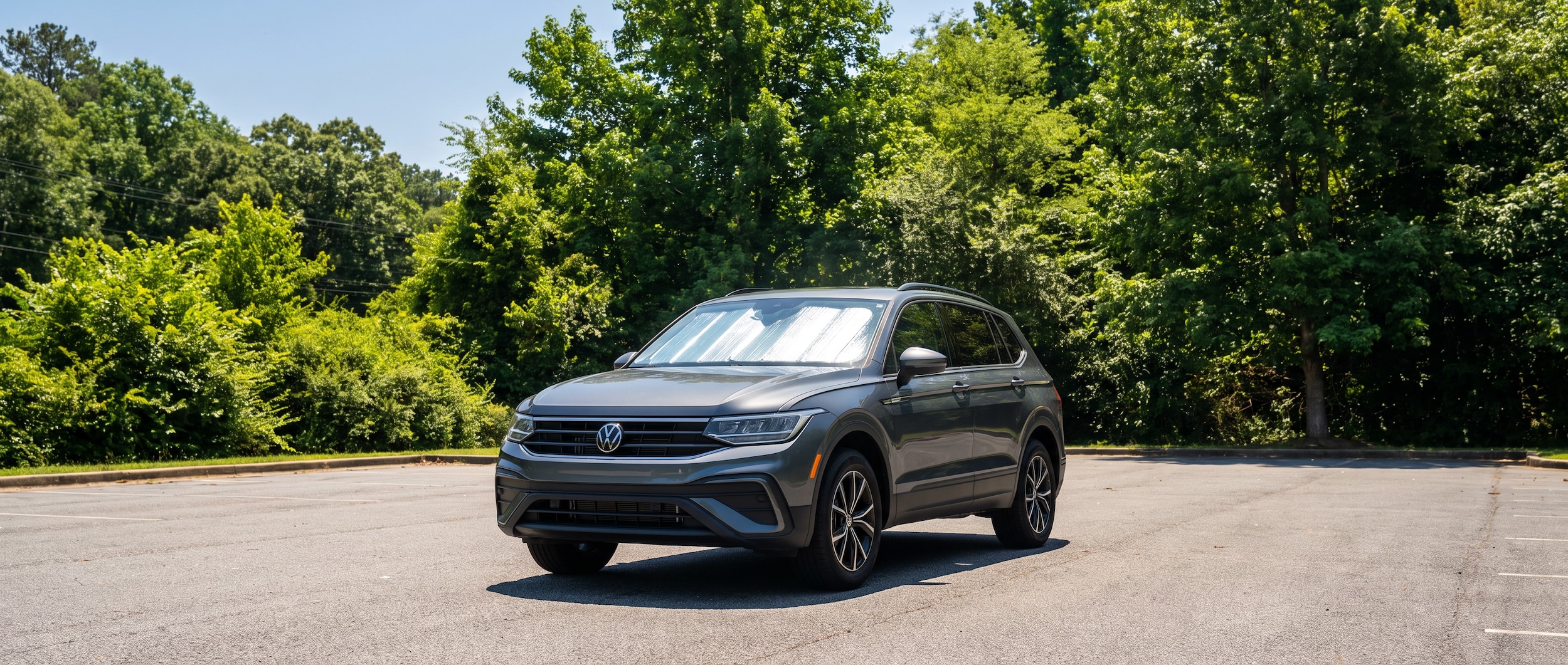
Greenville in August isn't a gentle heat. The National Weather Service station at Greenville-Spartanburg International Airport has recorded heat index readings of 106 degrees F during summer heat events, and when you park your Volkswagen on an exposed asphalt lot at noon, the physics inside that cabin turn brutal fast. Research published by scientists at UC San Diego and Arizona State University found that on a day reaching 95 degrees F, a car parked in the sun for one hour produced an average dashboard temperature of 157 degrees F, a steering wheel surface of 127 degrees F, and a seat surface of 123 degrees F. Those aren't exaggerations. A thermometer produced those numbers in conditions that match Greenville summers closely.
So yes, a sunshade works. Placement changes everything, though, and the specific surfaces in your Volkswagen deserve a smarter plan than tossing a fold-up accordion shade across the windshield and calling it done.
The 2026 Volkswagen Tiguan ships with a standard 12.9-inch center touchscreen, and the 2026 Atlas comes standard with Climatronic three-zone automatic climate control and its own large infotainment surface. Both are expensive to fix if repeated thermal cycling cracks the coating or degrades adhesive layers behind the display. And this matters well beyond comfort.
A windshield sunshade cuts steering wheel and dashboard surface temps by 40 to 50 degrees Fahrenheit according to Florida Solar Energy Center testing, but cabin air temperature only drops 15 to 20 degrees. Coverage zone and material type determine the rest.
How Does Interior Heat Actually Build Up?
Interior heat builds because sunlight isn't warming your cabin directly, and the surfaces are doing the work, soaking up shortwave solar radiation that slips through the glass almost unimpeded before re-radiating it as longer-wave heat the glass won't easily release, a mechanism the Florida Solar Energy Center (FSEC) at the University of Central Florida documents. It lands on your dashboard, seats, and steering wheel first, and those are the surfaces feeding the cycle. Your cabin becomes an oven with a one-way valve.
What makes Volkswagen interiors worth protecting? The materials react in ways worth knowing. The V-Tex leatherette standard on the 2026 Tiguan SE trim is a high-quality engineered material, but it behaves differently from fabric under sustained UV load. It holds heat longer, and it's vulnerable to surface hardening and micro-cracking once protective coatings degrade. The ventilated Varenna leather seats on the Tiguan SEL R-Line Turbo are genuinely premium, though ventilation alone won't protect the material from surface-temperature damage while the car is parked. Then there are the large touchscreen surfaces shared across the lineup, and they bring a technology concern most generic sunshade guides skip over. Adhesive layers and anti-glare coatings on large displays are sensitive to repeated thermal cycling, not just one-time peaks.
The comparison below is what matters when you're deciding what to buy.
| Protection Zone | Avg. Surface Temp (1 hr in sun, approx. 95 degrees F day) | With Windshield Shade | With Side + Rear Shades | Without Any Shade |
|---|---|---|---|---|
| Dashboard | approx. 157 degrees F | approx. 107-117 degrees F | Minimal benefit | approx. 157 degrees F |
| Steering wheel | approx. 127 degrees F | approx. 77-87 degrees F | Minimal benefit | approx. 127 degrees F |
| Front seats | approx. 123 degrees F | Partial benefit | Significant benefit | approx. 123 degrees F |
| Rear seats / cargo | Varies by glass area | Minimal benefit | approx. 20 degrees F cooler surfaces | Hottest in long sun |
| Touchscreen surface | Similar to dashboard | Protected | Minimal benefit | Most at risk |
Surface temperature data sourced from UC San Diego / Arizona State University published research. "With shade" temperature reduction reflects FSEC testing (40-50 degrees F surface reduction for windshield shade, 15-20 degrees F air temperature reduction).
The table tells the honest story. A windshield sunshade is the single highest-impact purchase for front-surface protection, but it does almost nothing for rear passengers or rear glass areas, where summer sun hits the back seats on any westward-facing afternoon spot.
Which Shade Setup Do You Actually Need Here?
Your parking spot decides this, and Greenville hands you a wide range, from a gravel Paris Mountain State Park trailhead lot with zero tree cover from 9 a.m. to noon to the shaded comfort of the covered deck near Falls Park in Downtown Greenville, and each one puts a very different thermal load on your Volkswagen. Exposed surface lots along I-85 commuter corridors are the worst-case scenario. Full solar angle, reflected heat off the asphalt, no relief.
Our recommendation at Steve White Volkswagen is shaped by how Upstate SC summers punish interiors when this step gets skipped. Start with a custom-fit windshield shade. Universal accordion shades leave exposed gaps at the edges of larger windshields, and the 2026 Atlas has a wide front glass area where an ill-fitting shade creates a thermal leak right over the instrument cluster. Custom-fit shades, including the official Volkswagen accessory sunshade for the 2026 Tiguan, use a multilayer construction engineered for that specific windshield geometry. Full edge coverage is what turns those FSEC numbers from a best case into a real result for your car.
The front of the cabin is handled at that point. If you've got children or pets in the rear, or you leave valuables visible, add rear side window shades next.
- Static-cling and magnetic mesh styles both work for rear-door glass.
- Neither one interferes with window operation.
They don't require removing the windshield shade, and on a Tiguan or Atlas Cross Sport with standard rear side glass, they can bring rear seat surface temperatures down meaningfully when the car is parked with the rear glass taking full afternoon sun.
One detail worth flagging is the reflective side facing the interior, not the glass. Testing by the FSEC found the best results when the reflective surface points back toward the car's interior, so it re-radiates any heat that does get in back out toward the glass rather than absorbing it. Check your shade. Most are labeled, though it's easy to install one backwards without noticing.
Sunshade Quick-Reference Glossary
| Term | What It Means |
|---|---|
| Reflective layer | Metalized or silver-coated material that bounces solar energy outward before surfaces absorb it |
| Thermal cycling | The daily expansion and contraction of surfaces from heat buildup and cooldown (the pattern that causes micro-cracking in dashboards and display coatings over time) |
| Shortwave radiation | The solar energy that passes through glass and heats interior surfaces; distinct from the longer-wave heat that gets trapped afterward |
| Custom-fit shade | A windshield shade cut to match a specific vehicle's exact windshield dimensions, eliminating the exposed gaps that reduce a universal shade's effectiveness |
What This Means for Your Next Volkswagen
If you're shopping and heat protection is a real factor in your Upstate SC life, trim selection does make a difference, though it won't replace a good shade. The 2026 Tiguan SEL R-Line Turbo includes ventilated Varenna leather front seats, which means the seat surface is actively cooled when the car runs, and that helps when the base temperature already sits high after a hot park. The Taos and Jetta share the same Greenville heat exposure as the larger SUVs, so the sunshade strategy above applies right across the lineup, big glass-heavy SUVs and compact sedans alike.
The honest tradeoff is straightforward. Sunshades slow the heat buildup, they don't eliminate it. Even a perfectly installed windshield shade and rear side shades in full Greenville August sun will still leave a warm cabin by hour two, though nothing near a 157-degree dashboard. And they only work as a habit. We've watched owners spend well on a quality shade, then leave it in the cargo area through the hottest months because deploying it feels like a chore. The fix is a shade that stores compactly enough that grabbing it every time becomes automatic. Umbrella-style and roll-up designs with an integrated fastener handle that more reliably than accordion folds, the ones that always fight the glove box.
If your Volkswagen's interior has already been through a few Upstate summers without protection, our service center team can assess the cabin for signs of coating fatigue or sealing issues before a fall refresh. Better to catch wear early.
Frequently Asked Questions
Does a sunshade damage my Volkswagen's windshield over time?
No. A properly fitted sunshade rests against the interior side of the glass and doesn't scratch or stress the windshield surface. The primary concern runs the other direction. Repeated high-heat cycles without a shade can degrade the adhesive behind rearview mirror mounts and sensors on modern Volkswagen models over time. A shade that fits the windshield correctly and stores cleanly when it's not deployed causes no mechanical or structural concern.
How do I know if my sunshade is sized right for an Atlas or Tiguan?
An undersized or universal shade will show daylight gaps at the A-pillar corners when installed. On the 2026 Atlas and 2026 Tiguan, the windshield's wide relative to compact sedans, so those corner gaps are where most of the dashboard heat gain slips past a generic shade. Look for fit verified for your specific model year and trim. Volkswagen produces an official accessory sunshade for the 2026 Tiguan with a multilayer construction confirmed for that windshield profile. For the Atlas, several aftermarket custom-cut options list fit compatibility through model year 2026. If in doubt, ask our team at Steve White Volkswagen before ordering.
Categories:
Social