
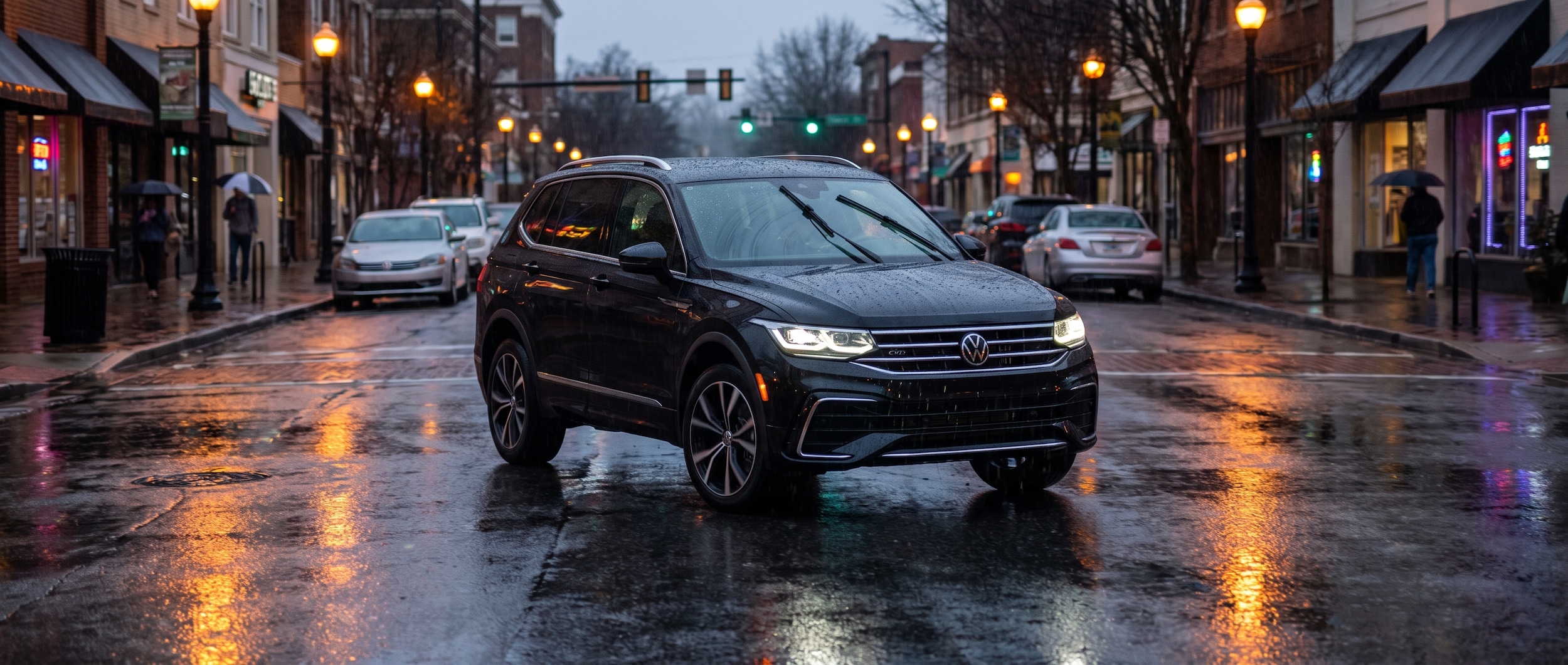
You've seen the phrase "IQ.DRIVE" on a window sticker. Maybe a sales sheet listed six features you half-recognized. But the question that matters is simpler. When traffic gets bad on Woodruff Road or the rain comes sideways on I-385, does any of this stuff actually do something?
It does. And the answer is more specific than a brochure gives you credit for.
Volkswagen's IQ.DRIVE suite is not a single feature. It's a layered collection of radar, camera, and ultrasonic sensor systems that each kick in at different speeds and in different situations. Some are meant for the highway. Some are built for the exact slow-crawl gridlock this city produces every weekday afternoon. Understanding which system does what and where it has real limits is the whole point of this post.
The 2026 Volkswagen Tiguan carries the full IQ.DRIVE suite standard across every trim. That's where we'll anchor most of our examples, though the same core systems carry over to the 2026 Atlas and the rest of the lineup.
IQ.DRIVE is standard on all 2026 Volkswagen automatic models (every trim, no packages to add).
How Does IQ.DRIVE Actually Work?
IQ.DRIVE is not autopilot, and it doesn't pretend to be. Think of it as a second set of eyes that reacts faster than you can. In specific, bounded situations, it takes action before you've even registered the problem.
The system uses a front-facing radar that watches traffic ahead, a forward camera that reads lane markings and detects pedestrians and cyclists, and multiple ultrasonic sensors around the vehicle that handle the close-range work (parking, backing out, adjacent lanes). All of it feeds into the vehicle's brain simultaneously.
| IQ.DRIVE Feature | How It Works | Activates At | Primary Greenville Use Case |
|---|---|---|---|
| Front Assist (Forward Collision Warning + Auto Emergency Braking) | Radar monitors gap to vehicle ahead; warns acoustically and visually, then brakes automatically if driver doesn't react | Forward Collision Warning above 18 mph; AEB can engage at lower speeds | Sudden stops on Woodruff Road; pedestrians crossing Main Street |
| Lane Assist | Camera reads lane markings; steers gently back into lane if drifting without a signal | Above 35 mph | I-385 and I-85 highway runs; distraction on the Haywood Road stretch |
| Travel Assist | Combines Adaptive Cruise Control (maintains following distance) + Lane Assist (keeps centered) into one coordinated system; 2026 models add driver-initiated lane changes | Highway speeds, hands on wheel required | I-85 through Greenville County; long I-26 drives toward the coast |
| Active Blind Spot Monitor | Side and rear sensors watch adjacent lanes; indicator blinks in mirror when you signal toward a detected vehicle | All speeds | I-385 on-ramp merges; lane changes near the I-85/I-385 interchange |
| Rear Traffic Alert | Rear sensors detect cross-traffic when reversing | Reversing | Backing out in downtown parking decks and busy lots |
| Emergency Assist | Detects driver inactivity; if Lane Assist or Travel Assist is active and the driver goes unresponsive, the vehicle will safely slow to a stop and stay in its lane | Active when Lane Assist/ACC/Travel Assist are engaged | A genuine last-resort feature (but worth knowing it exists) |
Per Volkswagen's official 2026 Tiguan press kit, Forward Collision Warning activates acoustically and visually when the vehicle is traveling above 18 mph. That matters: the system works in city traffic, not just at highway speeds.
Which Features Actually Help in Greenville Traffic?
Greenville isn't a generic American city when it comes to traffic. SCDOT data shows the I-385 corridor near Haywood Road handles over 91,000 vehicles per day. The stretch of Woodruff Road between I-385 and I-85 sees more than 40,000 vehicles per day during peak periods, and SCDOT has flagged it as one of the most congested surface corridors in the state. Throw in summer thunderstorms that drop visibility fast near downtown, and morning fog that settles in the Reedy River valley on I-85, and you've got a traffic environment that tests multiple safety systems in a single commute.
Here's how specific features map to real Greenville conditions.
Woodruff Road stop-and-go: Travel Assist with stop-and-go capability. Travel Assist handles the Woodruff Road crawl well. It maintains your following distance as gaps open and close, and it keeps the Tiguan centered in the lane without you riding the brake and gas constantly. The honest caveat: you still need your hands on the wheel and your eyes on the road. The system is Level 2 semi-automated assistance, not a substitute for attention. It earns its keep by reducing physical fatigue, not by replacing your judgment.
I-385 on-ramp merges: Active Blind Spot Monitor. The interchange where I-385 meets Haywood Road is a consistent friction point, with traffic accelerating and merging in compressed space. When you signal toward a lane with a vehicle in your blind spot, the Active Blind Spot Monitor's indicator blinks in the mirror and (if Lane Assist is also active) can apply corrective steering. That's a system worth understanding cold, not discovering for the first time mid-merge.
Summer thunderstorms and downtown pedestrians: Front Assist. July thunderstorms in Greenville arrive fast and drop hard. Front Assist's pedestrian and cyclist detection capability is meaningful in exactly this scenario (a runner in dark rain gear crossing Main Street, for instance). The system detects cyclists and pedestrians crossing in front of the vehicle. That said, Volkswagen's own documentation states clearly that system performance can be limited by weather, road conditions, and visibility. The IIHS gave the Atlas's standard front crash prevention an "Acceptable" rating in pedestrian testing (not a perfect score, and not something to treat as a guarantee). It's a backup, not a replacement for slowing down.
The 2026 Atlas Cross Sport carries the same IQ.DRIVE suite, and it earned IIHS Top Safety Pick+ alongside the Atlas. That is the institute's highest designation for 2026.
See Current Volkswagen Specials
I-85 morning fog: Lane Assist. That stretch of I-85 where it crosses the Reedy River valley is prone to low-hanging morning fog in fall and on warm summer mornings after overnight rain. Lane Assist uses a camera to track lane markings and apply gentle steering corrections when the system detects drifting without a turn signal (it engages above 35 mph). One real limitation: the camera needs visible lane markings to function. In fog so thick that markings are obscured, or in construction zones where paint is freshly laid or half-worn, the system will alert you that it's temporarily unavailable. That's not a flaw. It's the system being honest about its own physics.
IQ.DRIVE Terms, Plainly Defined
| Term | What It Actually Means |
|---|---|
| Level 2 Assistance | The driver is always responsible; the car assists steering, braking, or speed (never all three without driver input simultaneously) |
| Travel Assist | Volkswagen's branded name for adaptive cruise control + lane centering working together; hands must stay on wheel |
| Front Assist | The umbrella name for forward collision warning plus automatic emergency braking; includes pedestrian/cyclist detection |
| 4MOTION | Volkswagen's all-wheel-drive system; distributes power to wheels with the most grip (relevant for rain, ice, and Upstate SC mountain roads) |
| Emergency Assist | A last-resort feature: if the vehicle detects complete driver inactivity while assisted driving is active, it will slow to a stop within its lane |
What IQ.DRIVE Means for Your Next Vehicle
Here's the thing about safety technology: it only helps if it's in the vehicle you actually buy. The good news is that Volkswagen made that decision easy. The 2026 lineup ships IQ.DRIVE standard across every automatic transmission model. It's not a package you can miss by choosing the base trim.
The 2026 Tiguan's IQ.DRIVE bundle includes Front Assist with pedestrian and cyclist detection, Lane Assist, Active Blind Spot Monitor with Rear Traffic Alert, Adaptive Cruise Control, Travel Assist (with driver-initiated lane changes, new for 2026), Emergency Assist, Front and Rear Park Distance Control, and Exit Warning. All of that comes on the base S trim. The Jetta carries the same core suite at a more accessible entry point if a sedan fits your household better.
One honest tradeoff to acknowledge: the IIHS gave the 2026 Atlas's standard Front Assist pedestrian detection an "Acceptable" rating (not the top "Good" mark). That result is specific to nighttime pedestrian scenarios and certain crossing-speed scenarios. In 2026, Volkswagen also added rear seat belt pretensioners and load limiters to the Atlas to improve rear occupant protection. Progress is real, and it's documented. But no system eliminates risk entirely, and Volkswagen's own documentation is direct about it: IQ.DRIVE cannot overcome the laws of physics or prevent all collisions.
Knowing what each feature actually does, where it works well, and where it has limits is what makes a confident purchase. Come see us on Duvall Drive and we'll walk you through any of these systems on a real vehicle, on a route that looks like your actual commute.
Frequently Asked Questions
Does Volkswagen's Lane Assist work in city traffic?
Lane Assist activates above 35 mph, so it's built for highway and faster arterial driving rather than low-speed urban stop-and-go. For city speeds, Front Assist's forward collision warning system handles the protective role (it activates above 18 mph), which covers most surface-street situations where a sudden stop is the primary risk.
Is IQ.DRIVE available on all 2026 Volkswagen models?
Yes. Volkswagen confirmed that IQ.DRIVE is standard on all 2026 Volkswagen automatic models across the lineup (Tiguan, Atlas, Atlas Cross Sport, Jetta, and others). You don't need to select an upper trim or an optional package to get the core suite. Individual features within IQ.DRIVE can vary by model and trim, with upper trims adding items like a 360-degree Area View camera and Park Assist Plus.
Categories:
Social