
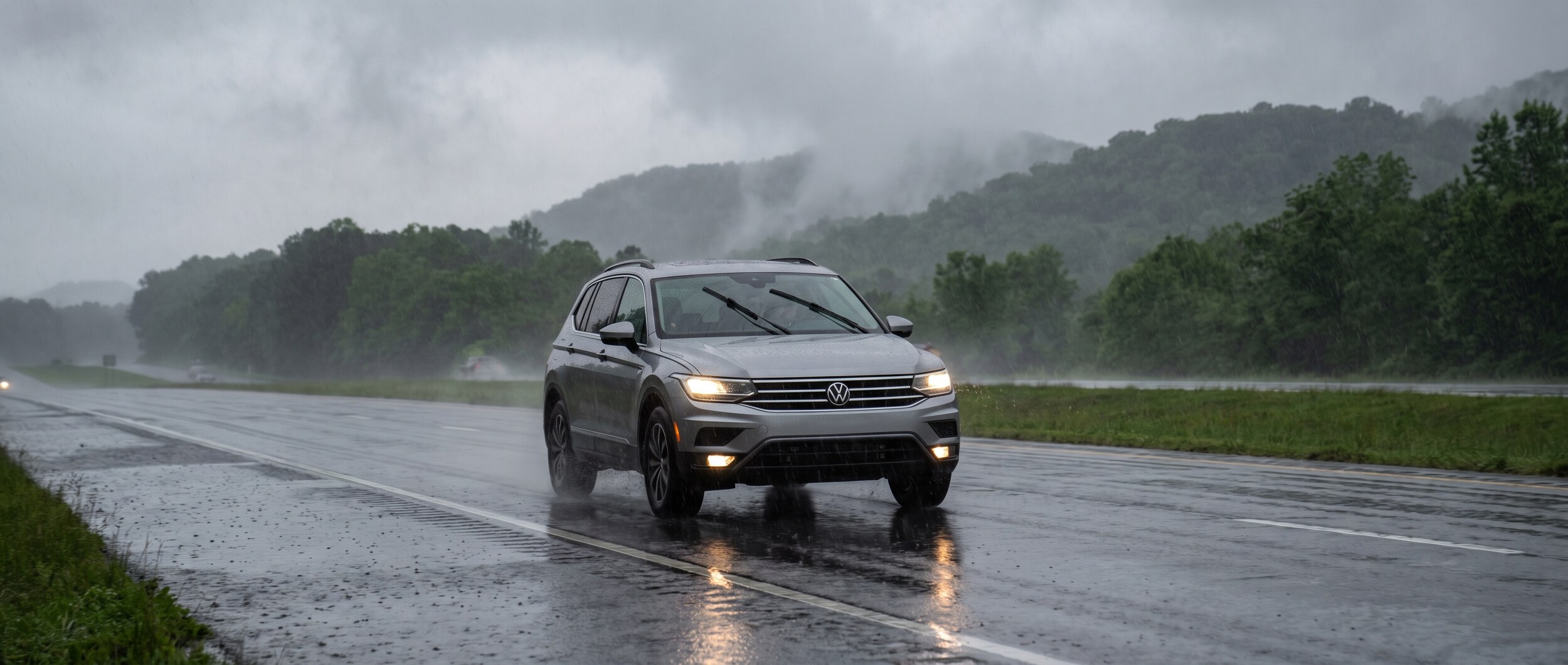
September 2024 made something clear to everyone who drives the Upstate. Greenville isn't a coastal city, but it doesn't get a pass. Hurricane Helene's rain bands dropped between 8 and 24 inches of rain on Upstate South Carolina, per the National Weather Service's Greenville-Spartanburg office. Greenville County alone logged 258,688 power outages. Roads flooded. The I-85 corridor backed up. And if your car wasn't ready for that kind of soaking, you knew it fast.
So before another system tracks inland this season, our team wants you to know one thing. Not every Volkswagen handles those conditions the same way, and the gap between them is wider than a spec sheet makes it look.
The short version
- The 2026 Volkswagen Taos is the most fuel-efficient pick and the right starting point for budget-conscious drivers who want optional 4MOTION AWD.
- The 2026 Volkswagen Tiguan is the sweet spot, with more power, available 4MOTION from the base S trim, and rain-sensing wipers with heated washer nozzles standard across the board.
- The 2026 Volkswagen Atlas is the family hauler that can manage any passenger load through a rain band, with 4MOTION available on all trims and 5,000 pounds of tow when the weather clears.
- All three have 4MOTION available, but the FWD variants are still capable in rain, provided your tires are in good shape.
- One tradeoff worth naming is that 4MOTION adds real wet-road confidence, but it doesn't replace good tires or good judgment when water is standing on the road.
How Do These Three Volkswagens Actually Compare in Wet Conditions?
All three are engineered for wet-road confidence, and any of them will get you through a Greenville downpour, but they aren't identical, and those differences steer toward different Upstate drivers depending on how many passengers you carry and how much rain exposure you plan for.
Volkswagen's 4MOTION system is an on-demand all-wheel-drive setup. Under normal conditions it sends power mostly to the front wheels for efficiency. Traction drops, say your front tires hit standing water on I-85 or a slick patch coming off the I-385 interchange, and it redistributes torque rearward on its own, no input from you. That redistribution happens before you feel the problem. Below, the table shows where each model lands on the criteria that matter when a slow-moving tropical band parks over the Upstate.
| Criterion | 2026 Taos | 2026 Tiguan | 2026 Atlas |
|---|---|---|---|
| 4MOTION AWD available? | Yes (optional on all trims) | Yes (optional S-SE; standard on SEL R-Line Turbo) | Yes (optional SE/SE w/ Tech; standard upper trims) |
| Base engine output | 174 hp / 184 lb-ft torque | 201 hp / 207 lb-ft (FWD) | 269 hp / 273 lb-ft |
| EPA mpg (FWD / AWD combined) | 31 / 28 | 29 / 25 (approx.) | 23 / 22 |
| Rain-sensing wipers? | Standard | Standard (heated washer nozzles too) | Standard |
| Seating capacity | 5 | 5 | 7 (3-row) |
| Best for | Commuters, value shoppers | Couples, small families | Large families, towers |
The EPA rates the front-wheel-drive 2026 Taos at 28 city / 36 highway / 31 combined mpg, and the 4MOTION version at 25 city / 33 highway / 28 combined. For the Tiguan, the EPA puts the FWD model at 26 city / 34 highway, and the 4MOTION version at 22 city / 30 highway. The 2026 Atlas FWD earns an EPA-estimated 20 city / 27 highway / 23 combined, with AWD models ranging 19-20 city / 25-26 highway depending on trim.
Does 4MOTION Actually Help in Rain, or Is It Mostly a Snow Feature?
Yes, 4MOTION genuinely helps in heavy rain and not only on packed snow, and the payoff is real on wet pavement, but it works alongside your tires rather than replacing them, so think of it as one layer of grip and not the whole answer. When Volkswagen's system detects front-wheel slip on wet pavement, it shifts torque rearward to stabilize your takeoff and cornering. Where you notice it is on flooded underpasses and rain-slicked on-ramps, the spots that turn treacherous during a tropical rain band. You feel steadier through the corner.
4MOTION is not a substitute for tread depth. AAA notes that just one-twelfth of an inch of water at speeds above 35 mph can cause tires to lose traction entirely. AWD with bald tires still hydroplanes.
The tradeoff is worth stating plainly. If your tires have worn tread, adding AWD won't save you. The system can redistribute power, but it can't create grip on a slick surface the rubber can't hold. A well-maintained FWD Taos on good all-season tires will outperform a neglected 4MOTION Tiguan in a downpour. That isn't a reason to skip AWD, just a reason to keep both in shape.
Check your tread with the quarter test. Slide a quarter upside down into the tire groove, and if you can see the top of Washington's head, your tires are due for replacement. Do that now, not during the next warning.
The Tiguan's rain-sensing wipers earn a specific mention here. From the base S trim, the 2026 Tiguan includes rain-sensing wipers with heated washer nozzles. In a sudden tropical downpour, the kind that goes from dry road to zero visibility in 90 seconds on I-26, that automatic adjustment isn't a luxury. It keeps your hands on the wheel and your eyes forward instead of fumbling with a stalk.
Schedule a Wet-Weather Inspection
Which Volkswagen Fits Your Upstate Rain-Season Driving?
The right pick depends on how you use the vehicle and how much rain exposure you're realistically planning for, so there's no single winner here, only a best match for your household size, your commute, and whether you ever tow.
The 2026 Taos makes sense if you're a solo commuter or couple driving I-385 into Greenville every day and you want the option to add AWD without jumping into a larger footprint. Of the three, it's the lightest and most fuel-efficient. The FWD base handles normal heavy rain just fine. Add the 4MOTION variant for extra confidence during tropical events, and you've got a compact SUV that takes the Upstate's summer storm pattern in stride.
The Tiguan is the pick we'd point most Upstate families toward right now. Its 2.0-liter turbo produces 201 horsepower in base configuration and steps up to 268 horsepower in the SEL R-Line Turbo trim (with 4MOTION standard on that top trim). Those rain-sensing wipers and heated washer nozzles from the S trim are a real functional advantage in Greenville's July-through-October tropical window. Visibility matters, full stop. It also seats five with a genuinely useful cargo area, so it covers school-run and quick-evac-route duty equally well.
The Atlas is built for the family with real cargo to move during a storm. Three rows, seven seats, and the ability to tow up to 5,000 pounds when properly equipped (per Volkswagen) means this is the SUV for the household that might also have a trailer, a boat, or gear to relocate when weather forecasts escalate. Across all trims, the 2026 Atlas runs the same 2.0-liter TSI engine at 269 horsepower and 273 lb-ft of torque, and 4MOTION is available on every trim in the lineup. For buyers who want AWD but haven't settled on a trim yet, that's real flexibility.
The concession worth naming is fuel. The Atlas drinks more than the Taos by a significant margin, and if you're mostly running a commute along I-85 toward Spartanburg with it rarely full of passengers, the size works against you every fill-up.
What to Check Before the Next Rain Band Arrives
Before the next system shows up, five checks do the most to keep you safe in a tropical rain band, and our service team confirms these are the ones that matter for the wet Upstate stretch from July through October, tires and wipers first.
- Tire tread depth and inflation. Worn tires are the single biggest risk factor in heavy rain. Check tread with a quarter, confirm pressure against your door-jamb sticker while the tires are still cold in the garage, and do it now before a system is in the forecast.
- Wiper blades. If your wiper leaves a streak or skips, replace it. Blades degrade faster in summer UV heat. The Volkswagen's rain-sensing system can't compensate for a blade that isn't clearing glass cleanly.
- Brake condition. Wet stopping distances are longer than dry. If you've been hearing any brake noise or feeling any pedal softness, get it looked at before the season peaks.
- Lights: front and rear. South Carolina law requires headlights on when wipers are in use. Make sure your taillights and brake lights are working, because the driver behind you in a heavy rain band is relying on them.
- Emergency kit in the cabin. A flashlight, phone charger, and a small bag of essentials belong in the car from now through November. If a flooded road forces you to wait it out, you want those things reachable.
Pick by Need: Your Upstate Hurricane-Season Guide
Match the SUV to the need and the choice gets simple, so weigh efficiency against the full wet-weather feature set against three rows and towing, and the three Volkswagens sort themselves out cleanly for a Greenville hurricane season. The Taos fits if you want efficiency first and occasional-AWD confidence second. Choose the Tiguan if you want the complete wet-weather feature set (rain-sensing wipers, heated nozzles, 4MOTION access from the base trim) in a size that feels manageable every day. The Atlas fits if your household needs three rows and you want the towing capacity for the days when storms clear and a weekend trip can happen.
None of these is a bad call for Greenville's climate. The real mistake is rolling into August with worn tires and cracked wiper blades and assuming the engineering will cover the maintenance gap. It simply won't.
Frequently Asked Questions
Does Volkswagen 4MOTION AWD help in rain, or is it mainly for snow?
4MOTION is genuinely useful in heavy rain, not just cold-weather conditions. The system continuously monitors wheel traction and redistributes torque from front to rear the instant it detects slip, including on wet pavement during tropical rain bands. That said, it works in combination with your tires, not instead of them. Worn or underinflated tires will still hydroplane regardless of drivetrain.
Which 2026 Volkswagen SUV is best for the Upstate's hurricane season?
The 2026 Tiguan is the most complete wet-weather package for most Upstate drivers, with available 4MOTION from the base S trim, rain-sensing wipers with heated washer nozzles standard, and a 201-horsepower turbocharged engine that handles Greenville's stop-and-go flooding traffic without strain. Families who need three rows should consider the Atlas, and budget-focused commuters will find the Taos more than adequate with proper tire maintenance.
Categories:
Social