
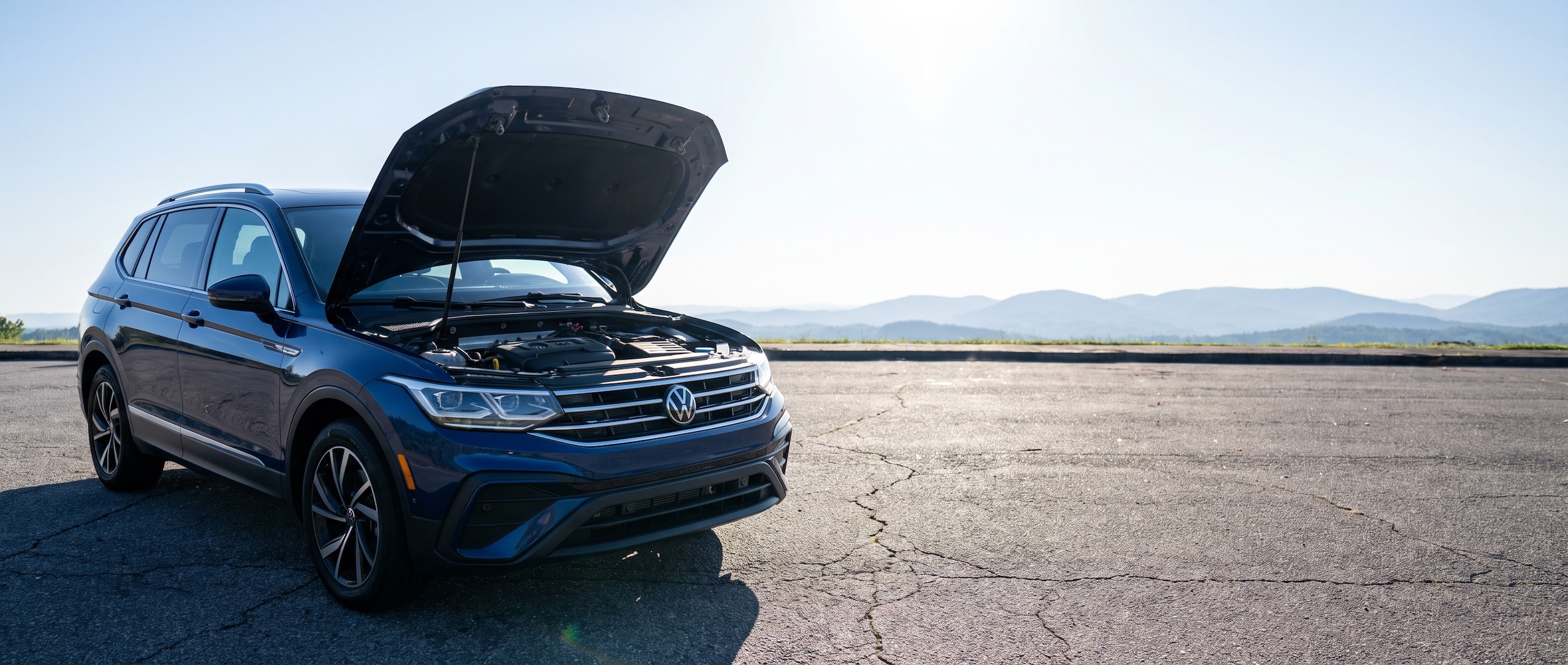
Greenville's July heat is not a gentle inconvenience. According to NOAA climate normals for the Greenville-Spartanburg area, July is the hottest month of the year here, with average highs reaching 90F and 2026 forecasts showing days touching 100F. When you park your VW on black asphalt after a morning errand and come back twenty minutes later to a long, cranky crank before it catches -- that is heat soak at work, and it is a real, explainable mechanical event with a real solution hierarchy. Understanding what tier of your VW's engineering addresses it is the most practical thing you can do before another Upstate summer day turns a quick stop into a frustrating one.
The 2026 Volkswagen Tiguan sits at the center of this conversation, but the principles apply across the entire lineup -- from the Jetta to the Atlas.
What Does "Heat Soak Start" Actually Mean at Each Stage?
Heat soak is not just "the car is hot." It is a specific sequence of events that happens in the roughly 10 to 30 minutes after you shut down a fully warmed engine in extreme ambient heat.
When the engine is running, coolant circulation, airflow through the grille, and the cooling fans keep everything in balance. The moment you turn the key off, all three stop. The residual heat trapped in the block, exhaust manifold, and turbochanger has nowhere to go fast. Under-hood ambient temperatures can spike well past 200F during this soak window, with Greenville asphalt itself reaching upward of 145F and pre-heating the air being pulled into the engine bay from below.
Three specific systems are affected in ways that a cold morning start simply would not trigger:
| VW System Affected | What Happens During Heat Soak | What You Feel at Restart |
|---|---|---|
| Fuel rail pressure | Residual heat causes fuel in the rail to expand; pressure drops below reliable injection threshold | Extended cranking before the engine catches |
| Crankshaft or camshaft position sensor | Sensors that function normally when cool can lose signal quality as heat builds after shutdown | Intermittent long cranks, occasional stall-then-restart pattern |
| Engine coolant temperature (ECT) sensor | A heat-stressed sensor can report the wrong temperature to the ECU, delivering the wrong fuel mixture | Rough idle for a few seconds after it finally fires, possible rich smell |
| Battery and starter circuit | Electrical resistance rises with heat; a battery carrying marginal capacity at 75F is noticeably weaker at 110F | Noticeably slower crank speed, harder starts only in high heat |
| Turbocharger heat mass (EA888 engine family) | The turbo housing stays extremely hot; heat conducts into nearby intake and fuel lines | Intake air temperature spike on restart, slight power lag until airflow normalizes |
The 2026 Tiguan's standard EA888 2.0T engine (producing 201 horsepower in S through SE trims, and 268 horsepower in the SEL R-Line Turbo) is a sophisticated, well-engineered unit. None of this means VW builds a fragile product -- it means Greenville summers create thermal loads that reveal the value of certain features more clearly than milder climates ever would.
Smart Ownership Choices That Reduce Heat Soak Exposure
Prevention is simpler than diagnosis. The single most effective tool available to a Greenville VW owner is shade -- covered parking, a carport, or a parking structure reduces the under-hood peak temperature substantially by removing direct solar load. But for drivers who park at exposed lots along I-85, or spend mornings at the trails at Paris Mountain State Park before a midday restart on baking gravel, the thermal environment is simply unavoidable.
That is where trim-level features start earning their keep in a way that is hard to quantify in a brochure but impossible to ignore on a 95-degree Tuesday.
Pre-conditioning is the clearest VW answer to heat soak. The remote start feature available on the 2026 Volkswagen Taos SE and above, and on the 2026 Tiguan SE and above, lets you run the engine and air conditioning from inside your home or office before you ever open the door. This does two things simultaneously: it begins moving coolant again (actively dispersing the heat soak that built up during the shutdown window) and it pre-cools the cabin so the A/C is not fighting a 140F interior when you need full concentration for the first few minutes of driving.
The Volkswagen Climatronic three-zone climate control system -- standard on the 2026 Atlas SE per Volkswagen of America -- pairs with ventilated front seats to manage cabin temperature rapidly. On a car without ventilated seats, the driver's body heat plus a soaked interior can mean the A/C is still catching up ten minutes into a drive. The cabin thermal load indirectly stresses the electrical system (compressor draw) at the same time the battery is managing a heat-stressed restart.
For owners who use their VW in stop-and-go Greenville traffic -- particularly the midday I-385 run between downtown and Simpsonville, where idling at stoplights in direct sun is unavoidable -- the stop-start system on the 2026 Tiguan SEL R-Line Turbo deserves a note. Volkswagen lists the system as refined for 2026, and when the battery is in good health, it manages the restart cycle quickly. A heat-weakened battery is the first thing that makes stop-start feel sluggish, so battery state is worth checking at each service visit once a VW crosses into its third or fourth Upstate summer.
The 2026 Volkswagen Atlas is worth calling out for families doing longer hauls -- weekend runs down I-26 to the coast, or the climb toward Caesars Head State Park at 3,208 feet in elevation. At highway speeds, the thermal environment normalizes quickly because ram-air cooling resumes. The heat soak scenario is specifically a short-stop problem: gas station, school pickup, a grocery run. Longer drives in a well-maintained Atlas with a healthy cooling system simply do not create the same restart conditions.
The 10-to-30-minute window after a hot shutdown -- before the engine cools to ambient -- is when heat soak restart difficulty peaks; remote start and pre-conditioning during that window are the most direct engineering answers available on the 2026 VW lineup.
The Smart-Choice Tier Guide: VW Features by Heat-Soak Relevance
Different buyers have different exposures. Not every VW owner needs the top trim to manage Greenville heat sensibly -- but knowing which features do the real work helps you choose the tier that fits your actual driving pattern, not just the one that looks impressive on a window sticker.
| VW Model / Tier | Key Heat-Relevant Feature | Who Benefits Most in Greenville |
|---|---|---|
| Jetta S | Reliable 1.5T with efficient thermal management; no remote start | Commuters with covered parking; lower heat soak exposure |
| Jetta SE | Remote start added; 15-watt wireless charging | Daily commuters parking in surface lots along I-85 |
| Taos SE | Remote start; available 4Motion AWD; 1.5T producing 174 hp (2026, per VW) | Single drivers, young families; exposed lot parkers |
| Tiguan SE | Remote start; power liftgate; MIB4 infotainment with IQ.DRIVE safety suite | Compact SUV buyers doing school runs and weekend trails |
| Tiguan SEL R-Line Turbo | 268-hp EA888 evo5 engine; 4Motion standard; refined stop-start; sport suspension | Enthusiasts and commuters who want maximum restart confidence plus performance |
| Atlas SE | Three-zone Climatronic; ventilated front seats standard; remote start with SE Technology | Families; longer hauls; the most heat-load management standard at this tier |
| Golf GTI S | Sport-tuned 2.0T; 12.9-inch display; no remote start at base | Enthusiast buyers with access to shaded or garage parking |
| Jetta GLI Autobahn | Eight-speaker audio; upgraded tech; performance-oriented packaging | Enthusiast sedan buyers who want GTI character in a trunk |
No dollar amounts belong in this conversation -- value is what you get per real-world mile, and in Greenville's July heat, a remote start that pre-conditions your cabin and begins coolant circulation during the heat soak window delivers something a higher trim sticker on a shaded garage car simply does not need to.
Schedule a Service Appointment
Why Your Service Cadence Matters More in Upstate Summers
The heat soak problem is partly a thermal physics problem. It is also partly a maintenance problem. Three service items directly affect how well your VW handles the Upstate heat cycle:
Battery health. Electrical resistance rises with heat. A battery at 80 percent capacity handles a cold Minnesota morning fine, but may not spin the starter fast enough to satisfy the ECU's hot-start RPM window on a 95-degree Greenville afternoon. VW recommends battery testing at regular service intervals; the Steve White VW service center uses diagnostic tools that give a real state-of-health reading, not just a voltage snapshot.
Coolant condition. Per published engine service intervals, coolant should be checked and flushed on schedule. Degraded coolant raises the effective boiling point, reduces heat transfer efficiency at the radiator, and allows localized hot spots in the cylinder head to develop more easily. A car that runs fine in November can begin showing heat-soak cranking behavior in July simply because the coolant has absorbed contaminants over two or three years.
Sensor health (crankshaft and camshaft position sensors). These sensors are heat-cycle items. They function perfectly for years, then reach a threshold where heat causes them to lose signal quality. The symptom -- extended hot-start cranking that clears on a cold morning -- is one of the more common heat-related patterns the service team sees coming out of Upstate summers. An OBD diagnostic during a service visit can flag a stored code long before the sensor causes a no-start event.
The Steve White VW service center on Duvall Drive performs these checks as part of routine maintenance. Catching a degrading sensor or a marginal battery in spring saves a frustrating parking lot experience in July.
Frequently Asked Questions
Why does my Volkswagen crank longer on a hot afternoon than a cold morning?
A cold engine starts with a well-pressurized fuel system, sensors reading accurate temperatures, and a battery at full electrical output. When you shut a hot engine down and restart it 15 to 30 minutes later, residual heat inside the engine bay can cause fuel pressure to drop below the reliable injection threshold, cause temperature sensors to read incorrectly, and raise electrical resistance in the starter circuit. The ECU needs accurate crank speed and temperature data to time fuel injection correctly -- if any of those signals are degraded, the engine takes longer to fire. This is heat soak, and it is normal engine physics. A well-maintained VW with a healthy battery, clean coolant, and functioning sensors handles it with minimal drama. A VW with a marginal battery or aging sensors will show the symptoms more clearly in Greenville's July heat.
Which 2026 VW features do the most to prevent heat soak restart issues?
Remote start is the most direct answer -- it lets you pre-condition the cabin and resume coolant circulation during the peak soak window before you ever get in the car. It is available on the 2026 Tiguan SE and above, the 2026 Taos SE and above, and the Atlas SE with Technology package. Beyond remote start, three-zone Climatronic climate control (standard on the 2026 Atlas SE) and ventilated front seats reduce the cabin thermal load, which reduces the demand on the electrical system at restart. And consistent maintenance -- battery health, coolant quality, and sensor checks -- is the foundation that makes any trim level perform reliably through an Upstate SC summer.
Categories:
Social