
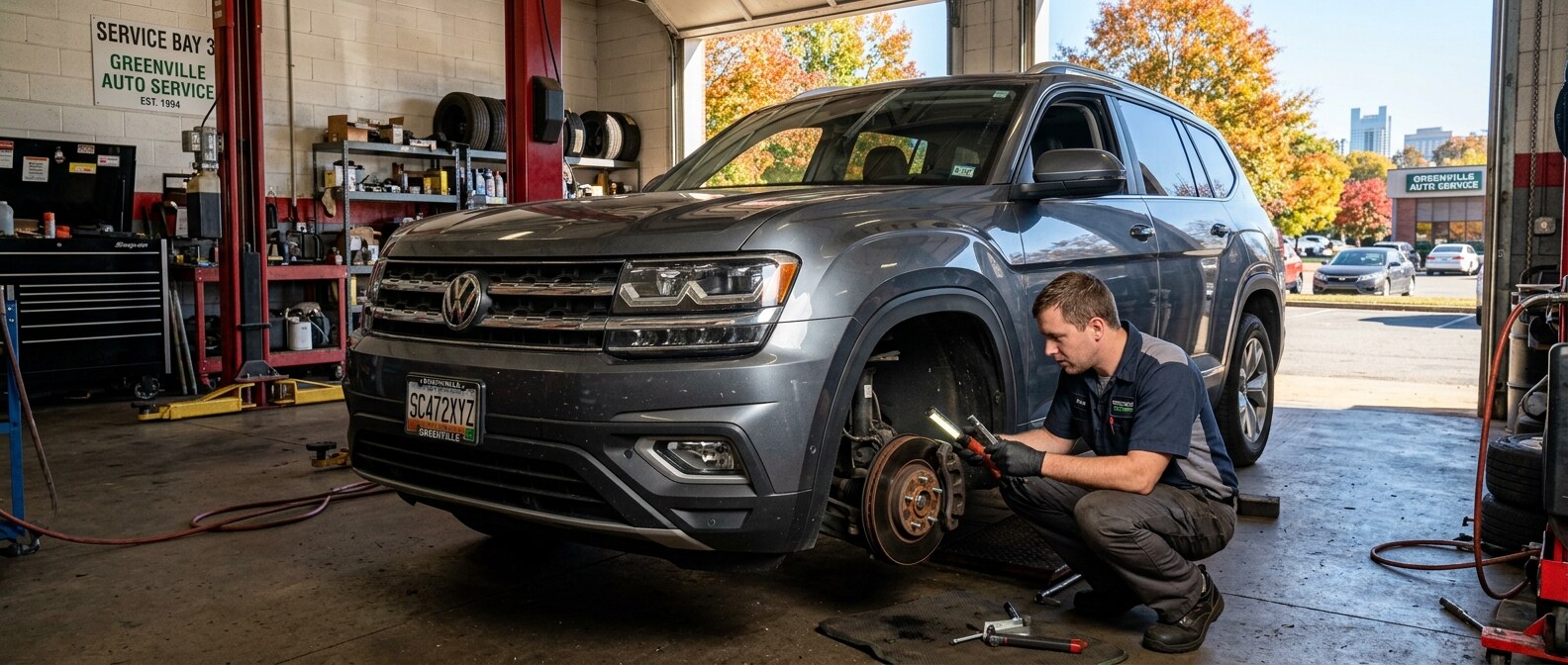
A high-pitched squeal when you slow for a red light on Wade Hampton Boulevard probably registered as background noise last Tuesday. Loaded up with luggage and family, braking from highway speed on I-85 as holiday traffic stacks at the I-385 interchange, you'll find it a lot harder to ignore. Brakes almost always warn you before they fail. The question is whether you know what the warning means.
What's the short version? Squealing usually means you have time, grinding means you've run out of it, and a soft pedal is a hydraulic problem that needs attention now. The full picture is worth understanding, though, because holiday driving changes the math on every one of these symptoms.
Schedule your pre-holiday brake inspection at our service center
What's Actually Going On in There? A Symptom-to-Cause Breakdown
Brake systems talk to you through three channels, sound, feel, and the dash lights, and each one carries a different part of the story, which is why a squeal and a soft pedal are never the same problem even if they both reach you through the pedal underfoot.
| Symptom | Likely Cause | What It Means | Urgency |
|---|---|---|---|
| High-pitched squeal when braking | Wear indicator contacting rotor | Pads approaching 3mm. Service threshold | Inspect within 1-2 weeks |
| Metal-on-metal grinding | Pad material fully worn through | Rotor damage underway; costly if left | Inspect this week |
| Soft or spongy pedal | Air in brake lines or fluid leak | Hydraulic problem; most urgent symptom | Do not delay |
| Steering wheel pulls when braking | Stuck caliper or uneven pad wear | Uneven braking force across axle | Inspect within days |
| Pulsing or vibrating pedal | Warped rotors | Reduced rotor contact patch | Inspect before long drive |
| Brake warning light on dash | Low fluid, ABS fault, or parking brake | Multiple possible causes; needs diagnosis | Same day |
One note on that table is worth adding: the top two rows describe mechanical wear you can anticipate and plan around. The hydraulic issues (soft pedal, warning light) sit in a different category, and they deserve their own section.
Pad Wear Is the Most Common Issue, and the Numbers Actually Tell You Something
Most front brake pads start life at around 10 to 12 millimeters thick, and the service threshold where manufacturers recommend scheduling replacement sits at 3 to 4mm, so you've got real planning room there, but under 2mm is the absolute mechanical minimum and the metal backing plate is approaching direct contact with the rotor surface.
Knowing that number helps. You won't be measuring your own pads in the driveway, but when our service team tells you you're at 3mm, you now understand what it means. You're at the planning stage. At 2mm, you've reached the emergency stage.
Atlas families loading up for Thanksgiving should know that a full vehicle (adults, luggage, gifts) increases the braking force the front pads absorb on every deceleration. Standard factory brake systems are built around normal passenger loads and everyday driving patterns. Add significant weight and you're asking for more heat and friction per stop. If you're already at 3mm, this isn't the week to find out.
Tiguan drivers doing regular Greenville commutes should check how much of that driving is short, repeated stop-and-go. The kind of braking you get on Woodruff Road or in the I-85 corridor approaching the I-385 interchange wears front pads faster than steady highway miles, because the pads never get a full cool-down between applications.
Rotors are their own story. A warped rotor produces the pulsing pedal feel drivers describe as the pedal "breathing" underfoot. Rotors warp from repeated hard heating and uneven cooling cycles. The minimum thickness specification is stamped directly on most rotors, and below that number, resurfacing is off the table and replacement is required. That's why a grinding noise left unaddressed for months tends to generate a substantially larger repair bill, since the rotor gets machined past its safe threshold and can no longer be saved.
Brake pads are at their service threshold at 3-4mm and should be replaced before reaching 2mm, where the metal backing plate risks direct contact with the rotor surface.
The Soft Pedal Is the One You Don't Wait On
A soft or spongy pedal is the one symptom here you don't schedule around, because while squealing pads give you a week or two of runway, a sinking pedal points to air in the hydraulic lines and can slide from slightly soft to floor-level without much warning in between.
A slightly spongy pedal is easy to read as low fluid you'll just top off, and that's the wrong read.
A spongy or sinking pedal tells you there's air in the brake hydraulic lines. When you press the pedal, you're compressing brake fluid, which, being a liquid, doesn't compress. That incompressibility is exactly how the force transfers to the calipers. Air compresses. So a spongy pedal means part of your pedal travel is squishing a pocket of air rather than generating stopping force at the wheel. The vehicle still stops, but with reduced responsiveness. A hydraulic problem can move from "slightly soft" to "pedal on the floor" without a lot of warning in the middle.
Brake fluid is hygroscopic. It pulls moisture from the air through the lines and seals. DOT 4 fluid (which Volkswagen vehicles specify) has a dry boiling point of around 446 degrees Fahrenheit when fresh. As it absorbs moisture over time, that wet boiling point drops, down to around 311 degrees Fahrenheit once fully moisture-saturated. That lower boiling point matters under sustained heavy braking, when fluid temperatures climb and vapor pockets become more likely. Most manufacturers recommend a fluid flush every two to three years for exactly this reason.
A red BRAKE warning light can point to low fluid level, a detected pressure anomaly, or a parking brake that's still engaged. Check the parking brake first. If that's not it, our team needs to look at it before you get on I-385 headed toward Columbia for the holiday.
Schedule a Pre-Holiday Brake Inspection
DIY vs. See the Service Team: Where the Line Actually Is
Some of this you can genuinely do from your own driveway, and some of it needs a lift and trained eyes, so the useful split is between what a fluid check and a visual on the outer pads will tell you and what only a measurement on a service lift can confirm.
What you can check at home. Fluid level in the reservoir gives you a rough read. The reservoir sits under the hood, clearly labeled on the cap. Visibly low fluid is useful information. Looking through open alloy wheel spokes can sometimes let you eyeball the outer pad. If the friction material looks thinner than a few stacked coins, you're in the range where a measurement matters. And listening carefully is real information: a squeal that shows up every time you brake in dry conditions is different from one that fades after the first few stops on a wet morning.
What needs a lift and trained eyes. Inner pad wear is the one that catches people off guard. Pads don't wear evenly inside and out, and the inner pad often wears faster because of how the caliper piston pushes against it. You can't see it through the wheel spokes. A service lift is the only way to measure both pads accurately. The same goes for rotor thickness (measured with a micrometer against the spec stamped on the rotor itself), caliper slide pin condition, and fluid quality. None of that is accessible from the driveway.
Jetta drivers on a daily Greenville commute who haven't had an inspection in over a year can get the full read in one visit. Our service team measures both pads per wheel, checks rotor thickness, and assesses fluid condition. You'll see the whole picture, including the part you can't eyeball from the outside.
Checking your fluid level and doing a visual on the outer pads tells you something real. It doesn't tell you enough to skip a professional inspection before a long holiday drive. Think of them as two steps that work together, with the inspection doing the part your eyes can't.
The I-85 and I-385 interchange carries some of the heaviest traffic volumes in Upstate SC during the Thanksgiving and Christmas stretch. If you're hearing anything consistent (not a one-time squeak in the rain, but a sound that shows up reliably when you brake), get it checked before you're on that interchange with a full car. Steve White Volkswagen is on Duvall Drive in Greenville. Book a brake inspection and we'll give you a real measurement with an honest recommendation.
Frequently Asked Questions
How do I know if my brake squeal is the wear indicator or just wet brakes?
A wear indicator squeal stays consistent. It shows up every time you brake above a low speed, in dry conditions and wet, and it often quiets for a moment during a hard press of the pedal, then returns. A wet-brake squeal is different, showing up after rain or a car wash and fading within the first few stops once the rotor surface dries. If the squeal is there reliably on a dry day after normal driving, treat it as the wear indicator doing its job and telling you the pads are approaching the 3 to 4mm service range, so an inspection is due.
Does brake fluid actually need to be replaced, or is that a service upsell?
Brake fluid genuinely needs replacing. Glycol-based brake fluids (DOT 3 and DOT 4) are hygroscopic, meaning they pull moisture from ambient air through the hoses and seals over time. That absorbed water lowers the fluid's boiling point. Fresh DOT 4 has a dry boiling point around 446 degrees Fahrenheit, and once it's moisture-saturated, the wet boiling point drops to around 311 degrees Fahrenheit. Under sustained braking (think stop-and-go on I-85 during the holiday rush), degraded fluid is more susceptible to vapor pocket formation, which produces that spongy pedal feel. Most manufacturers set a two-to-three-year replacement interval for exactly this reason. If you don't know when yours was last flushed, that's the first question to ask at your next inspection.
Categories:
Social