
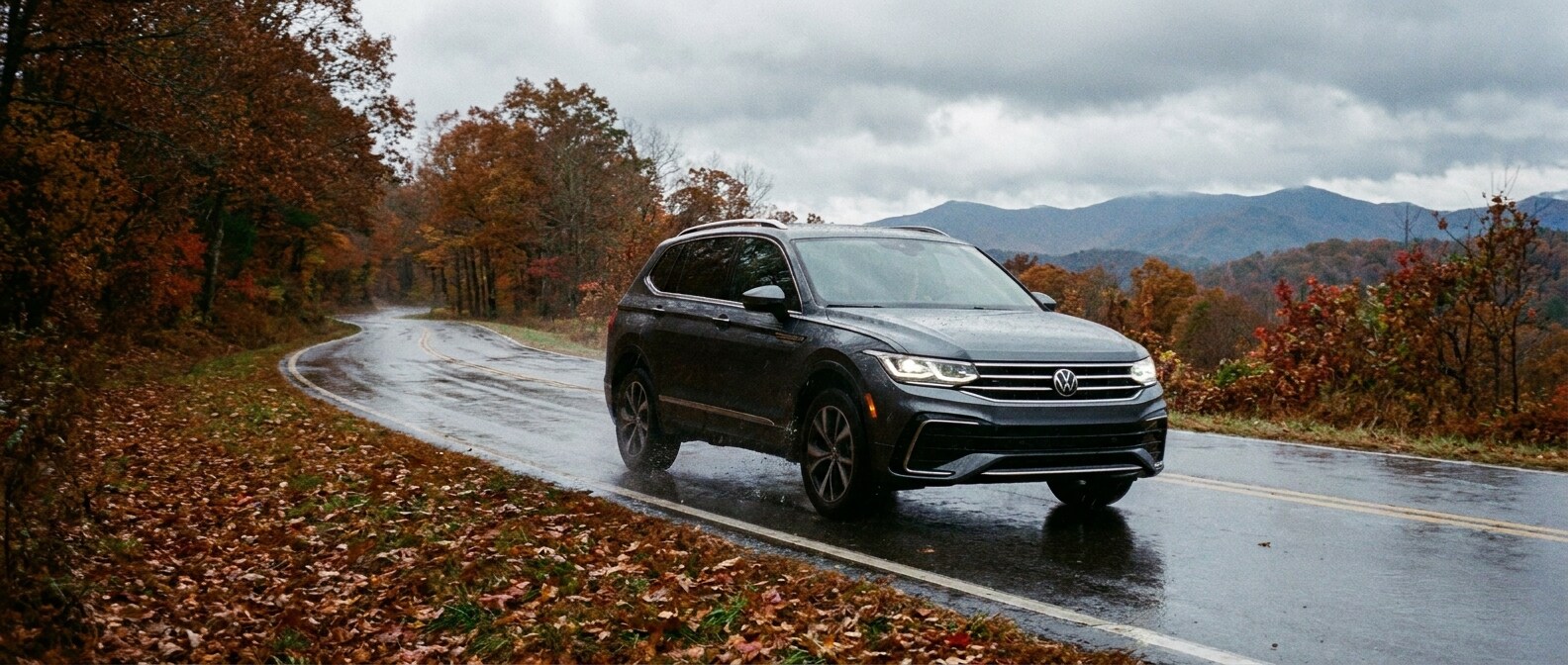
Greenville in November won't hand you a dramatic winter. You get something more specific and trickier. Average highs sit around 60 degrees F, lows brush 40 degrees F, and the month brings about nine rainy days. Cold. Wet. Not frozen. That gap between "not icy" and "fully safe" is where drivers misread what their Volkswagen SUV's 4MOTION actually does, and what it genuinely cannot.
Let me give you the corrected answer up front. 4MOTION is a real, predictive all-wheel-drive system that improves launch traction and stability on wet Upstate grades. What it doesn't do is shorten your stopping distance. That job belongs to your tires, full stop.
The 2026 Volkswagen Tiguan is a fair SUV to frame this around, so let's work through it properly here at Steve White Volkswagen.
The short version
- Myth: 4MOTION makes your Volkswagen SUV safe in any rain or cold, just drive normally.
- Reality: 4MOTION helps you accelerate and maintain stability on wet roads, but it does not reduce your braking distance. Tires determine that.
- Reality: Under normal dry or light-wet conditions, 4MOTION runs in a 90/10 front-bias and only engages the rear axle predictively when it detects impending slip.
- Reality: At Greenville's November lows near 40 degrees F, all-season tire compounds begin to harden and lose grip on cold-wet pavement, even before any frost appears.
- Reality: Snow mode in the Atlas and Taos adjusts throttle mapping and shifts earlier to reduce wheelspin. It is a traction aid, not a traction replacement.
Is "4MOTION means I'm covered" Actually True?
Partially true, and the part 4MOTION does cover isn't the part that gets people into trouble on I-85 in the rain. The system helps you put power down and stay planted on wet grades, yet it leaves your stopping distance almost entirely to your tires, which is where the real exposure sits during a cold Greenville downpour.
| Belief | What's Actually True | Source |
|---|---|---|
| AWD shortens my stopping distance on wet roads | Drivetrain does not change braking distance. NHTSA confirms braking distance on slick surfaces is unaffected by whether power goes to two or four wheels. | NHTSA winter-driving guidance |
| 4MOTION is always running all four wheels | Under normal conditions, 4MOTION sends roughly 90% of torque to the front axle. The rear engages predictively when sensors detect impending slip. | Volkswagen press materials |
| Snow mode is for snow only | The Snow mode of Volkswagen adjusts throttle tip-in and shifts the transmission earlier to reduce wheelspin. It's useful on cold-wet pavement in Greenville, not just snow. | Volkswagen 2026 Atlas press kit / 2026 Taos press kit (media.vw.com) |
| AWD makes tire condition irrelevant | An AAA study found tires worn to 4/32-inch tread on wet roads increased stopping distance of a passenger car by up to 87 feet compared to new tires. 4MOTION cannot compensate for that. | AAA / Consumer Reports tire traction study |
| All-season tires perform fine below 45 degrees F | All-season rubber begins to harden around 45 degrees F, reducing wet grip. At cold-wet 35 degrees F, braking distances with all-season tires can run roughly 16 feet longer than with winter tires from the same speed. | Comparative tire test data (35 degrees F cold-wet surface, 50-0 mph) |
That table is the whole post, really. Everything else explains why each row matters specifically on the roads around Greenville.
What 4MOTION Genuinely Does on Cold, Wet Upstate Roads
On cold, wet Upstate roads, 4MOTION does real work by pre-engaging the rear axle before your front tires slip, which steadies the SUV on grades and through hard merges, though it never touches how quickly you can stop. Let's be fair to the system before we correct the myth.
The 2026 Volkswagen Atlas and the Tiguan use a Haldex-style electronically controlled multi-plate clutch on the rear axle. It works predictively rather than reactively. When you plant the throttle merging from the I-385 ramp onto I-85 South in the rain, 4MOTION pre-engages the rear clutch before the front tires slip. You get a meaningful real-world difference on wet asphalt compared to a front-wheel-drive vehicle running the same tires.
The system can redistribute up to around 50% of torque rearward in conditions that demand it. On a wet uphill grade, on a painted highway lane marker in cold rain, on the kind of damp back-road pavement you meet heading toward Caesars Head State Park in November. 4MOTION earns its keep there.
The blunt truth is that 4MOTION won't stop you one foot sooner. We also tell customers that Snow mode isn't just for snowstorms. The press materials of Volkswagen spell it out. Activating Snow mode in the 2026 Atlas (and 4Motion-equipped 2026 Taos) adjusts throttle mapping to soften tip-in and shifts the eight-speed automatic earlier to minimize wheelspin. The Taos with 4MOTION includes Active Control with exactly that Snow setting. Greenville mornings in November, when the pavement is cold and wet but clear, are a reasonable time to use it.
4MOTION helps you get moving on wet Upstate grades and maintain stability in cold rain. It cannot help you stop faster. Those are two different physical problems, and drivetrain solves only one of them.
"NHTSA advises drivers to slow down and increase following distance because slick or snow-covered roads make vehicles harder to control or stop." National Highway Traffic Safety Administration winter-driving guidance
So What Should You Actually Do Before the Greenville Wet Season Settles In?
Focus on tires and following distance before the wet season settles in, because those two fix the braking gap that 4MOTION can't, while the drivetrain settings handle the traction side you're already fairly covered on. We see real preparation gaps here when customers come in for service.
The Atlas Cross Sport and every other Volkswagen SUV in our lineup ships from the factory on all-season tires. Those tires are a sensible compromise for most of the year. The complication is physics. All-season rubber is formulated to stay workable across a wide temperature range, but the compound begins to harden around 45 degrees F. Greenville's November lows average around 40-42 degrees F. That overlap isn't dramatic. We're not talking about an ice-driving scenario, yet it's real, and it shows up in stopping distance on cold, wet pavement.
An AAA-cited study found that tires worn to 4/32-inch tread on wet roads added up to 87 feet of stopping distance compared to new tires on the same vehicle. That figure comes before any temperature-related compound hardening. Add a 40 degrees F morning and damp pavement on I-26 heading toward the coast for a weekend, and your margin narrows further.
Four things actually move the needle.
- Check your tread depth now. The penny test is the minimum. The quarter test (Washington's head, tire level at the top of his head) is a better threshold for wet Greenville roads, leaving you near 4/32-inch.
- Use Snow mode when it's cold and damp, not just when it snows. For the Atlas and Taos with 4MOTION, Snow mode's earlier upshifts and softened throttle are designed for exactly this condition.
- Increase your following distance on the interstate. NHTSA is explicit here. AWD doesn't shorten stopping distance on slick surfaces. Add a full extra second to your normal gap on I-85 in the rain, minimum.
- Consider whether a dedicated winter tire set makes sense. Greenville averages about two snow days a year, so dedicated winter tires aren't a given. But if you run Caesars Head in November, or commute into the mountains regularly, a winter set on a second set of wheels is a legitimate option worth discussing with our service team.
Frequently Asked Questions
Does 4MOTION AWD help in Greenville rain, or is it mainly for snow?
4MOTION helps in both conditions, but differently. On wet Greenville roads, the system's predictive torque management improves launch traction and stability when accelerating on grades or merging at highway speeds. What 4MOTION does not do is reduce braking distance. That is determined by tire tread and compound, not by which wheels receive power. For Greenville's cold-rain conditions (November lows around 40-42 degrees F), the more impactful variable is tire condition and tread depth.
Should I use Snow mode on my Volkswagen SUV in Greenville when it's just rainy and cold, not actually snowing?
Yes, and Volkswagen press materials support that use. Snow mode on the 2026 Atlas and 2026 Taos with 4MOTION adjusts throttle tip-in to reduce wheelspin and shifts the eight-speed automatic earlier than normal. Cold, wet pavement without ice is exactly the condition the system is calibrated for, not just overnight snowstorms. It's a sensible default for damp Greenville mornings from November through February.
Categories:
Social