
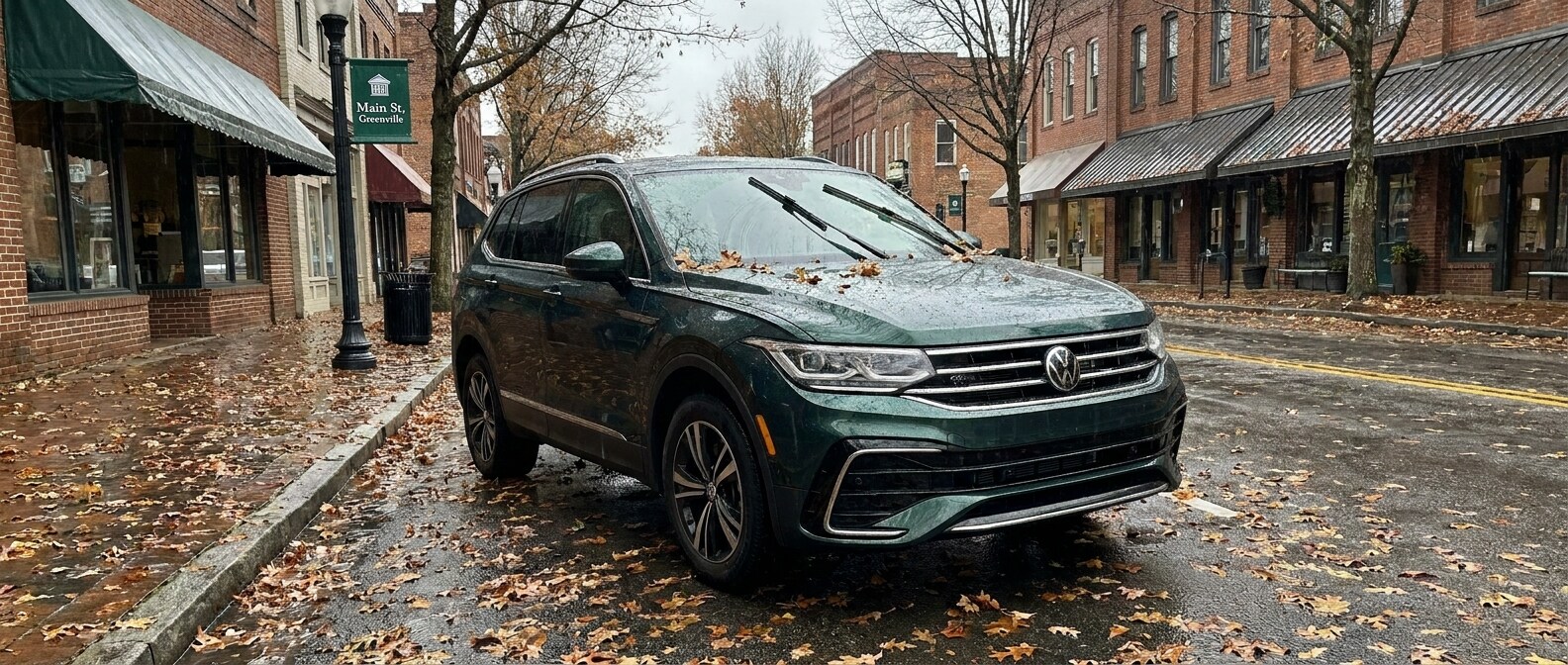
Greenville just logged its first frost of the season. Overnight lows are sitting in the low-to-mid 30s across the Upstate right now, and if your reservoir still holds summer-formula washer fluid, you're a few cold nights from that fluid freezing solid in your lines. Your wipers are probably a problem too. Nothing dramatic happened to them. A full Upstate summer did quiet, invisible damage to the rubber, and 34 degrees reveals exactly what five months of heat and UV took from a blade.
The good news is that both fixes take twenty minutes and cost almost nothing. We'll walk you through what you actually need to know, skipping the generic advice that ignores where you live.
Upstate SC winters run on freezing rain and black ice far more than deep snow. That specific pattern rewards a beam-style blade (no joints to freeze solid) and a washer fluid rated to at least -20F, because summer-formula fluid freezes around 32F, which is exactly where your overnight lows are sitting right now.
If you drive a Volkswagen Tiguan, an Atlas, a Jetta, or anything else on our lot, blade size and arm type vary by vehicle. Our service center can confirm the right fitment and handle the swap in one visit.
How Do Wiper Blades Actually Fail in Cold Weather?
Cold-weather blade failure isn't really about ice landing on the blade, though that's the visible symptom; the underlying failure mode depends entirely on which blade design you're running, and conventional frame blades and beam blades behave completely differently once temperatures drop into the 30s.
Conventional frame blades have a metal skeleton with hinged pressure points, typically six to eight of them, that push the rubber strip against the glass. In cold weather, those hinges sit exposed to water. When they freeze, the blade stops conforming to the curve of your windshield. You end up with one or two pressure points touching instead of eight, and you get a wide smeared band across the glass. Clearing it means getting out and knocking the ice out of the frame by hand.
Beam blades, also called flat or aero blades, have no external frame at all. The backbone is a single curved spring-steel element running the full length of the blade, spreading pressure continuously rather than at discrete joints. With no exposed hinges, there's nothing for ice to pack into and lock up. The blade keeps conforming to the glass even when the temperature drops into the 20s.
The comparison that matters for Upstate driving breaks down like this.
| Feature | Conventional frame blade | Beam blade |
|---|---|---|
| Pressure points | 6-8 fixed joints | Continuous along full length |
| Cold-weather joint freezing | Yes (hinges lock in ice or sleet) | No joints exposed to freeze |
| Conforms to windshield curve | Only when joints stay mobile | Always |
| Summer UV and heat effect | Rubber hardens; joints degrade | Rubber hardens; no joint failure |
| Best Upstate SC use case | Mild conditions only | Freezing rain, mixed precip, any temp |
The beam blade isn't just marketing hype. Modern Volkswagen vehicles come equipped with beam-style blades from the factory because they hold up consistently across seasons. If you swapped yours at some point for conventional framed blades, November is when you'll feel the trade-off.
Why does November expose this specifically? Upstate SC summers are brutal on rubber. UV radiation and sustained heat speed up the breakdown of the blade compound, and the rubber stiffens chemically before you ever spot a visible crack. A blade that felt fine in September, running through light rain on a warm afternoon, now drags hardened edges across a cold-curved windshield. None of that streaking is new damage. You're watching the summer's work finally reveal itself at the worst possible time.
Which Fluid Do You Actually Need in Greenville Right Now?
You actually need winter-rated de-icer fluid here, not the summer formula still sitting in a lot of Upstate reservoirs, and the swap catches drivers off guard because washer fluid looks like a plain commodity when it's really a formulation decision with a freeze point that counts in November.
Summer-formula fluid (and plenty of bottles marketed as "all-season" for warm climates) freezes around 32F, the same temperature as plain water. Greenville's overnight lows are already touching the low-to-mid 30s in mid-November, and elevations near Caesars Head and the Blue Ridge are dropping below freezing. Freeze that fluid in your reservoir or lines and you lose washer function completely. Freeze it mid-spray on your windshield and you lose visibility in a hurry. The expanding fluid can crack the plastic reservoir or chew up the pump lines too.
Winter de-icer fluid is rated to -20F or lower. Its active ingredient is methanol, which drops the freezing point of the water base sharply. According to published formulation data, a fluid rated to -20F runs roughly 35% methanol by volume. It stays liquid through everything Greenville throws at a vehicle from November through February. For most of the Upstate, a -20F rating is plenty, since overnight lows rarely dip below 22F in a typical Greenville winter. If you want more margin, fluids rated to -34F are easy to find.
Skip the shortcut of diluting pre-mixed winter fluid with water to stretch it. Adding even a small amount of water raises the freeze point noticeably, and according to published formulation data, that can turn a -20F solution into something closer to -5F protection. Buy the gallon. Fill it straight.
Volkswagen Atlas and Atlas Cross Sport owners running rear washers should check the rear reservoir on its own. It feeds through a separate circuit and needs the same winter-rated fluid as the front.
Schedule a Winter Service Check
A Quick Glossary: The Terms on the Packaging
| Term | What it actually means |
|---|---|
| Beam blade | Frameless wiper with a continuous spring-steel backbone; no exposed joints to freeze |
| Conventional blade | Traditional metal-frame design with hinged pressure points; standard fitment on most vehicles before the mid-2010s |
| Freeze-point rating | The temperature at which the fluid becomes non-functional; look for -20F or lower for Upstate SC winters |
| De-icer formula | Washer fluid with a high methanol or isopropanol content, formulated to stay liquid well below 0F |
| EPDM rubber | The synthetic rubber compound used in most OEM wiper blades; resists heat and cold better than natural rubber, but still hardens after prolonged UV exposure |
What This Means for Your Volkswagen at Our Service Center
Every vehicle that comes through our service center gets its wiper blades checked as a matter of routine, and what our team looks at isn't only whether the blade wipes but how the rubber edge meets the glass at the corners, since that's where UV hardening shows up first. A blade can clear the center of the windshield completely and still leave the bottom corners smeared. Wiper arm spring tension matters too. After a string of Upstate heat cycles, some arms lose enough tension that even a fresh blade won't seat with steady pressure.
For fluid, we drain and replace instead of topping off. Topping summer fluid with winter fluid won't deliver full -20F protection, because the leftover summer formula pulls the overall freeze point back up. A full drain and refill is the right call. It takes about five minutes.
If your Volkswagen Jetta, or any other model in the lineup, is due for an oil change or tire rotation, we can roll the wiper and fluid check into the same visit. No separate trip needed. Our service center sits at 100 Duvall Drive in Greenville, in the same Steve White Auto Group cluster as Audi Greenville and Volvo Cars Greenville.
Frequently Asked Questions
Does Upstate SC weather actually get cold enough for a blade and fluid change to matter?
It does, and the real threat isn't deep snow. Greenville's winter profile leans heavily toward freezing rain, sleet, and black ice rather than piling up snowfall. The National Weather Service records for Greenville-Spartanburg show the area's first freeze typically arrives around mid-November, and FOX Carolina reported the season's first widespread frost and freeze for the Upstate on November 15, 2026. Overnight lows run through the low-to-mid 30s from late November through February. That range is exactly where summer-formula washer fluid turns into a frozen liability and where conventional blade joints lock up. Beam blades and winter fluid earn their keep in a Southern winter. They're the right tools for Upstate conditions.
My wipers looked fine in September. Why are they streaking now?
The answer's that summer UV and heat do their damage invisibly. The rubber compound hardens chemically before you see physical cracks or splitting. A blade installed in the spring will have soaked up a full Upstate summer by October, and that hardened edge still looks intact. It fails under two conditions that land at the same time in November: colder glass stiffens the blade so it conforms less tightly to the windshield curve, and the first sustained rain of fall arrives. What felt fine on a warm September afternoon gives away its hardening the first morning you need the wipers in 38-degree drizzle on I-85.
Categories:
Social