
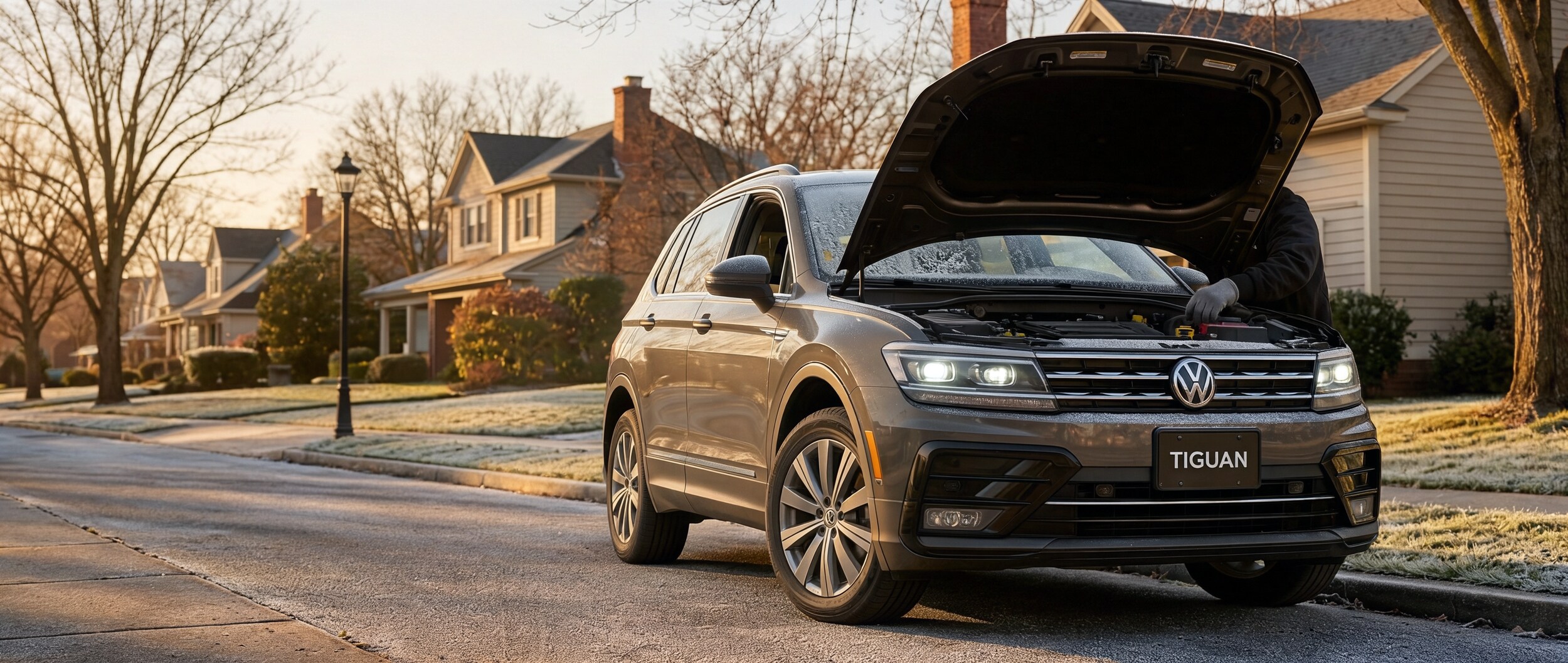
The short answer is simple. A slow, labored crank on a cold morning almost always signals a battery that has lost enough capacity to handle the double load of cold chemistry and thickened engine oil. It isn't a starter problem yet, and it isn't normal. Address it before the first hard freeze.
That sluggish "rrrr... rrrr... vroom" you heard pulling out this morning isn't Greenville's November air playing tricks. It's physics. Cold temperatures slow the electrochemical reaction inside a battery, reducing the current it can deliver at exactly the moment the engine demands more of it because cold oil moves like syrup through the block. A healthy battery shrugs that off. A battery that spent the summer cooking under the hood and quietly losing plate capacity struggles with it.
Schedule a battery check at our service center while the symptom is still a warning. It hasn't become a breakdown yet.
What's Actually Going On Under the Hood?
Cold weather doesn't kill a battery on its own, but it exposes the damage that Upstate SC summers already inflicted under the hood, which is why the first sluggish crank of the season tends to show up in late November rather than back in July. Here in Greenville, November average lows run around 42 degrees Fahrenheit, and the last week of the month routinely dips into the low 30s. That is enough of a temperature swing to reveal a battery that sailed through warm weather on borrowed capacity.
The table below maps the symptoms we see most on cold mornings to their likely causes, and what you'll want to do next.
| What you notice | What it likely means | What to do |
|---|---|---|
| Slow, labored crank; engine starts after a moment | Battery capacity is marginal; cold is exposing the gap | Have the battery load-tested soon |
| Single click or rapid clicking; no crank | Battery voltage has dropped too low to engage the starter | Jump-start and get a load test the same day |
| Car starts, but stop-start stops engaging | Battery health is declining; the system is protecting the battery | Load test; do not ignore this one |
| Crank is fine, but dashboard lights flicker at startup | Alternator may not be fully recharging the battery | Check the charging system, not just the battery |
| Starts normally all day but sluggish after sitting overnight | Parasitic draw is draining a marginal battery while parked | Charging system and parasitic draw test needed |
The second-to-last row deserves its own conversation, because it's the one that's easy to miss on a Volkswagen.
The Stop-Start System Is Your Earliest Warning Light
The Tiguan, Atlas, Jetta, Taos, and the rest of the current Volkswagen lineup with auto stop-start do something most vehicles don't, cycling the starter motor at every red light, and that's dozens of extra starts on a single commute down I-85. The system is smart enough to protect itself, and the quiet warning starts there.
When battery health falls below the threshold the car's Battery Management System considers safe, stop-start simply stops engaging. The engine idles through the red light as if the feature doesn't exist. No warning light, no message on the dash in many cases. Just silence where a brief engine-off used to be.
That silence is the system doing you a favor, telling you the battery can no longer absorb and release charge at the rate stop-start demands. Read that way, it looks like a software glitch or cold-weather quirk, and the car gets driven on for weeks. By the time the crank finally goes slow, that battery has been low for a while. The warning came earlier.
The practical point is simple. If your stop-start has gone quiet this fall, don't wait for a slow crank to confirm the diagnosis.
A note on Volkswagen battery chemistry. Not every AGM battery from an auto parts store is the right fit for a stop-start Volkswagen. These vehicles require a specific AGM specification, and after any replacement the car's Battery Management System needs to be registered to the new battery. Without that registration step, the charging system doesn't know the battery is new and may undercharge or overcharge it, shortening its life significantly. This is a documented requirement that generic battery guides never mention, not a dealership upsell.
On Volkswagen models with stop-start, a correct AGM replacement plus Battery Management System registration is what makes the new battery last.
DIY Swap vs. Letting Our Team Handle It
Our service center can run a proper load test before you spend anything on parts, and that first step matters because a battery can read an acceptable resting voltage and still fail the moment it's asked to hold that voltage under real starter load on a cold morning.
We'll draw the line honestly here. Swapping a battery isn't beyond a capable home mechanic. The tricky part, specific to Volkswagen vehicles, is what happens after the swap.
What you can reasonably do yourself:
- Clean visible corrosion off the terminals with a wire brush (it costs nothing and genuinely helps)
- Keep tabs on how the stop-start behaves over consecutive cold mornings
- Run a free test at any auto parts store to get a baseline voltage reading
What we strongly recommend doing with us:
- The load test itself, which requires calibrated equipment and takes about ten minutes
- The Battery Management System registration after any replacement, which needs diagnostic software wired to the car. A battery tester alone won't do it
- Verifying the alternator output at the same time, because a charging system fault will kill a new battery just as fast as the old one failed
The tradeoff is real. You can buy an AGM battery, install it, and have a car that starts. Skip the BMS registration, though, and the battery may degrade faster than it should, and you won't necessarily know why until the next cold snap.
Greenville's temperature swings in November can be significant. A morning in the mid-30s can appear without much warning, and a battery that's marginal in 42-degree weather won't handle 34 degrees gracefully.
Frequently Asked Questions About Volkswagen Batteries in Cold Weather
Why does my Volkswagen crank slowly in the cold but start normally later in the day?
Cold slows the electrochemical reaction inside the battery, reducing how much current it can deliver. As the morning warms up, the reaction speeds back up and the battery performs closer to its rated capacity. That afternoon-fine, dawn-sluggish pattern is a reliable sign the battery's cold-cranking capacity has slipped below where it should be. The battery is marginal rather than fine, and cold mornings are exposing that margin.
Does my Volkswagen need an AGM battery specifically, or will any replacement work?
Volkswagen models equipped with auto stop-start technology require an AGM battery by design. The stop-start system cycles the starter far more often than a conventional vehicle, and AGM chemistry handles those repeated charge-discharge cycles in a way a standard flooded battery can't sustain. Install the wrong type and it'll seem to work at first, but it'll degrade faster than you'd expect. Beyond battery type, the car's Battery Management System needs to be registered to the new battery after installation.
Can I jump-start my Volkswagen the normal way?
You can, with one important caveat. Modern Volkswagen vehicles carry sensitive electronics, and jump-starting with a badly positioned booster cable or an oversized power pack can spike voltage into the system. Use a jump starter rated for the vehicle, connect positive to positive and negative to an unpainted ground point away from the battery rather than directly to the negative terminal, and don't rev the engine hard once it fires. If the car needed a jump, treat that jump as the start of the diagnostic conversation, not the end of it.
Categories:
Social