
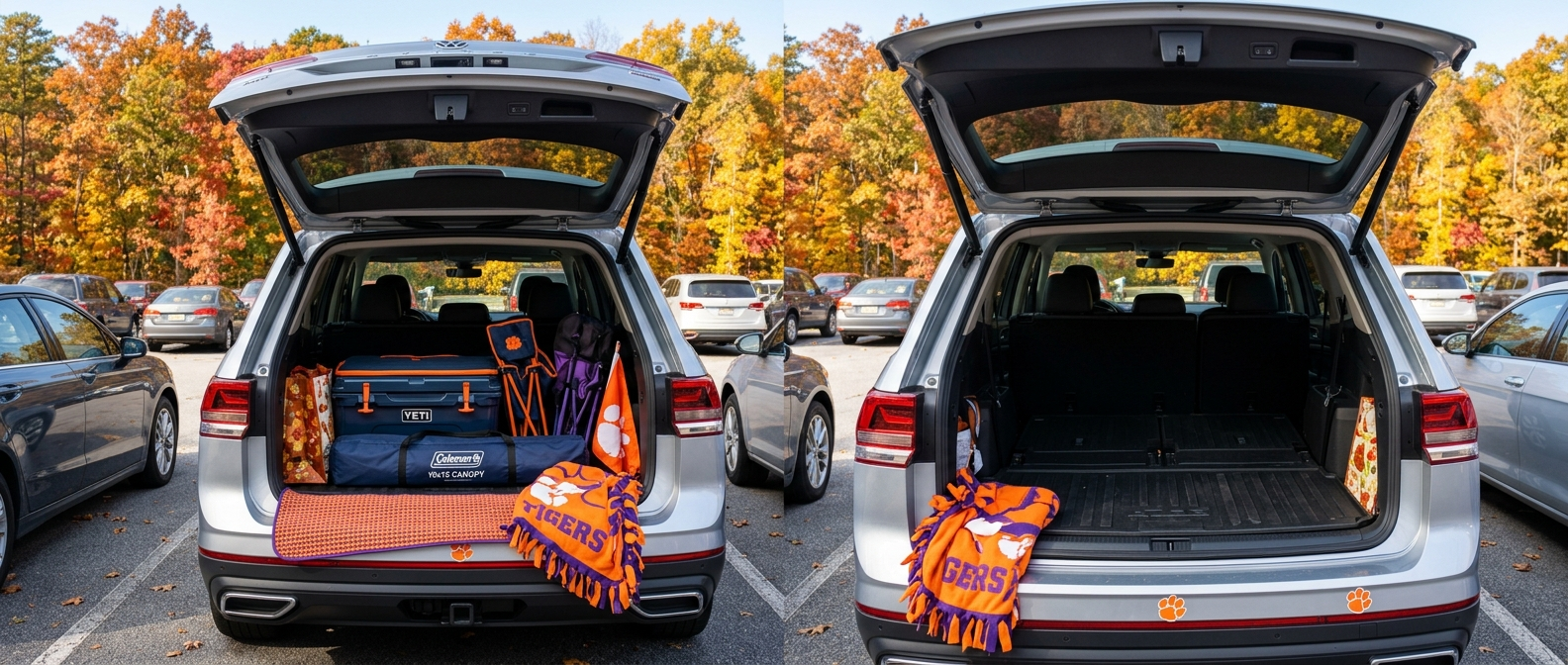
You've got the tickets. The cooler is half-packed. Then you open the back of your Atlas and find yourself playing a very stressful game of three-dimensional Tetris at 7 a.m. on a Saturday.
None of that chaos is necessary. The 2026 Volkswagen Atlas was built for exactly this kind of haul, and the gap between a messy load and a clean one comes down mostly to sequence. Do the seats first. Load in the right order, and know which items earn the floor and which ones go up top. Our team has walked through this setup with Atlas owners on the lot, and the most common mistake is jumping straight to throw-it-all-in-and-hope without taking 90 seconds to configure the cargo space first.
The payoff is real. Fold both rear rows flat and Volkswagen lists the Atlas at up to 96.6 cubic feet of cargo volume, enough space to hold a full-size cooler, a folding table, a six-person canopy, four chairs, and a bag of gear without anything stacked precariously on top of anything else.
The 2026 Volkswagen Atlas is the vehicle that makes an Upstate Saturday possible. So let's set it up, step by step.
The one step that matters most is folding the third row before you pack a single item, since it's nearly impossible to reach once a loaded cooler is blocking the rear hatch.
What You Need Before You Start
Check this against your list before you pull out of the driveway. The table covers the Atlas configurations and what each one buys you in real-world terms.
| Configuration | Cargo Volume | What fits |
|---|---|---|
| All three rows up | 20.6 cu ft | Small bags, a soft cooler, two small chairs |
| Third row folded (second row up) | 55.5 cu ft | Full-size hard cooler + chairs + one bag |
| Both rear rows folded flat | 96.6 cu ft | Full tailgate setup: cooler, table, canopy, chairs, all gear |
| Third row folded (one half only) | Partial rear floor | Two passengers in second row + cooler in the liberated side |
Gear checklist for a full four-person setup:
- Hard-shell cooler (100-qt or smaller fits cleanly)
- 10x10 canopy in carry bag
- Four folding chairs
- Folding table (half your second-row floor width when rolled)
- One gear bag (condiments, utensils, paper goods)
- Bungee cord or cargo net (optional but earns its space)
One trim note worth knowing now: the hands-free Easy Open power liftgate is not on the base SE. It arrives starting with the SE with Technology. If you're loading solo with both arms full of gear, that's a meaningful difference. More on this in Step 2.
Setting Up the Atlas: The Full Sequence
We ordered the steps below deliberately. The sequence matters.
Step 1: Clear the third row completely.
Before anything else, pull any items out of the third row. Kids' bags, jackets, anything. A third row loaded with miscellaneous items before you fold it means you're wrestling with it instead of folding it cleanly. The third row uses a 50/50 split-fold design, so you can fold just one side if you need to keep a passenger or two back there.
Step 2: Fold the third row flat.
Press the fold tab on the seatback and guide the cushion forward and down. Both halves fold independently. For a full haul, fold both sides. The seatback lays completely flat, flush with the cargo floor. Trim matters right here, and browsing Atlas trim options is worth the time. The SE with Technology adds the hands-free power liftgate, which means you can open the rear hatch with a foot kick under the bumper when your arms are loaded. That foot kick stops feeling like a luxury when you're alone with a 60-pound cooler at 8 in the morning.
Step 3: Decide whether you're folding the second row.
The honest tradeoff comes next. Fold the second row too, and you go from 55.5 cubic feet to 96.6 cubic feet. You gain a massive amount, and the floor sits fully flat from the front seatbacks to the hatch. But you lose all your rear passenger seating. If you're shuttling four people to the game after the tailgate, keep the second row up and let the 55.5 cubic feet do the work. For groups who drive separately to the lot, or who caravan with another vehicle, folding both rows is the move.
The second row uses a 60/40 split-fold. Fold the 60 side and keep the 40 side up, and you can seat one passenger while still running most of the extra floor length. Flexible.
Step 4: Load heaviest items first, closest to the rear seats.
The hard cooler goes in first, slid straight in from the hatch and pushed toward the second-row seatbacks (or the first-row seatbacks if both rear rows are down). Make that your anchor. Everything else distributes around it. The cooler goes in before the folding table so you're not lifting the cooler over a table that's already flat on the floor.
Check tire pressure before a long gameday run, too. Upstate fall temperatures in November can drop 20 degrees overnight, and that drops tire pressure roughly one PSI for every 10-degree Fahrenheit decrease.
Step 5: Load flat items along the floor, tall items against the seatback.
The canopy bag and folding table both lie flat on the cargo floor. Stack them parallel to the sides of the cargo area. Folding chairs go vertically against the rear seatback (or front seatback wall if both rows are folded) with their legs toward the ceiling. Doing it this way keeps the tallest items from sliding and leaves the center path clear for the cooler lid to open after arrival.
Step 6: Run a cargo net or two bungee cords across the top layer.
The Atlas has cargo anchor points on both sides of the rear floor. One bungee cord across the tops of the vertical chairs and one across the cooler keeps everything from shifting on the I-85 run toward Clemson. You also won't be picking scattered gear off the parking lot floor when you open the hatch.
Step 7: Last in, first out.
The item you need immediately after parking goes in last and near the hatch. Usually that's the folding chairs or the table rather than the cooler. Load what you need last toward the middle of the cargo area, and put the first-thing-you-need items right at the opening.
The step easy to get wrong: loading the cooler last because it's the heaviest and you're tired of lifting. Then it's blocking everything when you arrive and need to unload the chairs first. Heavy anchor items go in first, always.
The Atlas tows up to 5,000 pounds when equipped with the SE with Technology or higher trim, so if your setup includes a small cargo trailer or a trailer-mounted cooler, the hitch is already there.
The Passenger-or-Cargo Decision That Trips People Up
A fair question comes up before tailgate season, and plenty of guides skip it. What do you do when you have five people and a full tailgate setup? You can't fold the second row and still fit everyone.
The short answer is that you probably can't do both in one vehicle at maximum capacity. Call it a real limitation worth naming. But the Atlas design helps more than you'd expect here. The third row folds in a 50/50 split. Fold just the passenger-side half, and you free up a long L-shaped cargo zone on one side while keeping two seats available on the other side. A 100-quart cooler fits in that freed zone with the lid accessible. Chairs and bags go underneath and behind it.
The five-person-plus-full-gear scenario is where a cargo trailer attached to the 5,000-pound-rated hitch becomes genuinely useful rather than optional. Chairs and the canopy bag ride in the trailer. The Atlas interior carries the cooler and the people.
The Atlas Cross Sport is the two-row version of the same platform, with 77.6 cubic feet of maximum cargo but no third row to fold around. Worth knowing if your crew is consistently four people or fewer.
Quick-Reference Recap: Your Gameday Cargo Sequence
Print this or screenshot it before Saturday morning.
| Step | Action | Time |
|---|---|---|
| 1 | Clear third row completely | 1 min |
| 2 | Fold third row flat (both halves or one) | 1 min |
| 3 | Decide: second row up or down based on passenger count | 30 sec |
| 4 | Slide cooler in first, push to seatback | 2 min |
| 5 | Lay flat items (table, canopy) on floor alongside cooler | 2 min |
| 6 | Stack chairs vertically against forward wall, legs up | 1 min |
| 7 | Secure with cargo net or bungee cords at floor anchors | 1 min |
| 8 | Place first-need items at hatch opening | 30 sec |
Total setup time: under 10 minutes.
That covers it. The I-85 stretch to Clemson from Greenville is about 45 minutes with no delays on a typical fall Saturday morning. Get the setup right before you leave, and you'll arrive ready instead of arriving and re-sorting gear in a parking lot while everyone else already has their canopy up.
Our team at Steve White Volkswagen is happy to walk you through the Atlas cargo floor in person so you can measure your actual gear against the real space before gameday weekend. Walk in during sales hours, Monday through Saturday, and we'll pull one around.
Frequently Asked Questions
Does the 2026 Volkswagen Atlas fold completely flat?
Yes. Both the second and third rows fold completely flat in the 2026 Atlas. The third row uses a 50/50 split-fold design, and the second row uses a 60/40 split-fold. When both rows are folded, Volkswagen lists the cargo volume at 96.6 cubic feet with a flat, level load floor running from the rear hatch to the back of the front seats.
Does the base Atlas SE have a power liftgate?
No. The hands-free Easy Open and Close remote power liftgate isn't included on the base Atlas SE. It comes standard starting with the SE with Technology trim. The base SE has a manual liftgate. If hands-free liftgate access is important to your setup, the SE with Technology is the first trim where it's included.
Categories:
Social