
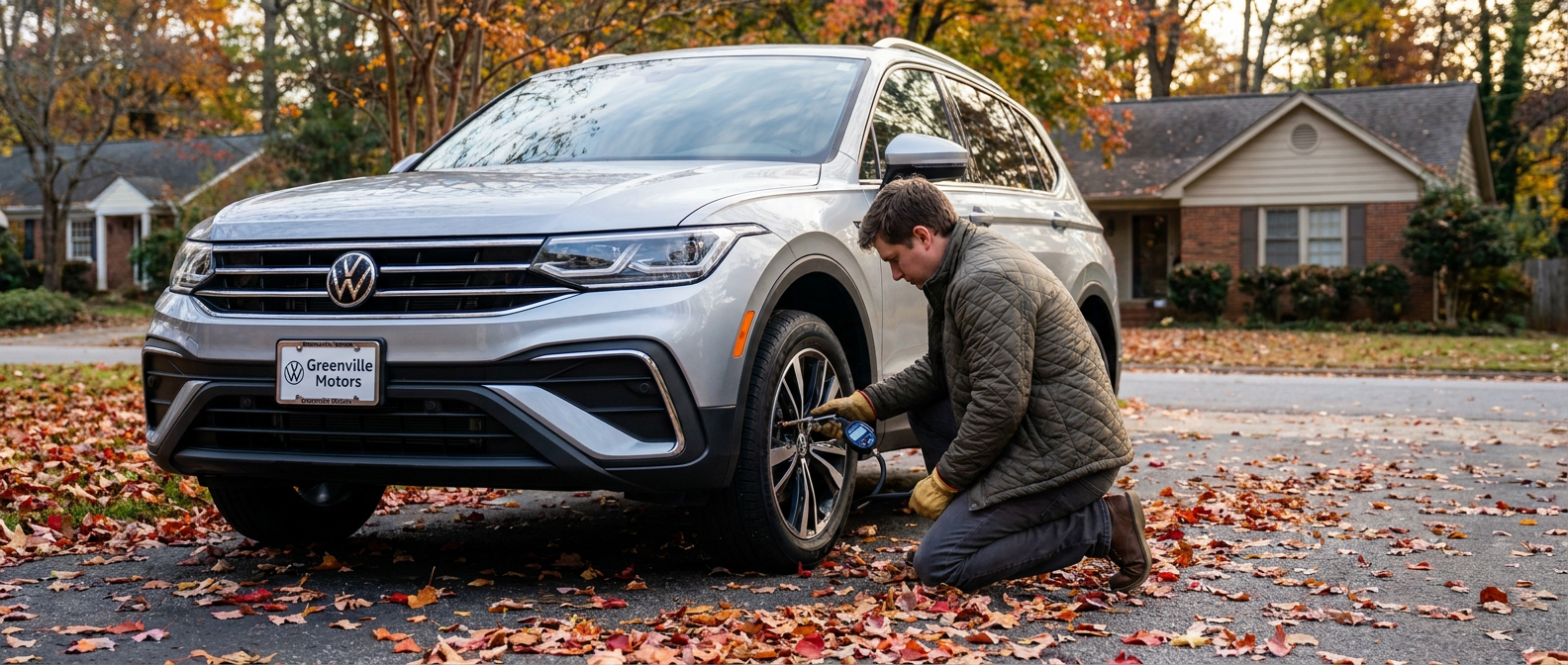
Greenville's October and November nights get genuinely cold. By morning we're talking 42-52 degrees Fahrenheit, after afternoons that can still hit the mid-60s. A 20-plus-degree gap between your afternoon high and your pre-dawn low is the swing that pulls 2-3 PSI out of every tire overnight, and it happens whether your Volkswagen sits on a driveway, in a garage, or at a trail head near Caesars Head State Park.
The fix takes about two minutes with a gauge. Knowing which number to target is the tricky part, since the Volkswagen lineup doesn't run a universal cold-inflation spec. Get that number wrong and you'll manage your tires against the wrong target all season.
The short version
- Greenville's fall diurnal temperature swing (roughly 20 degrees Fahrenheit between afternoon high and overnight low) pulls approximately 2 PSI from your tires every night, per the standard 1-PSI-per-10 degrees rule confirmed by Consumer Reports.
- The 2026 Atlas runs 36 PSI front and rear. The 2026 Tiguan ranges from 36 to 44 PSI depending on trim and tire size. The 2026 Jetta runs 36 PSI. Always verify against your driver's door jamb placard.
- Your TPMS light won't fire until pressure is 25% or more below placard (per NHTSA FMVSS No. 138). On a 36 PSI vehicle, that means no warning until you're below roughly 27 PSI.
- Check cold PSI weekly from October through February. Cold means before you've driven, or after the car has sat for at least three hours.
- The tire sidewall number is the maximum the tire can hold. It is not your target. The door jamb is.
Book a free tire pressure check with our service team
Which Volkswagen model runs which cold inflation pressure?
The right number depends on your exact model and trim, since the Volkswagen lineup spans a wider cold-inflation range than any single figure can cover, from 36 PSI on several models up to 44 PSI on certain Tiguan builds, and running the wrong spec quietly costs you tread wear, handling, and fuel economy even when the TPMS light stays off. So the spec sheet earns a look before fall settles in.
We've pulled a verified model-by-model reference for the vehicles across the current lineup. Cross-check it against your own door-jamb placard, since trim variants within the same model can differ.
| Volkswagen Model | Trim / Tire Size | Cold PSI (Front) | Cold PSI (Rear) | Source |
|---|---|---|---|---|
| 2026 Atlas | All trims / 235/55R19 | 36 PSI | 36 PSI | Door jamb placard |
| 2026 Tiguan SEL | 235/55R18 | 36 PSI | 36 PSI | Manufacturer data |
| 2026 Tiguan Comfortline 4Motion | 215/65R17 | 41 PSI | 41 PSI | Manufacturer data |
| 2026 Tiguan SEL Premium (20-in wheel) | 255/40R20 | 44 PSI | 44 PSI | Manufacturer data |
| 2026 Jetta | All trims / 205/55R17 | 36 PSI | 36 PSI | Door jamb placard |
| 2026 Taos | All trims | 36-41 PSI | 36-41 PSI | Verify at door jamb |
The gap between the lowest spec of the Tiguan (36 PSI on the SEL) and its highest (44 PSI on certain SEL Premium configurations) runs eight full pounds. Run a Tiguan SEL Premium at 36 PSI all fall and you'll chase underinflation the whole season. Set any Atlas to 44 PSI and you'll speed up center-tread wear while cutting wet-road grip. The door jamb number is the engineered target. Treat it as one.
See the 2026 Tiguan at Steve White Volkswagen
Why does the TPMS light stay off even when tires need air?
The light stays dark because the federal warning threshold sits far below your real maintenance target, so a tire on a 2026 Atlas can drift several pounds out of spec long before the dashboard ever says a word, and that quiet gap is exactly where fall PSI loss lives. NHTSA's FMVSS No. 138 requires the TPMS light to illuminate when a tire drops to 25% or more below the manufacturer's placard pressure. On a 2026 Atlas running 36 PSI, the light won't come on until you're below roughly 27 PSI. That leaves a 9-PSI gap between "properly inflated" and "dashboard warning."
Inside that gap, a tire that's 10-15% low wears faster on the outer edges (when underinflated, the sidewall flexes more and the contact patch deforms), brakes longer in wet conditions, and costs you measurable fuel economy. All of it happens with the warning light completely off. Treat the TPMS as a catastrophe net and keep your own maintenance schedule running beside it.
Per NHTSA FMVSS No. 138, the TPMS warning fires at 25% below placard. On a 36 PSI Volkswagen, that's roughly 27 PSI. A tire can be 10-15% low with zero dashboard indication.
Why does this hit in November specifically? Because Greenville's fall swing runs full force. When afternoon highs sit around 63 degrees and overnight lows slide to the low 40s, you're looking at a 20-plus-degree drop. Physics wins. At roughly 1 PSI per 10 degrees (confirmed by Consumer Reports and consistent with the Ideal Gas Law), you lose about 2 PSI per night, every night, with no leak and no warning light. By Friday morning after a cold week, tires you set correctly on Sunday are running well under spec.
Our service team's honest take: We reset plenty of TPMS lights in November that no puncture ever triggered. The light finally fired after several cold nights stacked the PSI loss up to the 25% floor. Catch it at 3 PSI low in week one and the whole sequence never starts. That's the weekly check doing its job.
Schedule a Tire Pressure and Inspection Check
How should Greenville drivers actually check tire pressure in fall?
Cold inflation pressure means the number you read before you've driven, or after the car has parked for at least three hours, and nailing that timing matters as much as the gauge itself, because a single mile of driving heats the air and inflates your reading by 4-6 PSI. Low tires look perfectly fine that way, which is exactly the trap.
We recommend this process for a weekly fall check:
- Check before you drive. First thing in the morning, before the car moves. You'll get the most accurate reading that way.
- Use a digital gauge. A pencil gauge works, though a digital one reads to the tenth of a PSI and spares you the squinting. Keep one in the glovebox.
- Check all four, not just the one that looked low. Temperature pulls PSI from all four tires at once. One low tire often means the other three are close behind.
- Target the door jamb number, not the sidewall. The sidewall shows the maximum the tire can hold. Your target is the placard number on the inside edge of the driver's door.
- Add air to cold tires, not warm ones. If you've already driven, park for three hours before topping off. Adding air to warm tires means you're overshooting once they cool.
- Check after any temperature drop of 15 degrees Fahrenheit or more. A cold front moving through Greenville can drop overnight temps fast. After that kind of swing, don't wait for the weekly cadence.
One blunt limitation here. A standard tire gauge and a gas-station air pump tell you nothing about bead seal condition or a slow leak. If a tire keeps dropping more than the expected 1-2 PSI per month through normal permeation, have the service team inspect it for a slow leak.
Which Volkswagen in the lineup needs the closest attention this fall?
Owners driving a Tiguan on 20-inch wheels should watch pressure the closest this fall, since those larger-diameter tires carry the highest cold specs in the lineup at up to 44 PSI on certain SEL Premium configurations, and the same 2-PSI overnight drop plays out very differently against that higher number. On those tires the drop is a smaller percentage loss in absolute terms, yet the TPMS 25% threshold means the warning fires even later relative to how far you've drifted. In practice, a high-spec Tiguan owner lives with a wider gap between properly inflated, noticeably underinflated, and a dashboard warning than an Atlas or Jetta owner does.
Atlas owners have the easiest job here. Every trim runs 36 PSI front and rear, so there's nothing to look up. Jetta owners sit in the same comfortable spot. Set it to 36, check it weekly, done.
Taos and Golf GTI owners should spend an extra minute verifying at the door jamb. Taos cold inflation varies by trim, and the Golf GTI runs performance-oriented tire sizes where the spec shifts from one trim to the next. Your placard holds the right answer, and 30 seconds finding it is time well spent.
For every Volkswagen in the lineup, weekly is the right cadence from October through February in Greenville. Monthly covers you in spring and summer, once temperatures settle. Fall here is not a stable season.
Frequently Asked Questions
Why does my tire pressure warning light come on only in the morning and then go off?
Overnight cooling pulls 1-2 PSI from each tire for every 10 degrees Fahrenheit the temperature drops, which lines up with the Ideal Gas Law governing gas pressure and temperature. Once you start driving and the tires warm up, the air inside expands and pressure climbs back toward its daytime level. If the light clears within 10-15 minutes of driving, cold-related pressure drop is almost certainly the cause. A cleared light doesn't mean your tires are fine. They crossed the NHTSA FMVSS No. 138 threshold of 25% below placard during the cold stretch, then recovered as the tires warmed. Check cold PSI with a gauge anyway and top up to your door-jamb spec.
My TPMS light never comes on. Do I still need to check my Volkswagen tire pressure manually?
Yes, and it's the one thing worth internalizing about TPMS. The federal requirement (NHTSA FMVSS No. 138) sets the warning threshold at 25% or more below placard pressure. On a 2026 Atlas running 36 PSI, the light won't illuminate until pressure sits around 27 PSI or lower. A tire at 32 PSI (11% low) wears unevenly, brakes longer in wet conditions, and costs you fuel economy with the warning light completely off. Treat a monthly gauge check as the minimum, and go weekly from October through February in Greenville's climate.
Where exactly do I find the correct tire pressure for my specific Volkswagen model and trim?
The authoritative source is the placard on the inside edge of your driver's door, visible whenever the door is open. It lists the manufacturer's recommended cold inflation pressure for your exact model, trim, and tire size. Skip the number molded into the tire sidewall, which is the maximum pressure the tire can structurally contain, well above your real target. Skip the generic "32 or 35 PSI for all cars" default too. The Volkswagen lineup runs from 36 PSI (Atlas, Jetta, Tiguan SEL) up to 44 PSI on certain Tiguan SEL Premium configurations, and using the wrong number works against tire wear, handling, and fuel efficiency all season.
Categories:
Social