
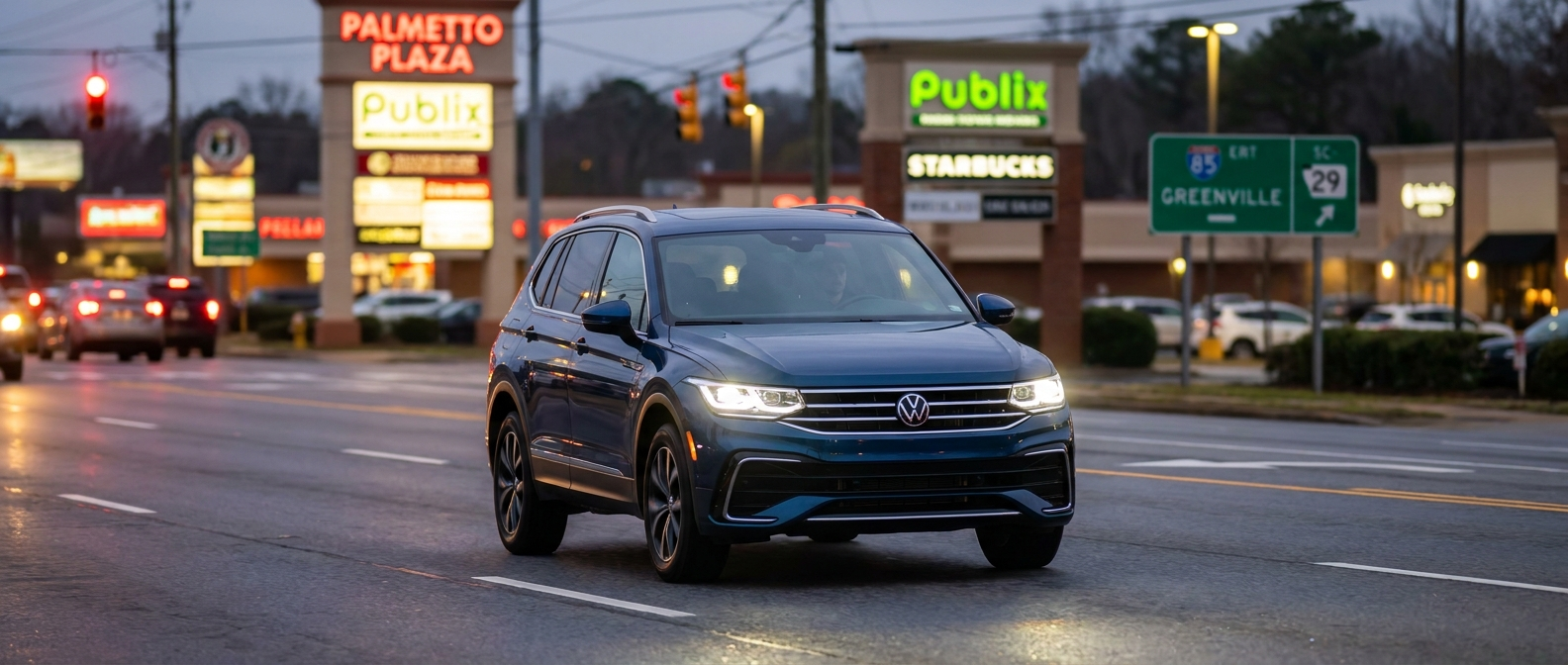
Woodruff Road after dark is a different animal. The corridor ranks among the most heavily traveled surface streets in Greenville County, with traffic volumes climbing past 40,000 vehicles per day between I-85 and I-385 during peak periods. At night all of that volume compresses into a tunnel of oncoming headlights, parking-lot pull-outs, and pedestrians cutting across to the restaurant rows. The good news is that your Volkswagen came with more night-driving capability than you've probably switched on. And your windshield is likely costing you more glare than the oncoming traffic is.
We'll cover two things in order. First, confirm your headlight setup and switch on what you already have. Second, clear the interior windshield film that turns every approaching headlight into a starburst. Do both before your next after-dark run on Woodruff, and it genuinely feels like a different drive.
The Tiguan is a natural example here, and you'll find every model in the lineup benefits from the same steps.
Light Assist (auto high-beam control) is standard on every 2026 Volkswagen Tiguan and Atlas, activates automatically above 18 mph on dark roads, and most owners never realize it's already enabled waiting to be switched on.
What You Need Before You Start
Knowing which technology your specific trim carries changes what you do in steps 1 and 2, so you'll want the quick reference below first.
| Volkswagen Model / Trim | Headlight Type | AFS (Cornering)? | Light Assist? | Light Bar / Cornering Lamps? |
|---|---|---|---|---|
| 2026 Tiguan S, SE, SE R-Line Black | 900-lumen LED | Yes (standard) | Yes (standard) | No |
| 2026 Tiguan SEL R-Line Turbo | 900-lumen LED | Yes (standard) | Yes (standard) | Full-width LED bar + cornering lamps |
| 2026 Atlas (all trims) | 900-lumen LED | Yes (standard) | Yes (standard) | DRL light bar on non-base trims |
What you'll need for the windshield steps:
| Item | Notes |
|---|---|
| Ammonia-free automotive glass cleaner | Ammonia damages tinted glass; auto-formulated cleaners resist streaking |
| Two clean microfiber cloths | One for the wet pass, one for dry buff, never cross them |
| Distilled water (optional) | Reduces mineral spotting on lightly hazed glass |
| Interior glass reach tool (optional) | Saves your back on the lower windshield angle |
| Flashlight or work light | Check results at a raking angle; streaks hide when viewed straight on |
Step-by-Step: Activate Your Headlights and Clear the Windshield
The Atlas and the Tiguan share the same switch logic, so these steps cover both. The Taos and Jetta family use the same controls, so you're set there too.
Step 1. Confirm your headlight switch position
Turn the headlight stalk to Auto. Auto lets the vehicle's light sensor take over, switching low beams on when ambient brightness drops. Leaving the stalk on the manual-on position is an easy habit to fall into. It works, but you'll lose the automatic dimming in lit parking lots and miss the ability to engage Light Assist in step 2. Auto is always the right setting on Woodruff Road.
Step 2. Enable Light Assist (this is the one most owners skip)
Light Assist comes standard on the 2026 Tiguan, and it switches the headlamp high beams on above 18 mph on dark or poorly lit roads when no oncoming traffic is detected. The threshold matters on Woodruff. At a full stop or crawling through a parking-lot queue, the system correctly stays on low beam. Once you're moving on the darker stretches toward I-85, it switches up.
To switch it on, keep the stalk on Auto and push the high-beam stalk lever away from you (toward the dash) past the momentary flash position until it clicks into the sustained position. A blue indicator lights up in the cluster when high beams are on, and a white indicator shows the system has dimmed them on its own. If you see neither, check that you've selected Auto and try again.
On the Atlas, Light Assist brings the high beams up above 18 mph on dark roads and shuts them off below 12 mph. The step-down threshold means the system doesn't blind the driver in front of you as you're both decelerating into a red light. Thoughtful engineering.
Step 3. Understand what AFS does (and doesn't do) on your trim
All 2026 Atlas models feature 900-lumen LED headlights with the Adaptive Front-lighting System (AFS) of Volkswagen. AFS pairs auto-high beam assist with swivel-mounted lamps that improve road illumination when cornering or driving around curves. On Woodruff Road's 90-degree turns into shopping centers, you'll feel AFS sweep the beam into the turn a beat before you'd otherwise see that far. There's no switch for it. The system runs on its own and rewards smooth inputs, so take the curves a little more deliberately.
On the 2026 Tiguan SEL R-Line Turbo specifically, the lighting signature adds a full-width LED light bar and backlit Volkswagen logo, plus all-weather cornering lamps with poor-weather lights. The cornering lamps are the meaningful upgrade over the standard LED setup. If you drive a lower trim and want that feature, it's a reason to look at the SEL R-Line Turbo when you're ready to trade up.
The detail that's easy to miss: Light Assist is not the same as IQ.LIGHT matrix headlights. Light Assist (automatic high-beam management) is standard on every current Volkswagen in the lineup. IQ.LIGHT (individually controlled LED matrix that shapes the beam around other vehicles) is a separate, upper-trim feature present on certain Volkswagen models sold in other markets. If your window sticker doesn't say "IQ.LIGHT," you have standard LED headlights with Light Assist, still a very capable system, just different. Don't expect matrix behavior from a standard LED setup and then blame the car.
Step 4. Clear the interior windshield film (this is your biggest visibility gain)
Where does most night-driving glare on Woodruff Road come from? A good share of it starts on your own windshield, and you'd be surprised how much. The oncoming traffic gets the blame, but the glass does plenty on its own. Most windshield haze at night is an oily interior film caused by off-gassing from the dashboard, vents, and vinyl trim. Heat cooks the plastic, releases volatile compounds, and they settle on the inside of the windshield as a thin film that scatters headlight beams into starbursts and halos.
The heat speeds this up. A car that's sat in the afternoon sun hazes over faster by evening.
South Carolina's October days still run warm enough that a parked interior stays hot for hours. We notice it on newer Volkswagen vehicles, where fresh interior materials off-gas more actively in the first year or two. Nothing's wrong with the car. In daylight the film is invisible. At night, facing oncoming traffic on Woodruff, it's the thing you're fighting.
Bottom line on the film: It's not the oncoming traffic, it's your own glass. A quick interior cleaning is the single biggest night-visibility gain on this list, so it's worth doing right.
Clean the inside glass in two passes. Start with a damp (not dripping) microfiber to lift the film, then follow with a dry microfiber to level and buff the glass. You're trying to lift the oily layer causing headlight glare, not just smear it around.
Spray your ammonia-free glass cleaner onto the cloth rather than the glass. Ammonia-based products damage tint and leave films behind. Most Volkswagen trims come with factory-tinted glass, so this isn't a small thing. Use automotive glass cleaner specifically.
A few things to keep in mind on the dry pass:
- Work top to bottom, flipping to a clean section of cloth often.
- The first pass loads up fast.
- After the dry buff, check at a raking angle with a flashlight.
- Streaks hide when you're looking straight on, then jump out the moment you catch the light at an acute angle.
Step 5. Check your wiper blades and set your HVAC correctly
Worn wiper blades smear fine mist across the windshield instead of clearing it. The smear catches every headlight on the road the same way interior film does. The 2026 Tiguan comes with rain-sensing wipers; if yours leave arcs or chatter, you're looking at the blade itself, and the sensor is fine. Our service center can swap them in minutes.
For the HVAC, set the defroster to fresh-air intake rather than recirculate to pull VOCs out of the cabin. Recirculate keeps the cabin air and its off-gassed compounds bouncing around and settling back on the glass. Fresh air carries them out. It matters most if the film keeps coming back after you've cleaned.
Insider note from our service team: If you clean the inside of the windshield and notice the residue smells sweet or slightly soapy rather than dusty, that's worth a closer look. A sticky film with a sweet smell can indicate a coolant leak from a failing heater core, which calls for a mechanic. Don't just re-clean and move on. Book a service appointment.
Step 6. Check headlight aim if you've recently had body work
A headlight that's aimed too low loses usable range. One aimed too high blinds oncoming drivers (and tells their Light Assist to dim, which reduces their own visibility). If your vehicle has had any front-end repair, or if you've noticed other drivers flashing their lights at you at night, headlight alignment is the first thing to inspect. Leave this one to the service center.
Schedule a Service Appointment
Print-and-Go Recap: Your Pre-Night-Drive Checklist
Before the next evening run on Woodruff Road, give this list two minutes and you'll head out ready.
| Task | What to do | Done? |
|---|---|---|
| Headlight stalk | Set to Auto | |
| Light Assist | Stalk pushed forward, sustained position, blue/white indicator confirmed | |
| Windshield interior | Two-cloth clean with ammonia-free cleaner, checked at raking angle | |
| HVAC setting | Fresh air (not recirculate) | |
| Wiper blades | No chattering, no arcs in fine rain | |
| Recent body work? | Book headlight aim check at service center |
The Atlas Cross Sport sits right next to the Tiguan on our lot and shares the same 900-lumen LED headlight setup with standard Light Assist. If you're cross-shopping between the two for a family night driver, the headlight systems are equivalent. The differentiation comes down to body style and interior space, not lighting.
A few minutes of setup before you leave, plus a windshield cleaning once a month, and you'll find Woodruff Road feels much more manageable after dark, glare and all. The stretch between I-385 and I-85 ranks among the busiest surface streets in the Upstate. Your Volkswagen already has the technology ready for it. The real question is whether your settings and your glass are ready too.
By the Steve White Volkswagen Team | October 2026
Frequently Asked Questions
Does every 2026 Volkswagen Tiguan have automatic high beams?
Yes. Light Assist, the automatic high-beam control system of Volkswagen, is standard on every trim of the 2026 Tiguan, from the S right up through the SEL R-Line Turbo. Per the Volkswagen 2026 Tiguan press materials, the system activates the high beams automatically above 18 mph on dark or poorly lit roads when no oncoming traffic is detected. You do need to enable it by pushing the high-beam stalk forward (with the headlight switch in Auto position) the first time.
What is causing the haze on the inside of my windshield at night?
The film is almost always interior off-gassing. Plastics, vinyl trim, and dashboard materials slowly release volatile organic compounds into the cabin air, and those compounds settle as a thin oily layer on the inside surface of the glass. Heat accelerates the process, which is why a car that sat in the Greenville sun all afternoon may be noticeably hazier that evening. The fix is a two-cloth cleaning pass with an ammonia-free automotive glass cleaner. If the residue smells sweet rather than dusty, that can indicate a heater-core issue, and a service inspection is the right next step.
Categories:
Social