
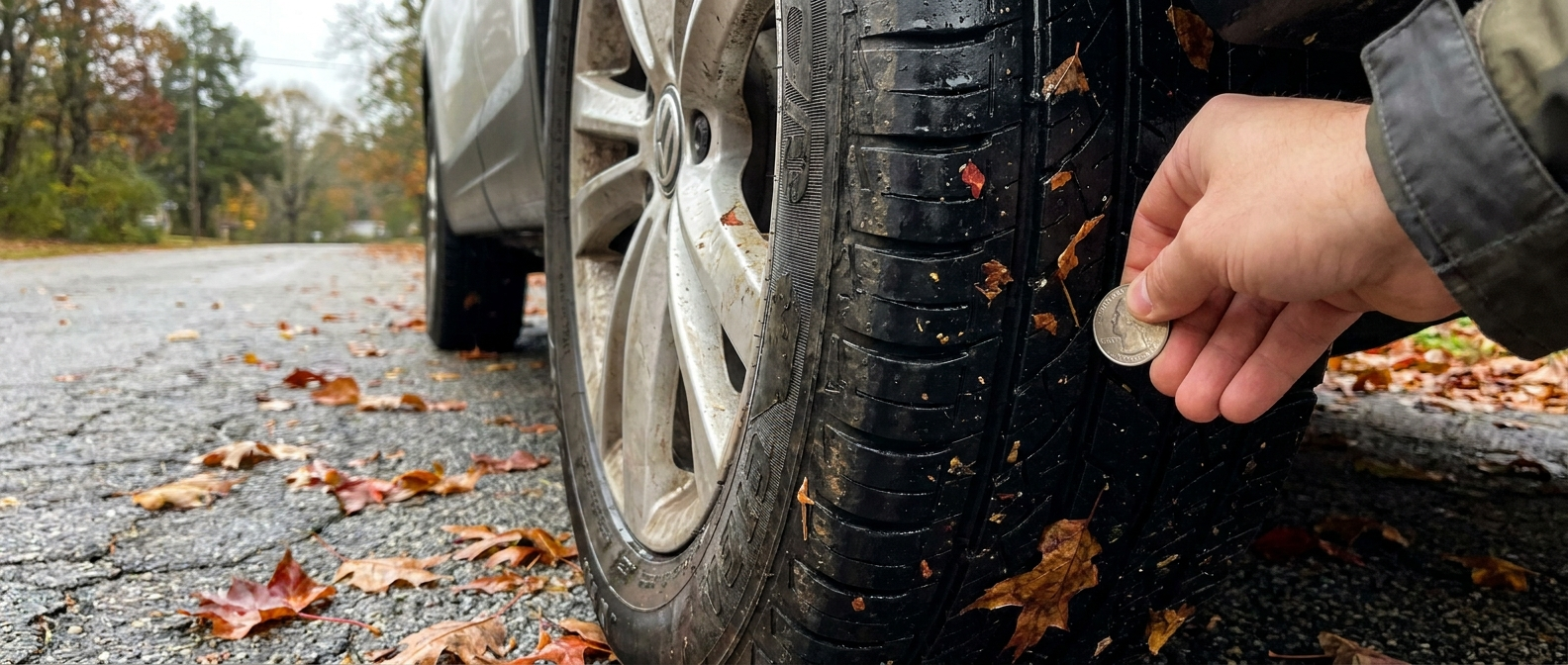
Greenville never hands you a dry season to coast through. NOAA 30-year climate normals put Greenville County at roughly 57 inches of annual precipitation, spread across all twelve months. That shifts the math on tire tread in a real way. The 2/32-inch legal minimum you'll read about in most articles is a "don't get ticketed" floor in the states that even have one, and South Carolina has no statutory minimum on tread depth. The threshold that actually protects you on a rainy I-85 interchange or a slick I-26 on-ramp is 4/32 inches. We'll give you three ways to check right now, a clear decision table, and Volkswagen-specific context your owner's manual glosses over.
Book a tire inspection at our service center if you'd rather let our team run the check and rotate while you wait.
The short version
- Penny test catches legal failure (2/32"): Lincoln's full head visible means replace now.
- Quarter test catches the real safety line (4/32"): Washington's full head visible means start shopping.
- Wear indicator bars flush with the tread surface also signal 2/32" exactly, no coin needed.
- Lower-profile Volkswagen trims (SE R-Line Black, Golf GTI, Golf R) run 20" or 18" tires with shorter sidewalls; there's less rubber between new and worn, so check more often.
- Greenville's year-round rain means the 4/32" line matters here more than in drier markets.
What Actually Matters When You're Checking Tread?
The penny test shows up in nearly every tire article, and it does work, though it only flags one thing, a tire that's already legally worn out. Wet-weather grip starts fading well before that point, so one check alone won't tell you the whole story. The table below lays out the full decision picture.
| Check method | Threshold it measures | What a "fail" means | Best for |
|---|---|---|---|
| Penny test (Lincoln head down) | 2/32" | Legally worn; replace immediately | Confirming a tire is truly done |
| Quarter test (Washington head down) | 4/32" | Wet-weather grip is already compromised; begin replacing | Everyday wet-climate safety decision |
| Built-in wear indicator bars | 2/32" exactly | Tread is flush with the bar; tire is at legal minimum | Quick visual without a coin |
| Tread depth gauge (inexpensive probe) | Exact measurement in 32nds | Precise reading; best for tracking wear over time | Monitoring gradual wear before it becomes urgent |
The 4/32" threshold isn't arbitrary. AAA ran highway-speed wet-braking tests at 60 mph and found tires worn to 4/32" needed an average of 87 additional feet to stop on a wet road compared to new tires. Tire Rack's own testing from 60 mph showed tires at the 2/32" legal minimum required up to 195 additional feet to stop compared to new tires. Greenville's October rainfall runs around 3.7 to 4.1 inches per month. We wouldn't gamble on 3/32" in a climate like that.
See the 2026 Tiguan on our lot if you're in the market and want to start fresh with a known tread depth.
Tire Size Changes Everything on a Volkswagen
Tire size changes the whole calculation, and it's the part generic penny-test articles skip right past. The size on your specific Volkswagen trim affects both how fast you burn through tread and how that wear registers when you check it. Bigger wheels with shorter sidewalls leave you less margin to work with.
The 2026 Tiguan S rides on 215/65R17 tires. Order the SE R-Line Black and it ships on 255/40R20 tires instead. Those 20-inch wheels carry a much shorter sidewall (40-series profile against 65-series). Less total rubber volume means each 32nd of tread stands for a smaller physical cushion, and those tires take uneven wear more easily from a single pothole or a slightly off-balance road on a secondary route through Upstate SC.
The same logic runs across the lineup.
- Jetta and Taos (entry trims): typically 205/55R16 or 215/65R17 territory; forgiving, taller sidewalls, easier to keep even.
- Tiguan SE, Atlas SE: 235/50R19 or 245/60R18 range; solid middle ground.
- Golf GTI and Golf R: 225/40R18 or comparable performance sizing; shorter sidewalls, stickier compound that wears faster under spirited driving.
- Atlas SE R-Line and SEL: up to 265/45R21; a high-load tire on a heavier platform, so checking inflation alongside tread depth is essential because underinflation drives sidewall flex, which accelerates wear.
Check your door jamb sticker for the OEM size on your specific trim. Don't assume the neighbor's Volkswagen is the same.
Team observation: When our service center rotates tires on performance-trimmed models (lower-profile 18" or 20" setups), we consistently see more inner-edge wear than on base-trim vehicles, especially on cars that haven't had an alignment check since purchase. A tread depth gauge at the inner groove of those tires often reads 2/32" shallower than the center groove. Check all three zones, not just the easy center spot.
Browse the Atlas at Steve White Volkswagen
Pros and Cons of Each Checking Method
| Pros | Cons |
|---|---|
| Penny test: free, zero tools, two seconds | Only flags 2/32" failure; won't warn you at 4/32" |
| Quarter test: free, finds the real safety threshold in wet climates | Still pass/fail only, no exact number |
| Wear indicator bars: always there, visual check at a glance | Only signals 2/32"; no warning before you reach the legal floor |
| Tread depth gauge: exact reading in 32nds, tracks gradual wear | Costs a few dollars; one extra step to carry the tool |
Our recommendation is simple enough. Run the quarter test on all four tires at every oil change, or every six months, whichever comes first. If Washington's head disappears into the tread, you're at 4/32" or better. Good. If you can still see the top of his head, you're at 4/32" or below, and Greenville's rainfall makes that a real problem. For anybody running a Golf GTI or an Atlas Cross Sport with larger-diameter tires and frequent highway miles on I-385 between Greenville and the I-85 connector, we'd say check quarterly.
Match the Tread Check to How You Actually Drive
How you drive sets the threshold as much as what you drive, so the right check interval looks different for a downtown errand-runner than for an interstate commuter who lives in the wet-weather lanes. We've sketched three driving profiles below, each with its own action point. Find the one that fits your week.
City and suburb driver (mostly Downtown Greenville, local errands, low highway miles): Your tires wear slowly, but check them just as often. City driving packs in more turning and braking, which loads the front tires unevenly. Run the quarter test every 5,000 miles and rotate on schedule.
Highway commuter (I-85 or I-385 regularly, Spartanburg or Anderson runs): You're covering distance fast, and the tires wear more evenly for it. The risk sits in the sustained wet pavement on interstate ramps and the long straights where aquaplaning builds at speed. Staying above 4/32" is non-negotiable, and we'd replace at 5/32" if you're putting 15,000-plus miles a year on the car.
Blue Ridge day-tripper (Cherokee Foothills National Scenic Highway, Paris Mountain State Park routes): Those two-lane roads through Upstate SC include elevation change, tight curves, and surfaces that go from dry to wet in the space of a mountain shadow. Fresh, low-profile performance tires earn their keep on exactly these roads, and worn tires show their weaknesses earliest here. Don't start those runs below 5/32".
Schedule a service appointment at Steve White Volkswagen
Frequently Asked Questions
Does South Carolina have a minimum tire tread depth law?
South Carolina does not have a specific statutory tread depth minimum, unlike the federal standard of 2/32 inch that applies in most other states. General unsafe-vehicle statutes still apply, so an officer can cite a vehicle with visibly bald tires. In practical terms, that makes the 4/32-inch safety threshold (not a legal floor) your real guide in Upstate SC. Don't count on a passing inspection to mean your tires are safe for wet Greenville roads.
How often should Volkswagen owners in Greenville check their tire tread?
Our service team recommends the quarter test at every oil change interval. For most Volkswagen models on a standard schedule, that's roughly every 5,000 to 10,000 miles. If you're on a performance trim with a lower-profile tire (the 18-inch setup of the Golf GTI, the Tiguan SE R-Line Black's 20-inch configuration, or the larger tire options of the Atlas Cross Sport), check the front tires specifically every 5,000 miles, because front tires steer and brake at once and wear faster. And always check before a longer mountain route, since Greenville's proximity to the Blue Ridge Escarpment means quick elevation shifts and road surfaces that amplify worn-tire behavior.
Categories:
Social