
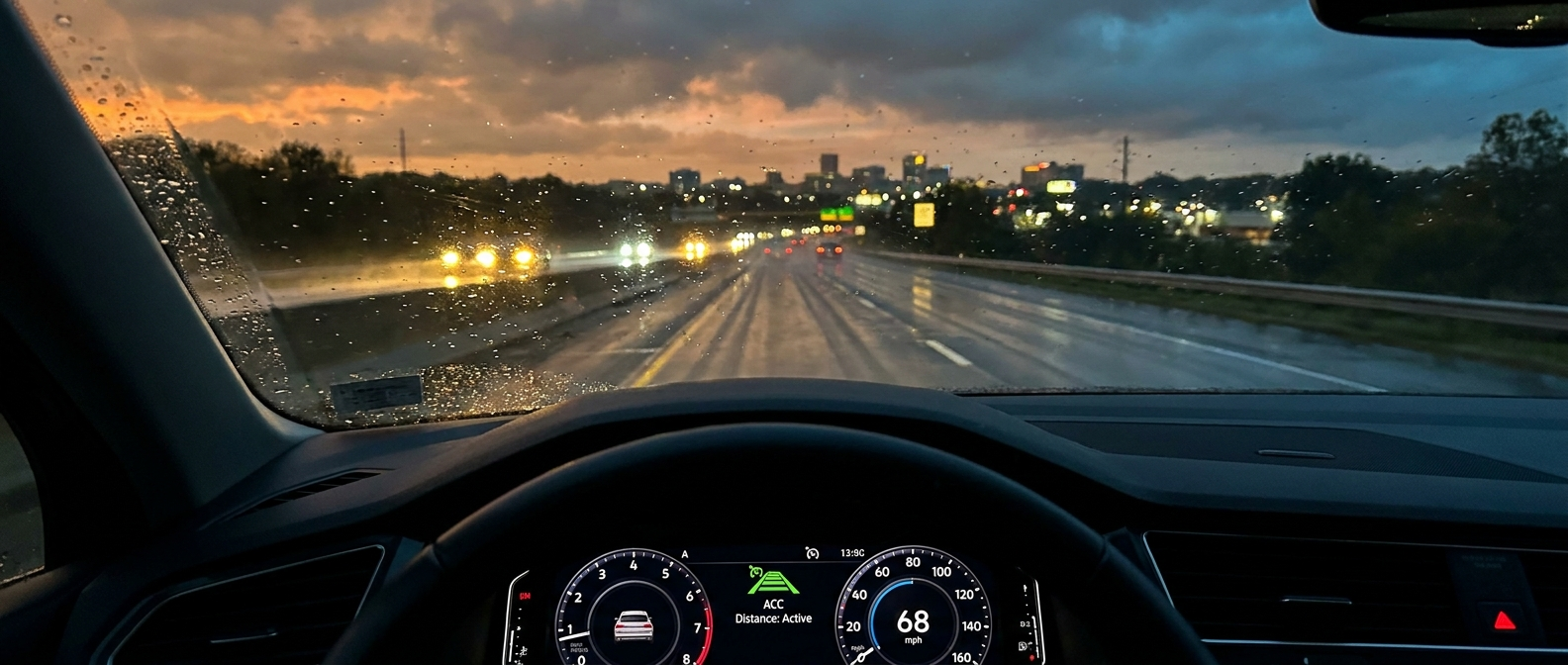
October in Greenville looks gorgeous right up until a storm cell slides east along I-85 and you're suddenly running 65 miles per hour in standing spray while a semi cuts over two lanes ahead of you. Greenville averages about 50.24 inches of rain per year, and when a storm system fires up west of town, it moves quickly along the I-85 corridor. You don't get a slow build here. You get the 20-seconds-to-decide kind of moment. It happens fast.
Every Volkswagen in the current lineup comes standard with IQ.DRIVE features including Travel Assist, Front Assist, Active Blind Spot Monitor, Rear Traffic Alert, Adaptive Cruise Control, Lane Assist, and Emergency Assist. That's the good part. The catch is that those tools only help if you set them for what the road is doing. Here's what to dial in before the rain arrives, and where the system hands control back to you.
In October rain on I-85, push the ACC distance level to 4 or 5 on your steering wheel control. Wet pavement can extend stopping distances by 30 to 50 percent, and the wider gap is the most direct thing IQ.DRIVE can do for you right now.
How Does IQ.DRIVE Actually Fit an October Downpour on I-85?
| Local condition | IQ.DRIVE feature that addresses it | Why it matters in the rain |
|---|---|---|
| Reduced stopping distance on wet asphalt | ACC Stop & Go (distance levels 4-5) | Wet pavement increases stopping distance 30-50%; a wider gap directly offsets that |
| Sudden braking by the vehicle ahead | Front Assist with AEB | Radar-based; scans ahead and can apply emergency braking even when cameras struggle |
| Blind-spot threats from lane-changing vehicles | Active Blind Spot Monitor | Spray reduces rear visibility for the driver; the radar-based side sensors keep working |
| Fatigue on a long wet Upstate stretch | Travel Assist (dry/light rain only) | Combines ACC and lane centering to reduce workload, only when lane markings are clear |
| Backing out at a congested rest stop in wet conditions | Rear Traffic Alert | Alerts to crossing traffic behind you. Useful when rear windows are fogged or spray-covered |
The honest tradeoff sits in the bottom row of that table. A limited sensor view, whether from a dirty sensor or inclement weather conditions such as heavy rain, degrades system performance. Travel Assist leans on a front-facing camera to read lane markings, so when standing rain obscures those markings, the system will tell you it can't engage or will disengage on its own. The system is working correctly here. That's not a malfunction.
Front Assist's forward collision radar is a different story. Radar is far less sensitive to precipitation than cameras are. Front Assist monitors the road ahead using radar and camera technology, and if it detects a potential collision with a vehicle, pedestrian, or cyclist, it provides visual and audible warnings. If you don't respond quickly enough, it can apply emergency braking. In heavy rain, that radar-based warning and braking function keeps working even when the camera-based lane-keeping has stepped back.
Setting Your ACC Distance for Wet Roads on I-85
Of all the IQ.DRIVE settings on a wet I-85 run, the ACC distance level is the one that genuinely moves your outcome. It only helps once you bump it off the factory level you've likely left alone since your first week with the car. Stick with us for a second.
Adaptive Cruise Control helps maintain a constant speed and a previously set distance between your vehicle and those in front of you, and you can set that speed-dependent distance from the vehicle ahead to one of five levels by pressing the button to cycle through distance intervals until you reach your desired level.
Level 1 or 2 is a tight setting plenty of us run on an ordinary day. It works fine in light, open-highway traffic on a dry fall afternoon. On a wet October afternoon, when a passing truck throws a wall of spray at your windshield? Wet pavement increases stopping distance by 30 to 50 percent, and the normal three-second following distance isn't nearly enough. Aim for at least five to six seconds. Levels 4 or 5 on the ACC dial get you there without doing the math every few minutes.
At Steve White Volkswagen, our team sees the same thing on wet I-85 runs (set the distance high, let ACC hold it, and the whole drive feels calmer). It frees you from doing gap math every few minutes. The road is yours to watch.
Local note: The stretch of I-85 between the Anderson and Spartanburg exits carries a steady mix of passenger vehicles and commercial trucks, especially on weekday afternoons. Large vehicles such as trucks and buses can kick up water spray that limits visibility, and allowing more space between you and the vehicle ahead also helps reduce the impact of spray on your windshield. Set the gap wide before you need it, not while you're already in the spray.
Things that make October I-85 rain worse than it looks:
- Early in a rain shower, road oils mix with fresh water and leave a surface that's slicker than either condition alone. Slow down before you feel it
- Low October sun at dusk can hit a wet windshield at an angle that wipes out visibility almost completely for 10 to 30 seconds
- Lanes narrow in active construction zones between Greenville and Spartanburg, and Travel Assist lists unclear lane markings as a condition where it won't engage
- ACC doesn't anticipate a vehicle cutting in from a merge. It reacts after the vehicle is detected, which is why the wider gap setting matters
- Front Assist's AEB can apply the brakes, but smooth, early braking from the driver stays more controlled than emergency intervention
What Front Assist Actually Does During a Rain-Driven Panic Stop
During a rain-driven panic stop, Front Assist earns its keep by watching the road ahead with radar and a camera and braking when you can't react in time. It's engineered as a last backstop and never as a stand-in for the judgment you bring to a wet highway. Drivers still need to understand what it really does rather than assume it thinks like a human.
Front Assist is standard across every Volkswagen in the lineup. Here's how it actually works:
- It uses forward-facing radar and a camera to watch for vehicles and pedestrians ahead
- When it detects a potential collision, it gives you a visual and audible warning first
- If you don't respond, it can apply autonomous emergency braking
- The braking is calibrated to avoid or reduce the severity of a collision, and it doesn't replace driver judgment on a wet highway
Front Assist hands you a margin at the end of that gap, though it doesn't build the gap for you. Treat it as a last-resort backstop rather than a first line of defense.
The traditional three-second following distance rule is often insufficient during heavy rain. Experts recommend increasing it to at least five seconds during moderate rain and six to eight seconds during heavy rainfall. The extra space buys valuable time if the vehicle ahead brakes suddenly.
Volkswagen is introducing several advancements for some of its 2027 vehicles, including an upgraded Predictive ACC that adopts speed limits earlier and reduces delays from traffic-sign recognition, as well as driver-initiated lane changing in Travel Assist and Emergency Assist Plus, on the 2027 Atlas family, Golf family, ID. Buzz, and Tiguan. The upgraded Predictive ACC is worth understanding on a rain day. If it reads a speed reduction sign ahead of you on I-85, it'll begin modulating speed before you see the source, which shortens the abrupt braking chain reaction in slow-and-stop traffic.
See Current Volkswagen Models and Specials
The Concrete Fit: What IQ.DRIVE Does Well on an October I-85 Run, and What It Doesn't
On an October I-85 run, IQ.DRIVE does its strongest work on following distance and collision warning. Volkswagen built those features around radar that rain barely touches, while the camera-based lane features are the piece that steps back once the markings vanish. Radar isn't knocked out by precipitation the way cameras are. Radar sensors positioned front and rear detect the distance and speed of nearby vehicles, allowing adaptive cruise control and collision avoidance systems to function with precision. Those sensors keep doing their job when rain is sheeting across the road.
The camera-based systems, primarily Lane Assist and the lane-centering part of Travel Assist, are more sensitive to what the camera can see. Travel Assist actively keeps the vehicle centered within the lane through steering inputs when clear road markings are detected. When heavy rain makes those markings unclear, the system steps back, which is exactly the right call. The driver takes over right there, wide-awake, gap already set wide on the ACC dial.
The honest version of what we'd tell you on the lot is simple. IQ.DRIVE handles following distance and collision warning well in October rain, and it'll hold a five-second gap with more consistency than a tired driver after an hour on a wet I-85. What it won't do is see lane markings through a waterfall, and it won't anticipate a truck merging from a blind side at 60 miles per hour. Those two jobs stay yours. The system's most useful when you treat it as a precision co-pilot and keep your hands on the wheel and your eyes on the road, not as a passenger handing off the driving.
If you're evaluating which Volkswagen fits your regular I-85 commute, and how the 2027 lineup's updated IQ.DRIVE shifts that calculus, our current inventory at Steve White Volkswagen is a good starting point. Our team can walk you through exactly which distance settings and assist features match what you really drive.