
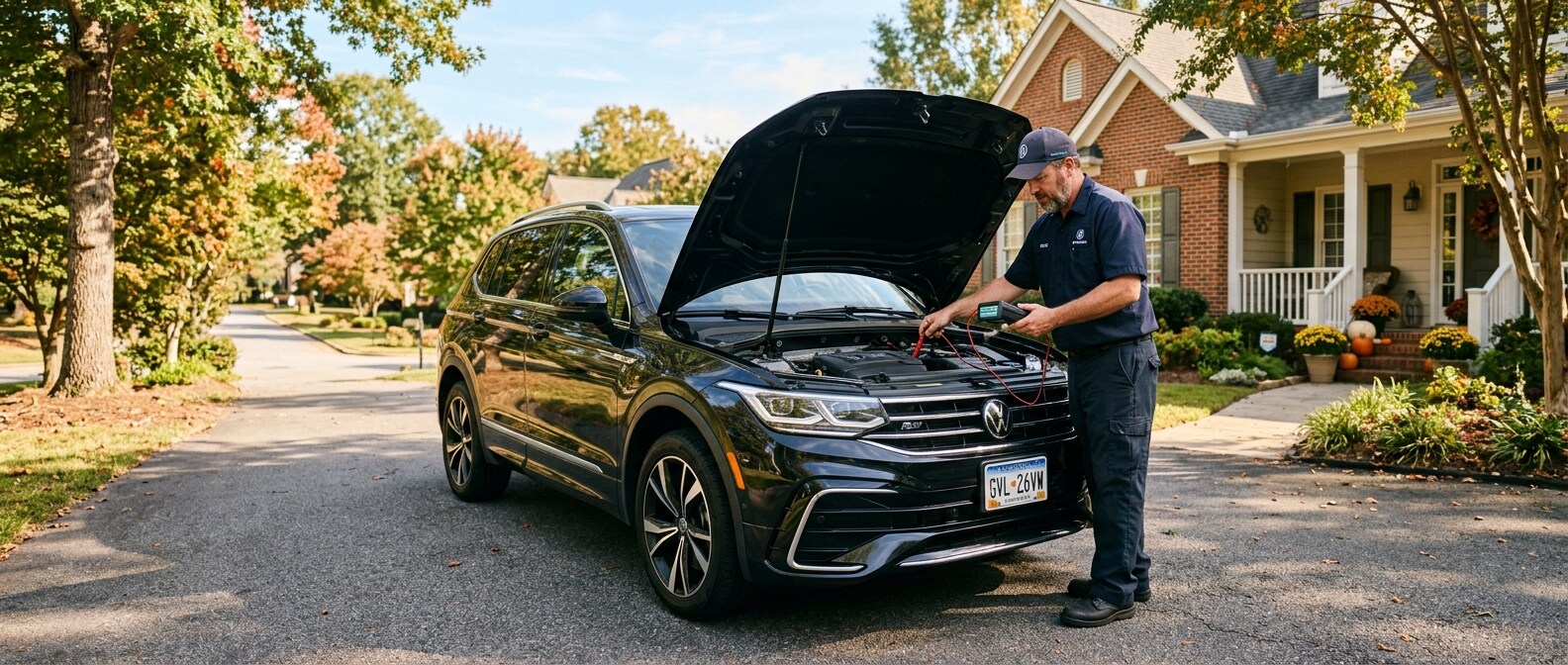
September feels like a false alarm around here. Mornings finally dip below 70, the Cherokee Foothills Highway is calling, and it's easy to assume the battery came through summer just fine. The assumption often doesn't survive the first cold morning.
You've heard the myth plenty of times. Cold weather kills car batteries. What actually happened is that Greenville's summer heat did the real damage months ago, and October just shows you the bill. If you're planning a fall trip up toward Caesars Head State Park and your battery is more than three years old, the time to act is right now, before the season turns.
The short version
- Myth: Cold weather is the primary killer of car batteries. Reality: Heat does the structural damage; cold only exposes what's already broken.
- Myth: Your battery is fine because the car starts every morning. Reality: A battery can lose significant internal capacity and still crank through warm weather, then quit when October demand increases.
- Myth: Idling the car recharges a weak battery. Reality: Meaningful recharge requires at least 20-30 minutes of actual driving, not idling.
- Myth: Any replacement battery will work in a modern Volkswagen. Reality: Most current Volkswagen models with stop-start technology require a specific AGM battery AND a Battery Management System registration afterward. Without it, the new battery degrades faster from day one.
- Bottom line: September is the right window to test. Our service center checks the battery and handles the BMS registration that most quick-lube shops skip entirely.
Is Cold Weather Actually What Kills Car Batteries?
Cold weather gets the blame, but it isn't the true culprit, because the cold only reduces how much current a battery can deliver on a winter morning, while the structural damage that actually ends the battery's life happens months earlier in Greenville's summer heat, and that difference changes when you should act. So the timing of when you check matters.
Inside a lead-acid or AGM battery during a Greenville summer, the chemistry takes a beating. Under-hood temperatures routinely climb past 140 degrees Fahrenheit on hot days. At that temperature, the electrolyte solution (a mixture of water and sulfuric acid) begins to evaporate. When the water level drops, the internal lead plates are exposed to air, and that's what drives permanent oxidation and corrosion. The battery's structural capacity degrades quietly all summer while the warm chemistry keeps everything cranking without complaint.
Then the air cools to the 50s in October. Cold temperatures slow the battery's chemical reactions, reducing how much current it can deliver to the starter. A battery at 32 degrees Fahrenheit loses roughly 20 percent of its rated capacity. That reduction is not a problem for a healthy battery. For one that summer already compromised internally? It's the last straw.
| Myth | What's Actually True | Source |
|---|---|---|
| Cold weather kills car batteries | Heat does the structural damage; cold exposes it | Battery industry technical data |
| Summer is safe for batteries | Under-hood temps above 140 degrees Fahrenheit cause permanent electrolyte evaporation and plate corrosion | Published automotive battery science |
| A car that starts is a car with a healthy battery | Internal capacity can fall significantly before cranking performance fails in warm weather | Midtronics battery management documentation |
| Idling the car recharges a weak battery | At least 20-30 minutes of driving is needed for meaningful recharge, not idling | Automotive battery maintenance data |
| Any battery fits your Volkswagen | Most current Volkswagen models with stop-start require AGM chemistry and BMS registration after replacement | Volkswagen service documentation |
The heat did the damage. September is when Greenville drivers find out.
What This Means for Upstate SC Drivers
Greenville isn't Phoenix, and that difference matters here, because our winters stay mild while the summer runs hot enough to do genuine battery harm, so the local risk profile looks nothing like the winter-kill stories written for colder cities up north.
Local climate records rarely show overnight lows below the mid-20s Fahrenheit. We average only about 44 frosty nights per year. So the catastrophic cold-kill scenario that dominates winter battery content written for Minneapolis doesn't translate directly to an Atlas owner commuting on I-85.
What translates instead is the summer, and it's brutal by battery standards. Average highs run into the upper 80s from June through August, with under-hood temperatures far exceeding ambient air temperature on a sun-baked parking lot. Three months of that heat, plus the constant electrical load of air conditioning, is exactly the scenario where degradation picks up speed before a warm-weather start would ever hint at trouble.
The Volkswagen Atlas and the Volkswagen Jetta both run sophisticated electrical architectures that draw continuous power for heated seats, infotainment, and advanced driver-assistance features. A battery that's already heat-compromised manages that load on a reduced reserve. The result is a vehicle that limps through short in-town commutes just fine, then stalls on a longer fall trip on I-385 toward the mountains.
A load test in September takes about 10 minutes. It measures the battery's actual usable capacity, not just whether it'll spin the starter once in a warm garage.
Schedule a Battery Check at Our Service Center
The Volkswagen Battery Detail Most People Skip
Battery care turns Volkswagen-specific at this point, and it's the part generic battery content never covers, because most current Volkswagen models pair the battery with a management system, so a correct replacement means matching the part and resetting the electronics, and skipping that second step undercuts even a brand-new battery.
Most current Volkswagen models use a Battery Management System that actively monitors battery state, adjusts alternator charging voltage, and manages the stop-start system's power cycles. When you replace the battery in one of these vehicles, you've got to tell the BMS a fresh one is in. The process is called battery registration or adaptation. Without it, the system continues charging the new battery using the degraded parameters it learned from the old one.
The cost of skipping it isn't abstract. Per Midtronics battery management documentation, a new battery that goes unregistered is typically undercharged from the first day, which shortens its service life measurably.
"Without registration, the BMS keeps using the old battery's learned charging profile, which can undercharge or overcharge your brand-new battery from day one." (Source: Midtronics battery management system technical documentation)
Volkswagen models on the MQB and MLB platforms require this adaptation through a diagnostic scan tool connected to the OBD-II port. An auto parts store can swap the physical battery. The registration step needs the correct software protocol for Volkswagen's Gateway module, and that's not something a parts counter runs. Our service center handles that with every battery replacement, and it's included in the job. A dealer replacement takes longer than a parts-counter swap. The registration and verification steps add time.
The chemistry matters too. The Volkswagen Taos, the Tiguan, Atlas, and Jetta (any Volkswagen with stop-start technology) require an AGM (Absorbed Glass Mat) battery, not a conventional flooded lead-acid unit. AGM batteries handle the repeated discharge cycles that stop-start creates, and they'll recharge more efficiently. Installing a conventional flooded battery where AGM is specified accelerates failure regardless of how the BMS is programmed. Your owner's manual specifies which chemistry your vehicle requires, and our team cross-checks that specification before any battery goes in.
So What Should You Actually Do This Fall?
Test the battery now, in September, rather than waiting for a no-start on the shoulder of I-385, because a ten-minute check in the bay tells you where you stand before the fall trips, and it puts the decision on your calendar instead of a cold morning that forces your hand.
A load test gives you the battery's actual delivered capacity under realistic demand (not just resting voltage, which tells you almost nothing about real performance). If your battery is more than three years old and has spent multiple Greenville summers under the hood, treat a clean test result as genuinely useful information rather than a reason to delay. If it fails, you'll replace it on your schedule instead of a roadside one.
When replacement is needed, here's what the process at our service center covers:
- Confirm the battery specification (group size, chemistry, and cold-cranking amp rating matched to your specific model and year).
- Install the correct battery type (AGM for stop-start models, EFB or flooded where the manufacturer specifies).
- Run the BMS registration through Volkswagen diagnostic software so the charging system resets its parameters for the fresh unit.
- Verify stop-start operation afterward, because that system depends on accurate BMS data to decide when it can safely cut the engine at a red light.
For a quick self-check in the meantime, look at the battery terminals for white or greenish corrosion (a sign of acid venting or sustained heat stress). A bulging or swollen battery case is a direct indicator of heat damage and means replacement without waiting for a formal test. Headlights that look noticeably dim at idle (especially while sitting in traffic) are an early warning that you've got a charging system working against a weakening battery.
One tradeoff is worth stating plainly, though. If your battery is under two years old and got proper BMS registration, you're probably fine with a visual check. Beyond three-plus years in Upstate SC heat is where the load test earns its place.
By the Steve White Volkswagen Team | September 2026
Frequently Asked Questions
Does heat really damage car batteries more than cold in Greenville, SC?
Yes. Under-hood temperatures in a Greenville summer routinely exceed 140 degrees Fahrenheit, which causes the electrolyte in a standard lead-acid battery to evaporate and internal plates to corrode permanently. Cold weather in Upstate SC (where overnight lows rarely fall below the mid-20s Fahrenheit and average frosty nights number around 44 per year) reduces available battery capacity but doesn't cause the same structural damage. The pattern is a battery that ran fine through summer, then failed in October or November when cooler temperatures reduced its available output and the car's electrical demand increased simultaneously.
Why does my Volkswagen need battery registration after replacement, and what happens if I skip it?
Volkswagen models with Battery Management Systems calibrate the alternator's charging voltage based on the battery's recorded age and condition. Installing a new battery without registering it means the system continues using the old battery's degraded charging profile. Per Midtronics battery management documentation, this typically causes the new battery to be undercharged from day one, which shortens its service life and can lead to failure within 12 to 18 months. The registration process requires a compatible diagnostic scan tool connected to the vehicle's OBD-II port. Our service center includes this step with every battery replacement.
Categories:
Social