
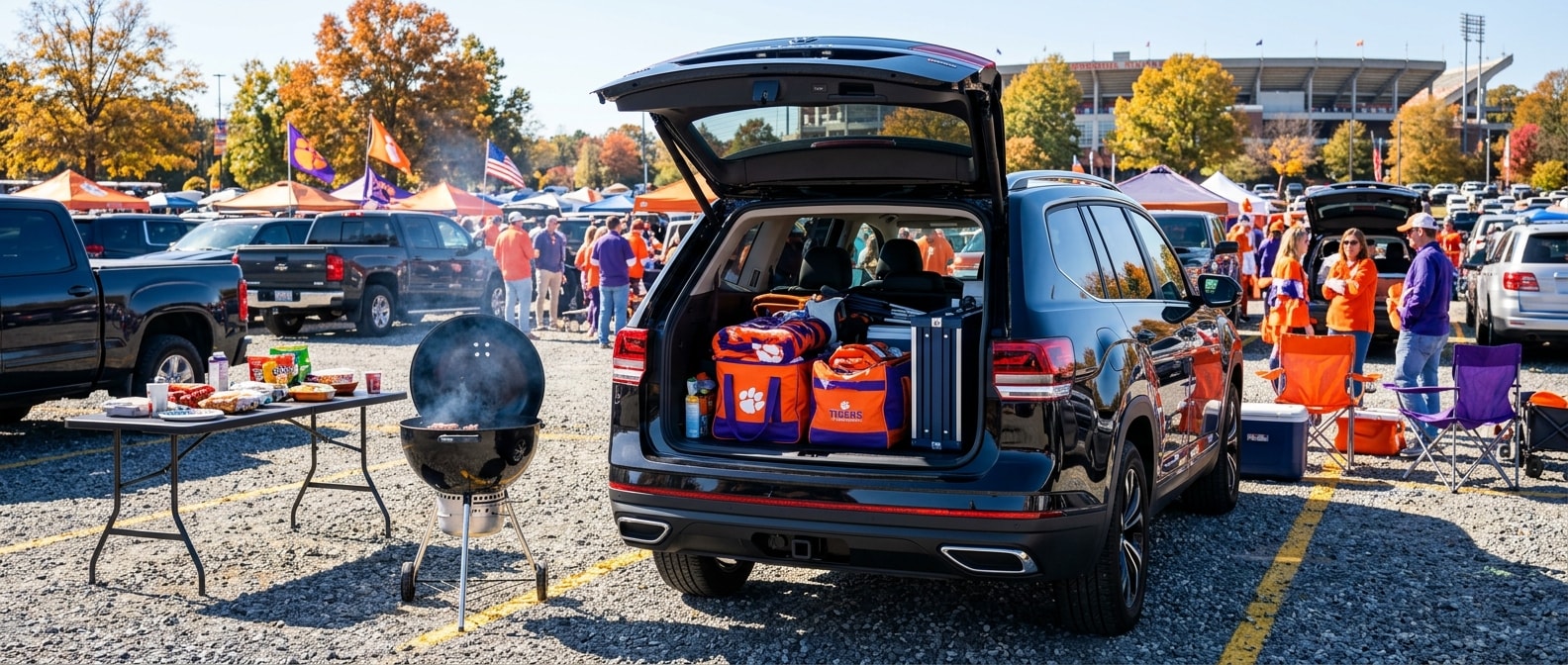
Fall Saturdays in the Upstate carry their own physics. You've got seven potential seats, a gravel lot 30 miles down I-85 toward Clemson, and a group that wisely named a designated driver before anyone packed a cooler. Whether the 2026 Volkswagen Atlas can hold the gear was never really the question, because it can. What matters is which storage zone holds what. Seat count changes everything.
Volkswagen lists three distinct cargo configurations for the 2026 Atlas. You get 20.6 cubic feet with all three rows up, 55.5 cubic feet with just the third row folded, and a full 96.6 cubic feet when both rear rows lie flat. A 76-cubic-foot spread is the whole planning problem in one sentence, so the job is matching the right configuration to your crew.
The short version
- Five people, full gear: fold the third row for 55.5 cu ft of cargo, keep the second row for your crew
- Three to four people, max gear: fold both rear rows for 96.6 cu ft (enough for a full pop-up setup)
- All seven seats in use: plan lean; 20.6 cu ft means soft bags only behind row three
- Rooftop zone: Volkswagen rates the Atlas roof rails at a 165 lb dynamic load limit. Crossbars unlock a hardshell carrier or chair set
- Sober-driver priority: the driver needs a clean sightline through the rear window; cargo height matters as much as volume
What Actually Determines Your Packing Plan?
What drives your plan isn't the cubic footage at all, it's headcount first and the height of your tallest item second, and those two facts cascade into your seat configuration and then into every packing choice that follows. The number on the spec sheet is downstream of both.
Before you touch a storage zone, lock in two numbers. Count how many people are riding, then measure how tall your biggest item is, which is almost always the cooler or the tent bag. Your seat configuration falls out of those two facts, and it sets every other choice on the list. Headcount first, height second.
| Option | Seats Available | Cargo Volume | Best For | Honest Tradeoff |
|---|---|---|---|---|
| All rows up | 7 | 20.6 cu ft | Full crew, light packs only | Soft bags or personal items. No room for a full grill setup |
| Third row folded | 5 | 55.5 cu ft | Crew of 4-5 with real tailgate gear | You lose two seats. Plan your ride-share count |
| Both rows folded | 2 | 96.6 cu ft | Maximum-gear run for a small crew | Only two seats. Combine this with a second vehicle for big groups |
| Third row half-folded (50/50 split) | 6 | Partial | One long item, six passengers | Works for a folding table. Not for wide loads like a pop-up tent |
Volkswagen builds the third-row seats to fold flat in a 50/50 split, while the second row folds in a 60/40 split. That flexibility matters more than the spec sheet lets on. Say you've got six people and a folding table. Fold one panel of the third row, and the table lays flat on one side while two people ride on the other. You wouldn't expect that kind of give from a mid-size SUV, and it solves more game-day problems than any single accessory.
the Atlas Cross Sport skips the third row entirely, so if your crew stays five or fewer and you want a permanent cargo advantage, that's the version worth a serious look before you buy.
Seat Configuration Is the Gear Decision
Seat configuration is the one call that locks everything else in place before you load a single bag, so settle it in the driveway rather than on the gravel (your group will thank you). Get it wrong and you're repacking in a crowded lot while everyone stands around waiting on you.
The crew of five setup (third row folded to 55.5 cu ft) is the sweet spot for a real Upstate tailgate. Five adults ride comfortable in rows one and two, and the cargo zone handles a 48-quart cooler, a folding table, a pop-up canopy in its bag, and a bag of chairs without stacking anything above the seatback line. Keep that point practical rather than decorative. Items stacked above the second-row seatback shift your rearward visibility and turn into a distraction on the drive home, which bites hardest when your sober driver is working the SC-93 post-game exit.
The two-person gear run (both rows folded, 96.6 cu ft) makes sense when you're hauling the group's shared setup and the rest of the crew rides with someone else. A 96.6-cubic-foot flat floor rivals some full-size SUVs. You can slide in a full-size gas grill, a 72-quart wheeled cooler, a popup tent, and a folding table without engineering the load. No puzzle required.
browse current Atlas inventory
Our team's observation on cargo height: Volkswagen rates the cargo floor to roof height at roughly 35 inches in the rear zone with all rows folded. A standard 48-quart cooler stands about 17 inches tall. Stack two and they'd clear the roof, but they'd also block your rear camera display and push above the rear window line. One cooler, one layer, and we'd hold to that line regardless of who's behind the wheel.
Pros and Cons: Third Row Folded vs. All Rows Up
| Pros (Third Row Folded) | Cons (Third Row Folded) |
|---|---|
| 55.5 cu ft of open, flat cargo floor | Drops capacity to five passengers |
| Tall items like canopy bags fit upright | Requires advance planning before everyone loads |
| Rear window sightline stays clear | You're repacking in a crowded lot if you misjudged |
| Wide load floor accommodates cooler and chairs side by side | 60/40 second-row split can't fold with people seated |
Match the Gear to How You Actually Drive
The roof rail system is the storage zone that's easy to overlook on game day, and getting it right decides how much of the heavy, awkward weight you can lift off the rear cargo floor and hand to the roof instead, which reshapes your whole loading order. Volkswagen specifies a 165-pound dynamic load limit for the Atlas roof rail system, and that figure covers the combined weight of the rack, any crossbar attachments, and the cargo itself while driving. A rooftop hardshell carrier rated at 150 pounds capacity plus the crossbar weight will push into that limit. Weigh your plan honestly.
What's the roof zone genuinely good for? Folding chairs in a soft bag, a cornhole set, or a duffel of extra layers for a cold November night at Clemson's Memorial Stadium, when temperatures drop fast after sunset. Load those up top and you free the rear cargo floor for the heavy, awkward stuff, meaning the cooler, the grill, and the popup.
The center console cargo passthrough solves a specific problem quietly. Volkswagen designed the channel between the front seats to accept long items when the second row isn't fully occupied. A folding table leg, a standard umbrella, a flag pole. It doesn't solve a cubic-footage problem, it solves a length problem, and for tailgating those two are different animals.
The sober-driver checklist, zone by zone:
- Under-floor storage (behind third row): First-aid kit, jumper cables, the stuff you don't want sliding. It lives here and stays put
- Behind third row (20.6 cu ft): Personal items only when all seven seats are full; soft bags stack better than hard-sided
- Third-row fold zone (55.5 cu ft): Cooler flat on the floor, chairs stacked beside it, canopy bag standing upright against the liftgate. Keep the sightline through the rear window open above the load
- Rooftop (165 lb limit): Light, wind-stable items in a secured carrier, nothing loose
- Center console passthrough: Long flat items only; confirm clearance with second-row occupants before loading
The sober driver gains from all of this even though the cargo was never their job. A well-loaded Atlas stays quieter and more predictable on the drive home. Nothing shifts, nothing rolls, nobody reaches back.
Frequently Asked Questions
Can the 2026 Volkswagen Atlas hold a full tailgate setup with five people?
Yes, with the third row folded. Volkswagen lists 55.5 cubic feet of cargo space in that configuration, which fits a full-size cooler, folding chairs, a canopy bag, and a portable grill alongside five passengers in rows one and two. Keep the load below the second-row seatback height so the rear view stays clear for whoever's driving.
What is the roof rail weight limit on the 2026 Volkswagen Atlas?
Volkswagen specifies a 165-pound dynamic load limit for the Atlas roof rail system, and that figure covers the combined weight of the rack, any crossbar attachments, and the cargo itself while driving. A hardshell rooftop carrier with light game-day items like chairs and small bags fits within that, but you'll want to weigh your full setup before loading to stay inside the spec.
Categories:
Social