
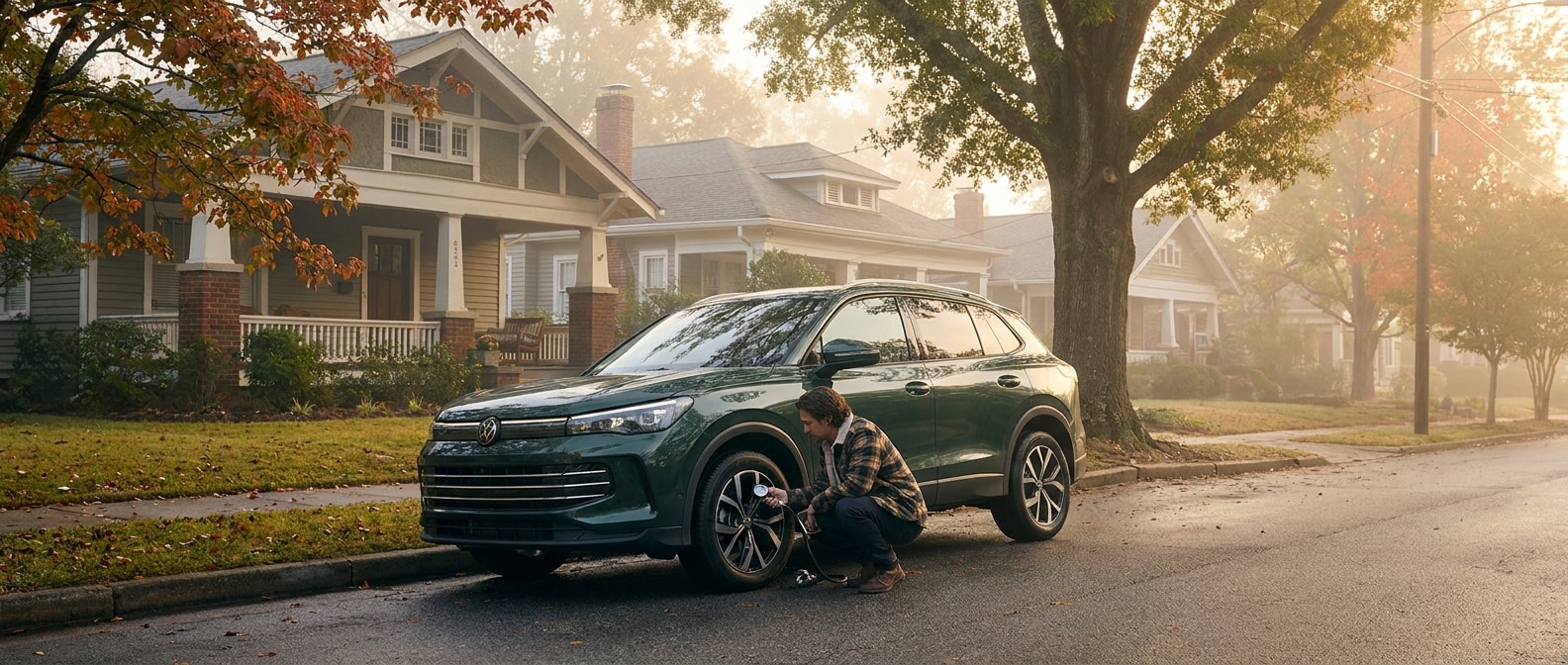
September in Upstate South Carolina still wears its August clothes. Afternoons keep pushing into the low 80s. But the overnight lows are quietly sliding toward the mid-60s, and that 20-degree swing between a Tuesday night and a Wednesday noon pulls two full PSI out of every tire on your Volkswagen, with no nail in sight.
For every 10F drop in temperature, tire pressure falls by approximately 1 PSI. Greenville's typical fall diurnal swing of 20F or more can pull tires 2 PSI below their cold-morning spec before you've backed out of the driveway.
The Volkswagen Tiguan and the rest of the lineup at Steve White Volkswagen come equipped with a Tire Pressure Monitoring System, but understanding what that system actually tells you, and when it goes quiet again, makes the difference between a two-minute fix and a wasted trip to a gas station.
What Do the Specs Actually Mean?
| Spec | Detail |
|---|---|
| Pressure drop per 10F | Approximately 1 PSI (gas physics; confirmed by tire engineers) |
| Greenville Sept. avg. overnight low | Around 64F |
| Greenville Sept. avg. afternoon high | Around 82F (decreasing from 85F early in the month) |
| Typical fall diurnal swing | 18-22F, producing 2 PSI of natural daily variation |
| Volkswagen lineup recommended cold PSI | 32-36 PSI (varies by model and trim; always check your door jamb placard) |
| TPMS warning threshold (Volkswagen) | Triggers at approximately 20-25% deviation from the system's stored baseline |
| Correct check timing | Cold tires only: before driving, or after the car has sat for at least three hours |
| Where to find your exact spec | Driver's side door jamb placard (not the tire sidewall, which shows maximum pressure) |
The specs boil down to one number worth remembering, and it's that 20-25% deviation threshold, because Volkswagen's system on most models from 2011 onward is an indirect TPMS that reads wheel-speed differences through the ABS sensors rather than a dedicated in-tire pressure sensor. So it won't tell your instrument cluster the left-front tire is at 31 PSI. It flags the system that something is rolling at a diameter inconsistent with the baseline it learned. The light isn't always a precise alarm. Sometimes it's just physics reminding you October is coming.
How Volkswagen's Indirect TPMS Works, and Why Resetting It Matters
Volkswagen's indirect TPMS often clears its own light a few miles after you add air, and that self-clearing is genuine, so it's easy to assume everything's handled, which is frequently right and occasionally wrong depending on whether the system relearned the correct baseline. Add air, watch the light clear, move on. More often than not, that works fine. Not always, though.
The system uses the ABS wheel-speed sensors to infer rolling diameter. When a tire loses pressure, its effective radius shrinks a touch and that wheel spins faster than the others. Sensors catch the difference and flag it. Add air, and the rolling diameter normalizes, so the light clears.
The catch shows up when you add air, rotate tires, or change pressure for seasonal reasons, because the system then needs to relearn its baseline. That relearn is a manual reset through the infotainment menu (the path varies by model year, so your owner's manual is the right reference here). Skip the reset and the system may keep flagging a condition that no longer exists, or miss a real slow leak once it's learned the wrong baseline.
Service tip from our team. When Greenville's first real cool front rolls through each fall, it's worth adding air to spec and doing a fresh TPMS reset in the same visit. Our service center can handle the reset in minutes. The combination means your system is calibrated to autumn temperatures, not to the July afternoon someone last topped off your tires.
Schedule a Tire Pressure Check
The Greenville Fall Swing: Why Upstate SC Is Harder on Tires Than You'd Think
Upstate South Carolina is harder on tires than its mild reputation suggests, not because Greenville gets northern winters (it doesn't, and there's no September snow here), but because the Blue Ridge terrain west of town drives meaningful diurnal temperature swings that arrive weeks before anyone calls it tire weather.
Greenville's September average lows run around 64F while the average highs start the month near 85F and taper toward 77F by the end, according to historical climate data. Those numbers make a swing of 18 to 21 degrees on a typical day. Run them through the gas-law physics of a pressurized tire, and you get nearly 2 PSI of variation every single day, just from the sun going down and coming back up.
- A tire inflated to spec at 3 p.m. reads roughly 2 PSI low the following morning at 7 a.m.
- A tire inflated in July's 90-degree heat reads even lower on a 65-degree fall morning.
- The difference between "set in summer heat" and "read on a cool fall morning" can reach 3-4 PSI.
- 3-4 PSI below spec measurably increases rolling resistance, which the EPA links to reduced fuel economy.
- Below-spec pressure also shifts the tire's contact patch geometry, accelerating shoulder tread wear.
- None of this triggers a TPMS light until the deviation reaches the 20-25% threshold.
The last point deserves a beat. Your tires can sit meaningfully underinflated, rolling with reduced grip and burning a little more fuel, while your instrument cluster shows nothing unusual. Treat the TPMS light as an emergency alert for serious deviation, not a monthly tire check.
The Volkswagen Atlas and Jetta carry the same indirect TPMS design and the same pressure sensitivity to temperature. The trim and tire size change the specific PSI on your door placard. Physics stays the same.
What to Keep in Your Volkswagen This Fall
Four items keep the seasonal transition straightforward, and none of them cost much or take up real space in your Volkswagen, so stocking them now beats scrambling on a cold morning when the amber light surprises you.
- A quality digital tire gauge. Pencil gauges are cheap and unreliable. A digital gauge accurate to 0.5 PSI costs very little and lives in a door pocket without issue.
- The door jamb placard number, not the tire sidewall number. The sidewall shows the maximum pressure the tire casing can hold. The placard shows what Volkswagen engineers specified for your exact vehicle, load, and handling balance.
- Cold-tire discipline. Check pressure first thing in the morning before the car moves. Driving even a few miles heats the air in the tire and temporarily raises the reading by 2-4 PSI, making a low tire appear normal.
- The TPMS reset procedure for your model. After any significant pressure change, resetting the system keeps it calibrated to your actual current pressures.
Who Actually Needs to Pay Attention to This
The driver who checks all four tires every Saturday can skip most of this, since that habit already covers the seasonal swing, but the Volkswagen owner who topped off at the end of summer and hasn't thought about tires since is exactly who'll see an amber light on a Tuesday commute down I-385 toward Downtown Greenville. I-385 links Greenville to Interstate 26.
An amber light isn't automatically a puncture. It might just be September doing what September does in Upstate South Carolina.
Volkswagen's indirect TPMS comes with a fair tradeoff. It's simpler and lighter than a direct sensor system (no wheel sensors to replace, no batteries to die inside the rim). The real limitation is that it reports deviation, not actual PSI. You can't glance at the cluster and read 34 PSI, front left. For that level of detail you need a gauge in your hand. If you'd rather have actual numbers, a quick stop at our service center anytime you're unsure is a solid call. We check all four tires and reset the system in one visit.
The Golf GTI and Taos are on the same system. Swap to a set of summer tires or aftermarket wheels, and the placard spec may not apply to your current setup, which is another case where a tech who knows the vehicle beats a gas station air pump.
Frequently Asked Questions
Why does my Volkswagen's TPMS light come on every fall even though my tires aren't flat?
It comes on because tire pressure drops as temperatures do. The physics are straightforward: air contracts when it cools, so the pressure inside your tires falls by roughly 1 PSI for every 10F drop in ambient temperature. Greenville's fall brings overnight lows that can sit 20 or more degrees below the afternoon highs, which translates to 2 PSI of natural daily variation. Volkswagen's TPMS triggers when pressure deviates roughly 20-25% from its stored baseline. If your tires were inflated during summer heat and the system's baseline was set then, a cool September morning can be enough to cross that threshold. The fix is simple: add air to the pressure shown on your driver's door jamb placard, then reset the TPMS through the infotainment menu or let our service team handle it.
Should I check my Volkswagen's tire pressure when the tires are warm or cold?
Always check when the tires are cold. That means before you've driven the car, or after it has been parked for at least three hours. Driving generates heat inside the tire, which temporarily raises the air pressure by 2-4 PSI. A warm reading can make an underinflated tire look completely normal. The pressure spec on your door jamb placard is a cold-tire spec, so checking warm means you're comparing two different things. First thing in the morning, before you back out of the driveway, is the most reliable time.
Categories:
Social