
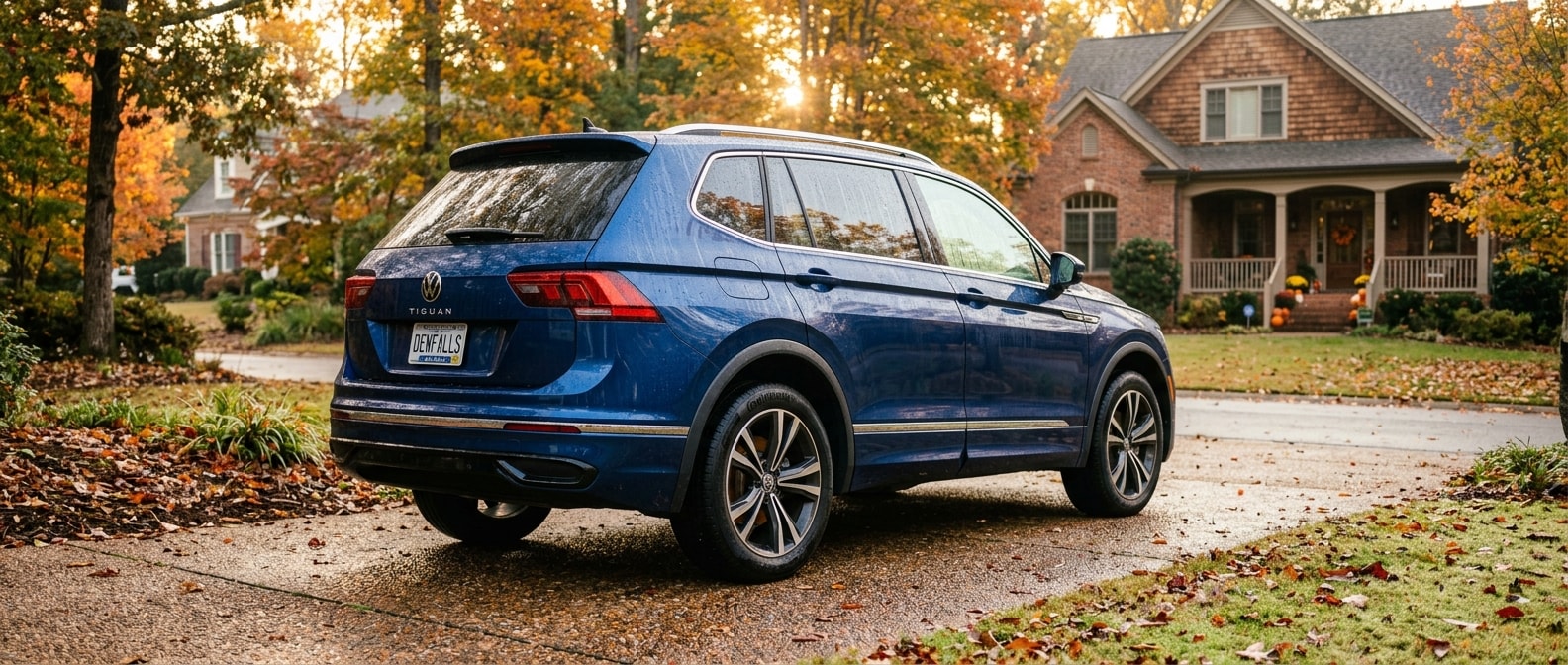
That slightly wooden pedal on your first stop of the morning. The faint scrape when you roll out of the driveway. The feeling that your brakes have somehow gotten heavier overnight when you know you didn't touch them. Welcome to fall in Upstate South Carolina.
Greenville's fall temperature pattern (warm afternoons, nights cooling into the low 60s, heavy morning dew) causes three distinct brake-feel changes. Two are completely normal physics. One is a real signal worth acting on. We'll walk you through telling them apart, so you know whether to just drive the first half-mile and let things settle or pick up the phone to our service center.
The morning scraping sound and the slightly wooden pedal on your first stop are almost always surface rust formed overnight by dew on bare cast-iron rotors; a few normal stops clears it completely.
Greenville drivers aren't dealing with road salt and ice like drivers further north. But our fall temperature swings create their own condensation cycle that shows up in brake feel in ways the generic "winter driving" articles skip. We see this pattern in the service bays starting right around mid-September, and reading it right saves a lot of worry, most of it needless.
A Volkswagen Tiguan parked overnight in Greenville's fall air is a perfect example of a vehicle that shows all three patterns, so we'll lean on the actual brake system of the Tiguan throughout.
What You Need Before You Start
| What to pay attention to | How to assess it | Normal or not |
|---|---|---|
| Morning scraping sound | Does it clear within 3-5 stops? | Normal if it clears |
| Pedal feels wooden or stiff | Does it normalize within the first mile? | Normal if it does |
| Scraping persists after 5+ minutes of driving | Sound stays or gets louder | Needs inspection |
| Pedal feels spongy, soft, or travels further | Present on multiple consecutive stops | Needs inspection |
| Vibration or pulsing through pedal | Consistent, not just on first stop | Needs inspection |
| Last brake fluid service | Over 2 years or 25,000 miles ago? | Book a check |
| Brake pad thickness (if visible through wheel) | Friction material above 3mm? | Below 3mm: replace |
You don't need any tools for this diagnostic pass. Just awareness on your next three or four cold-morning drives.
The Three Brake Feel Changes Greenville Fall Actually Causes
Change 1: Morning Surface Rust (Normal)
Brake rotors are cast iron by design. The bare metal is a deliberate engineering trade-off. Coatings on the friction surface would compromise braking performance, so manufacturers leave the metal bare. You'll see the downside soon enough. Bare cast iron begins oxidizing within hours of moisture contact.
Greenville's September-to-November mornings bring real condensation. The average high drops from around 82 degrees F in September to around 72 degrees F by October, while overnight lows settle into the low 60s. That swing is enough to leave a thin film of moisture on rotor surfaces overnight. By morning, you've got visible orange surface rust, usually within 8 to 12 hours of the car sitting. The same thing happens on the Atlas and every other Volkswagen vehicle in our inventory.
Driving is what clears it, because brake pads abrade the rust film during the first several normal stops. You might hear a light scrape on your first stop, and the pedal can feel a bit rough. You'll notice both sensations disappear within the first three to five stops. Call it physics, not a brake problem.
How to tell it's just surface rust: The sound clears quickly and braking feels consistent after a short drive. The rotor face, visible through the wheel spokes, returns to its normal shiny appearance within a mile.
When to keep watching: If the scraping lasts more than 10 to 15 gentle stops, or if braking feels rough or inconsistent after you've been driving for a few minutes, that's a different problem. Persistent scraping suggests the rotor surface may have pitting or uneven wear that normal driving won't fix.
Change 2: Cold Pad Compound Behavior (Normal, With a Caveat)
Brake pad material is formulated to work best within a moderate temperature range. As temperatures drop, the compound hardens, which cuts initial bite. The first few stops of a cool morning need a touch more pedal force than a stop on a 90-degree August afternoon. You'll feel it as a somewhat wooden or less responsive pedal right after startup.
The cold-pad stiffness on that first mile is normal enough. The first mile of a cool morning isn't the moment to test how fast you can stop, because the pads haven't generated the heat they need to reach their optimal friction range. A few gentle stops warm them up. After that, pedal feel should be consistent and predictable.
The caveat matters when pads are already worn. New pads start with about 10 to 12 millimeters of friction material. When that material approaches 3 millimeters, the pad compound has less thermal mass to work with on cold starts, and the cool-morning feel change gets exaggerated. If you're noticing that the morning wooden-pedal feeling has gotten worse compared to last fall, pad wear is worth a look.
Change 3: Brake Fluid Moisture Absorption (This One Needs Attention)
The change that's easiest to miss is also the most important one.
Brake fluid is hygroscopic. It'll keep absorbing moisture from the air through microscopic pores in rubber hoses, seals, and the reservoir cap. A general guideline across the industry is that brake fluid absorbs moisture at roughly 1 percent or more per year of service life. That moisture degrades performance two ways.
First, it lowers the boiling point. DOT 4 fluid, which most modern Volkswagen vehicles use, has a dry boiling point of 446 degrees F. Add 2 percent moisture and that boiling point drops by about 81 degrees Fahrenheit. It matters most on a drive with sustained braking, like the descent from the parking area above Caesars Head State Park on the Cherokee Foothills Highway, where you're holding the brakes on a long downhill grade rather than doing gentle city stops. Old, moisture-contaminated fluid gets exposed by exactly that kind of use.
Second, moisture-contaminated fluid thickens a bit in cool conditions. That thickening slows piston response and affects pedal feel directly. You might notice a softer or spongier pedal on the first cold morning of the season that didn't show up last fall. The culprit is the fluid rather than the pads or rotors.
DOT 4 fluid is commonly recommended for a change every two years or around 20,000 to 30,000 miles, whichever comes first. If you can't remember when it was last serviced, that's already a good reason to have it checked. A brake fluid condition check is part of the inspection our service center runs.
The step that's easiest to skip: Drivers address the scraping (surface rust) and the stiff pedal (cold pads) because those are noticeable and go away on their own. Brake fluid condition is invisible, doesn't fix itself on a morning drive, and degrades gradually enough that you often don't feel the full effect until the system is under real stress.
Brake fluid absorbs moisture at roughly 1 percent per year of service life; at 2 percent moisture, DOT 4 fluid's boiling point drops by approximately 81 degrees Fahrenheit, which is why fluid condition matters more on hilly Upstate drives than on flat city roads.
Performance-oriented vehicles like the Golf GTI are worth watching closely on fluid condition, because the brake system works harder on spirited driving, and you'll want to stay ahead of it.
The Step That Tells You Which Change You're Dealing With
Run through a quick self-check on the next three cool mornings, and it'll tell you almost everything:
- Note the sound on your first stop. A light scrape that you barely hear is surface rust.
- Count how many stops it takes to clear. If the sound is gone by stop five, that's the normal surface-rust pattern.
- Feel the pedal on your third stop vs. your tenth stop. If it feels meaningfully firmer by stop ten, the pad compound is warming up normally.
- Check the pedal travel. Press firmly but not abruptly. The pedal should feel solid before it travels more than about a third of the way to the floor. A pedal that keeps traveling, or feels spongy rather than firm, is a fluid signal.
- Look through the wheel spokes after a short drive. The rotor face should be shiny where the pads contact it. Rust that stays in the contact zone after a full drive isn't surface rust.
- Check your service records. If brake fluid hasn't been serviced in two or more years, book it. Upstate SC's humidity makes that interval worth taking seriously. High-humidity climates speed up moisture absorption in brake fluid compared to dry regions.
Tip: The easy mistake here is confusing a spongy pedal caused by fluid with the cold-morning wooden pedal caused by pad compound. The difference comes down to timing. The wooden pad-compound feel improves after a few stops and doesn't repeat on your second outing that day. A spongy fluid-related pedal stays consistent across multiple stops and doesn't go away with a warm rotor.
A Print-and-Go Recap: What Your Brakes Are Telling You This Fall
Use this before you call for service or before you decide to wait. It'll take less than five minutes on your next cool morning.
| What you're feeling | Most likely cause | What to do |
|---|---|---|
| Light scraping, clears in 3-5 stops | Overnight surface rust | Drive normally; it resolves itself |
| Wooden pedal feel, normalizes in 1 mile | Cold pad compound | Normal; allow warm-up stops |
| Scraping after 15+ stops or on warm days | Pitted/scored rotor or worn pads | Book an inspection |
| Spongy or soft pedal, doesn't improve | Moisture in brake fluid or worn pads | Book an inspection now |
| Vibration or pulsing through pedal | Uneven rotor wear or warped rotor | Book an inspection now |
| Pulling to one side when stopping | Stuck caliper or uneven pad wear | Book an inspection now |
| Fluid service over 2 years old | Moisture contamination risk | Book a fluid check |
If you're seeing any of the "book now" rows, our service team at Steve White Volkswagen is on Duvall Drive and can typically confirm brake condition in the same visit. The inspection itself doesn't take long, and knowing the state of your pads, rotors, and fluid before the real cold sets in in November and December is worth doing, sooner rather than later.
One last note worth ending on is a reassuring one. Surface rust and cold compound behavior are the changes tied straight to our September temperature swings, and both are common and harmless by nature. They aren't rare, they aren't tied to any one car, and they resolve on their own. The goal isn't to alarm you. The point is to hand you the information to tell the difference yourself.
By the Steve White Volkswagen Team | September 2026
Frequently Asked Questions
What causes the scraping sound from my brakes on cool Greenville mornings?
Cast-iron brake rotors have no protective coating on their friction surfaces by design. That bare metal oxidizes fast when moisture sits on it overnight. Greenville's fall mornings bring enough condensation to produce visible surface rust on rotors within 8 to 12 hours of the car sitting. The scraping sound you hear on your first stop is the brake pads abrading that rust film away. It should clear within three to five normal stops. If it doesn't clear after 10 to 15 gentle stops, or returns consistently even after a full warm-up drive, that warrants an inspection.
Should I be worried if my brake pedal feels stiffer in cool weather?
A wooden or firm pedal feel during the first mile of a cool morning is normal. Brake pad compound hardens at lower temperatures and needs more force for initial engagement. The sensation improves as the pads generate heat through the first few stops. What isn't normal is a pedal that feels spongy, travels further than usual, or won't firm up after several stops. Those sensations point to brake fluid condition rather than pad compound temperature, and a fluid check is worth booking if it's been more than two years since your last brake fluid service.
Categories:
Social