
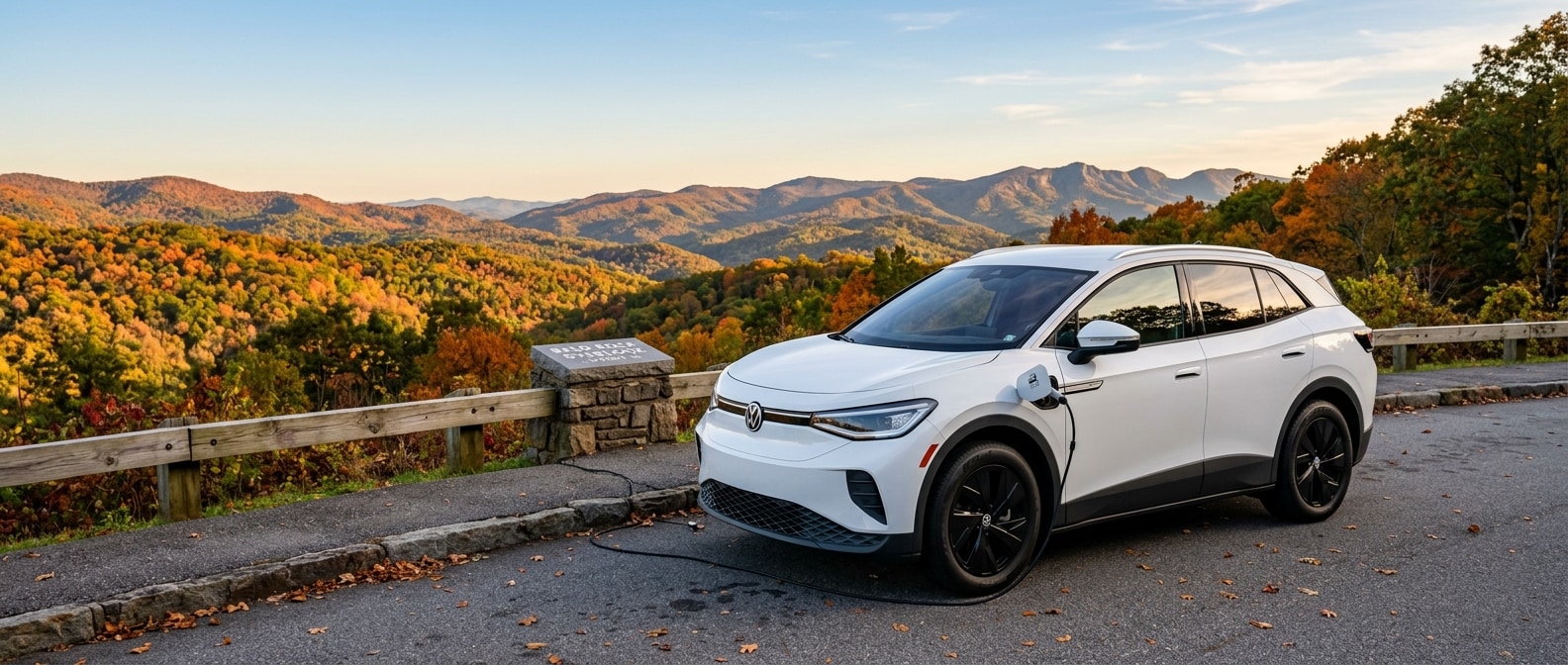
Fall is genuinely the best time to own a 2026 Volkswagen ID.4 in Upstate SC. Greenville's October overnight lows average around 52 degrees Fahrenheit, warm enough to keep the lithium-ion battery in the 82 kWh pack well above the sub-freezing threshold where range losses turn serious. At the same time, it's cool enough that the motor and power electronics run more efficiently than they did all August. The number-one move that makes the biggest real-world difference is enabling departure-time preconditioning while the car is still plugged in. That single habit protects most of your EPA-rated 291-mile range on RWD trims without costing you a single mile of charge. The four moves below build on top of that foundation.
Fall Range at a Glance: Ranked by Impact
| Rank | Action | Best For | What It Gains |
|---|---|---|---|
| 1 | Departure-time preconditioning (plugged in) | All owners, every morning | Preserves full charge; warms battery and cabin off the grid |
| 2 | Seat heaters over cabin blower | Short to mid commutes (under 40 mi) | Reduces HVAC draw on the battery significantly |
| 3 | NACS / Supercharger network access | I-85 and I-26 road trips | 25,000+ fast chargers now compatible with the 2026 ID.4 |
| 4 | Eco mode on cooler mornings | City driving, stop-and-go Greenville traffic | Smooths power delivery; lowers energy spikes up to around 15-20% |
| 5 | Tire pressure check as temps drop | All owners heading into November | Each 10 degree Fahrenheit drop costs roughly 1 PSI; drag adds up |
1. Precondition While Plugged In, Every Single Morning
Preconditioning while plugged in is the habit worth building first, because the 2026 ID.4 lets you set a departure time in the Volkswagen Car-Net mobile app, and with the car plugged in at home it warms the battery pack and cabin off the wall current while the battery stays untouched, as long as you remembered to plug in. A cold-soaked battery delivers less energy per charge cycle even at Greenville temperatures, so a warm pack matters more than any other single habit. Once the cabin is already toasty, the HVAC draws far less power on the road. You leave with a full charge.
Setting it up takes about five minutes the first time. After that it runs automatically every weekday. For most Greenville commutes on I-385 or the surface streets into downtown, that's all the cold-weather preparation you'll ever need.
2. Use Seat Heaters Before You Reach for the Blower
Heated front seats and a heated steering wheel come standard across the 2026 ID.4 lineup, and they're a lot more efficient than the resistive cabin air heater at Greenville fall temperatures, though on a truly frigid morning you'll still want the blower doing some of the work. The reason is simple physics. Seat heaters warm the occupant directly, while the cabin blower has to heat an entire volume of air, including the glass and door panels that immediately radiate it back out. On a 52-degree October morning, the seat heater plus a light jacket keeps you comfortable with minimal HVAC demand on the battery. Save the full blower for the truly cold days. Greenville barely sees those before January.
If you want an all-electric Volkswagen with more room for the family, the ID. Buzz leans on the same direct-heating strategy and is worth a look for larger Upstate weekend trips.
3. The NACS Port Changes the Road-Trip Calculus for Upstate Drivers
Volkswagen made the North American Charging Standard, or NACS, port standard on every 2026 ID.4, which means owners can now plug straight into Tesla's Supercharger network of more than 25,000 compatible DC fast chargers nationwide, though a long haul still takes a little route planning. For Greenville drivers, that includes Supercharger locations along I-85 and I-26, the two corridors most used for trips to Atlanta, Charlotte, or the coast.
The 2026 ID.4 also supports a 175 kW DC fast-charge rate, which takes the battery from 10 to 80 percent in approximately 30 minutes. A CCS adapter comes standard as well, so Electrify America stations, including the one at the Sam's Club on Woodruff Road right here in Greenville, remain fully accessible. Purchasing a new 2026 ID.4 also includes three years of Electrify America charging, per the published materials of Volkswagen. For anyone who takes occasional longer trips out of the Upstate, that's a meaningful benefit.
Buying caution: The heat pump (which makes the HVAC system significantly more efficient in temperatures approaching freezing) lives only on the top Pro S Plus trim, bundled into the Cold Weather Package. If you're eyeing weekend runs up toward Caesars Head State Park in November or December, where temperatures at 3,208 feet run noticeably colder than downtown Greenville, it's worth talking that option through with our team before you configure.
The Honest Trade-Off: What Fall Doesn't Fix
Before the pros and cons, let's be plain. The 2026 ID.4 is genuinely well-suited to Greenville's climate, and fall is an excellent season for it. But it's still an EV, and range varies.
| Pros for Greenville Fall Owners | Cons Worth Knowing |
|---|---|
| October temps average 72F high / 52F low (well above the worst-case threshold) | November overnight lows can touch the low 30s, starting to affect charging speed |
| 291-mile EPA range (RWD) is the best the ID.4 has ever offered | Highway driving at 70+ mph reduces real-world range noticeably below that figure |
| NACS port opens the largest DC fast-charge network in the US | Heat pump is a trim-level option, not standard across the lineup |
| Preconditioning fully addresses mild-cold morning scenarios | Preconditioning requires a home charger; apartment dwellers need a separate plan |
| 30-minute 10-80% DC fast charge is practical for Upstate day trips | DC fast-charging slows when the battery is cold, especially below 32F |
4. Eco Mode and Tire Pressure: The Easy Two
Eco mode and a tire-pressure check cost nothing and take about two minutes combined, and both claw back the range that Greenville's cooler months quietly siphon off, though neither one works miracles once you're holding 70 on the interstate. Eco mode softens the throttle mapping and limits peak motor output. Both changes smooth the acceleration spikes that drain range fastest in Greenville's stop-and-go traffic on Woodruff Road or the Pleasantburg Drive stretch. The battery rewards a calm right foot.
Check the tires as the season turns, because pressure is the easy one to forget. As Greenville temperatures slide from September's highs into October's cooler nights, tire pressure drops roughly one PSI for every 10-degree Fahrenheit decrease in ambient temperature. Underinflation raises rolling resistance, one of the leading causes of unnecessary range loss on any EV. Run a gauge over all four tires every few weeks through November, and add air to match the placard specification on the door jamb, and that drag never gets a chance to build. Our service center can check all four corners at any routine visit if you'd rather not deal with a gauge.
Why Fall Is the Right Time to Get Into a 2026 ID.4
Fall in Greenville is when the math tilts furthest in the driver's favor, because the climate is mild, the charging network is stronger than it's ever been, and the 82 kWh battery now comes standard on every trim, so there's no longer a smaller-pack version that under-delivers at highway speeds, even if a cold snap will still trim your numbers. The five moves above aren't workarounds. They're just the habits of a driver who gets full value from the vehicle.
Come fall, the charging questions that stack up over a Greenville summer tend to quiet down for good. The car fits the season. Come by our store on Duvall Drive or reach out to our team to talk through which trim and configuration makes the most sense for your daily drive and weekend trips.
Our financing center is a good next step once you've landed on the right trim. We'll walk through the options with you.
By the Steve White Volkswagen Team | September 2026
Categories:
Social