
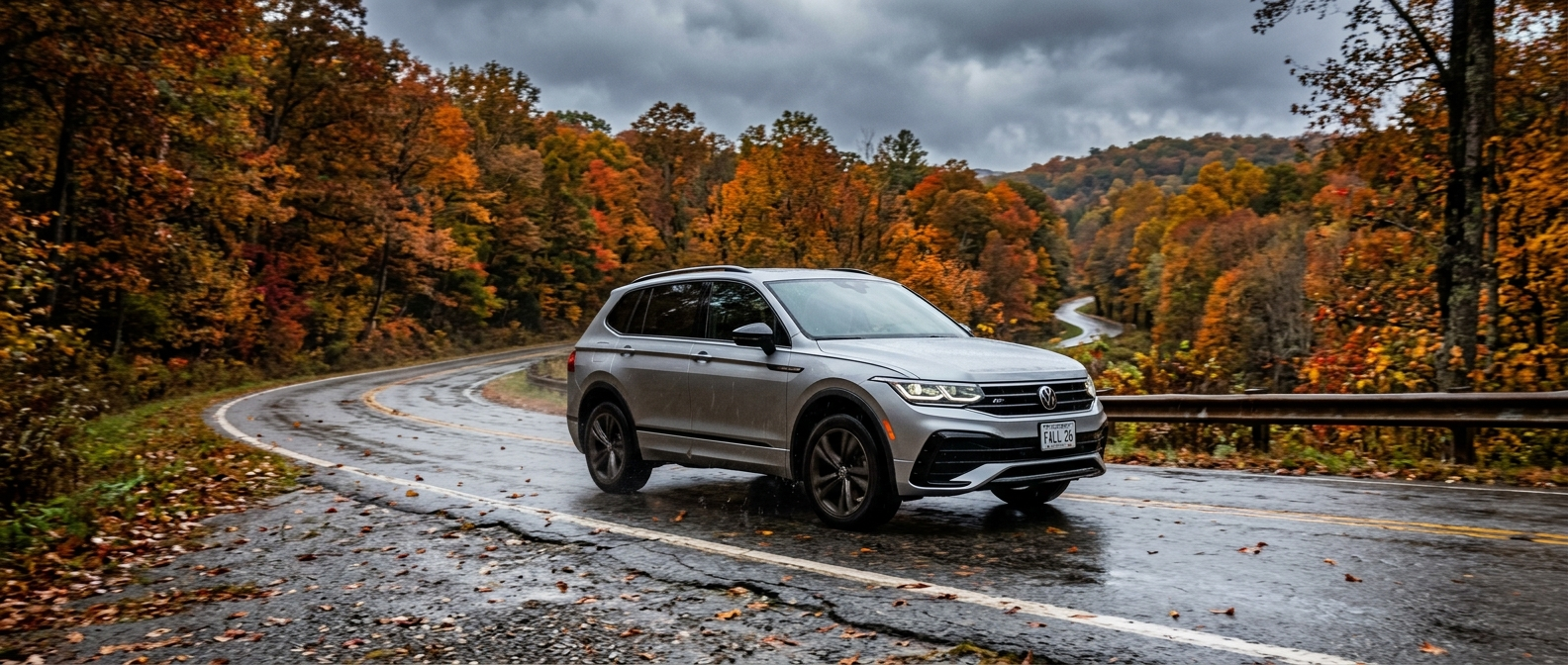
Greenville County maintains more than 1,850 miles of roads, and the county's own public works office is on record about what wrecks them. Utility cuts and the Upstate's freeze-thaw cycles break asphalt in ways routine patching doesn't fully resolve. South Carolina's infrastructure data confirms that more than half of state-maintained roads need reconstruction. Your Volkswagen suspension is engineered for demanding surfaces, but the trim and wheel size you're driving matter more than the model badge when it comes to absorbing what Greenville roads throw at you.
When pothole questions come up about The 2026 Volkswagen Tiguan, the answer nearly always comes back to one detail, and it's wheel diameter.
Do This, Not That: Greenville Surface Hazards and Your Volkswagen
The biggest threats on Greenville roads aren't dramatic ones, they're the shallow depressions where a utility crew patched asphalt last spring, the rough seams on secondary county roads between subdivisions, and the occasional sharp-edged pothole on Upstate surface streets after a winter freeze. We've broken down the practical moves below.
| Situation | Do | Don't |
|---|---|---|
| Pothole visible ahead | Ease off the brake before impact; let the suspension compress freely | Brake hard over the hole (locked suspension transfers the full force to the wheel) |
| Utility-patch seam | Slow below posted speed before reaching it | Cross at speed on larger-diameter wheels (20-inch or 21-inch); impacts arrive sharper |
| Standing water on a secondary road | Reduce speed, steer smoothly through | Accelerate into standing water (it hides surface damage underneath) |
| I-85 or I-385 construction zones | Follow posted speed reductions; increase following distance | Tailgate (work zone surfaces are uneven and lane transitions are abrupt) |
| Hard pothole hit | Pull off when safe and inspect the tire sidewall for bulging | Continue at highway speed on a sidewall showing visible bulging |
Wheel Size Is the One Detail That Changes Everything
Wheel size changes how rough Greenville roads feel from the driver's seat more than almost any other single spec on the window sticker, and ground clearance, the number people tend to check first, actually matters less for daily ride harshness than you'd expect. Both The 2026 Volkswagen Atlas and the 2026 Tiguan carry ground clearance that shrugs off everyday Greenville road debris. The Atlas comes in at 6.3 inches across all trims, while the Tiguan starts at 6.6 inches on front-wheel-drive models and rises to 7.0 inches on 4MOTION AWD trims. Solid numbers. What those specs don't tell you is how aggressively road imperfections arrive in the cabin, and that comes down to wheel size.
Smaller wheels ride on taller tire sidewalls, and that sidewall is your suspension's first shock absorber. Move up to 20-inch or 21-inch wheels and the sidewall gets shorter, which sends more of each pothole's force straight through the rim into the suspension components. On the Atlas, Volkswagen fits SE trims with 18-inch alloys and steps up to 20-inch on SE with Technology and SEL trims. On Greenville's secondary county roads, you'll feel that as a real difference in daily ride harshness. Not a dealbreaker. A genuine tradeoff worth knowing before you pick a trim on looks alone.
The 2026 Tiguan changes this equation. The official press materials of Volkswagen confirm the redesigned MQB Evo platform shed up to 170 pounds compared with the outgoing model, and aluminum suspension components carry much of that reduction. Lighter unsprung mass lets the suspension react faster to surface changes, which you'll notice as a more composed feel over the rough utility-patch seams common on Greenville's residential streets.
Inspection note: When our team checks a vehicle after a pothole impact, we look at the tire sidewall for bulging first, then the wheel rim for cracks or bends. A tire that holds pressure but shows sidewall bulging has internal structural damage. The window for catching this is short, so it's worth addressing early to keep the repair straightforward.
Schedule a suspension check at our service center after any hard pothole impact, before minor damage turns into a more involved repair.
Schedule a Suspension Inspection
The One Technique That Protects Your Suspension Most
The single most useful habit is to release the brake just before the wheel reaches the pothole, and yes, it feels backward the first time you try it, because your instinct on rough pavement is to slow down hard right at the hole. When you brake hard into a hole, the suspension is already compressed and has almost no travel left to absorb the blow. Let off the brake a beat before impact, let the suspension settle at natural ride height, and it'll do what it was designed to do.
The same brake habit applies across the Volkswagen lineup. Both the Jetta GLI and the Golf GTI run stiffer suspension tuning by design (excellent through I-385's on-ramps, genuinely punishing over an unmarked utility patch at 45 mph if you're not ready for it). Knowing the road helps. Secondary surface streets between Greenville's subdivisions and the I-85 interchange carry heavier freight and more utility-cut damage than the interstates themselves. Keep your speed down there, apply that brake technique in time, and your suspension handles the rest.
Keep Your Volkswagen Road-Ready in Upstate SC
Rough roads are part of driving in the Upstate, and while you can't do anything about the pavement itself, the right habits paired with a trim that matches how you drive go a long way toward protecting the engineering underneath you. If you're shopping, ask about wheel size across trims. It changes the ride feel more than almost any other single spec. If you're already driving one of our Volkswagen vehicles, the brake-before-impact technique and a post-pothole inspection are your two most practical tools.
Categories:
Social