
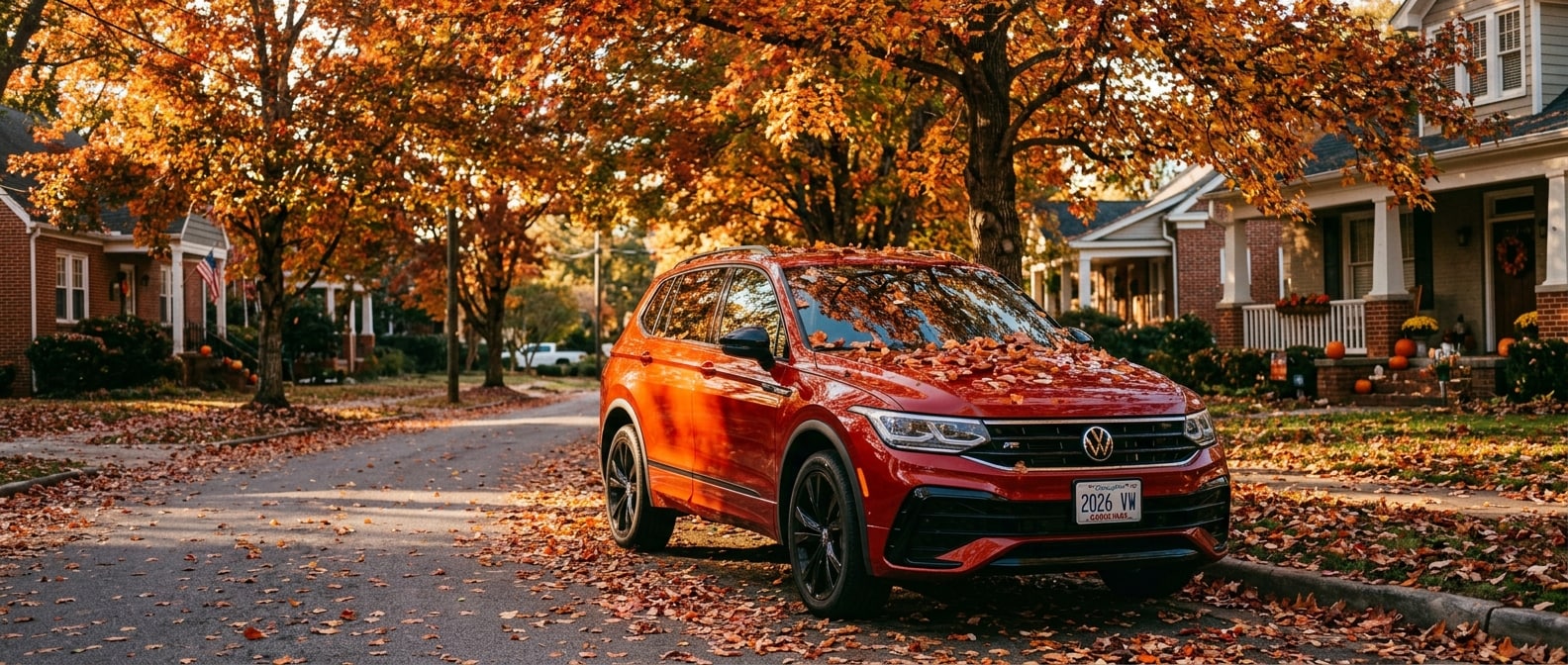
It does, and the threat is more specific than "leaves are messy."
Upstate South Carolina runs on an elevation-based color calendar. According to South Carolina State Parks, the mountain areas including Caesars Head begin turning in mid-to-late October, with Greenville County's lower elevations (Paris Mountain, the Tiguan-friendly neighborhoods around Falls Park) following in early November. By the time color peaks at street level, sweetgums, maples, and oaks are dropping at once. So sap and decomposing leaf tannins land on your hood, roof, and trunk in a concentrated two-to-three-week window. The afternoons stay warm and sunny. UV is still strong. And those conditions are what accelerate the chemistry that damages your clearcoat.
Greenville's fall sap window is brief but potent: lingering afternoon UV through October cures tree sap faster than most owners expect, which means a spot that looks harmless on Friday can start etching the clearcoat by Monday.
South Carolina State Parks confirms that peak Upstate foliage typically runs mid-October through early November, with the Cherokee Foothills National Scenic Highway (SC-11) catching the highest-elevation trees first. Treat that as your early-warning signal. When SC-11 is turning, the sweetgums on your street are loading up.
What Does Sap Actually Do to a Volkswagen's Clearcoat?
Sap does genuine structural harm to the top of the finish, and the reason sits in how Volkswagen builds its paint in distinct layers, from an electrocoat primer at the base to an elastic filler coat that resists stone chips, then a color basecoat, and finally the clearcoat on top. The clearcoat is the glossy layer that takes the abuse so the color beneath doesn't have to. It's also exactly what tree sap attacks.
Tree sap is a mixture of resins, terpenes, and sugars. When it first lands, it's soft and relatively forgiving. Leave it in Greenville's October afternoon sun for 48-72 hours, and the resin polymers begin to cross-link under UV radiation and heat, forming a rigid matrix that bonds to the microscopic texture of the clearcoat. The organic acids in sap (formic acid and acetic acid, among others) then start working on that bond from below. Sap won't wait. What began as a sticky amber dot is now a chemical grip on your paint. Our service team watches for this progression.
| Stage | What's Happening | Removal Method | Risk to Clearcoat |
|---|---|---|---|
| Fresh sap (0-24 hrs) | Soft, resin polymers still mobile, sits on clearcoat surface | Warm microfiber + car shampoo, gentle pressure | Low (wipes off cleanly if paint is protected) |
| Hardening sap (1-4 days) | UV and heat begin cross-linking resins, sap starts bonding to clearcoat texture | Isopropyl alcohol (90%+) or citrus-based solvent on microfiber, no scrubbing | Moderate (can still remove without etching if caught here) |
| Hardened sap (4+ days, sun exposure) | Rigid matrix fully bonded; organic acids actively working on clearcoat | Clay bar + dedicated sap remover FIRST, then isopropyl; never scrape | High (etching likely; may need polish to restore clarity) |
| Post-etch stage | Sap removed but dull ring or texture change remains | Two-step machine polish by a professional | Paint structure compromised; color layer below exposed |
One detail matters most for Volkswagen owners. Because Volkswagen's clearcoat uses a basecoat/clearcoat two-stage system (the basecoat carries the color but looks dull until clearcoat is applied), any etching that reaches the basecoat changes the color depth visibly. A repair that looks minor can show up as a dull patch in certain light. A dull patch like that isn't a cosmetic nuisance. It's a resale issue.
Skip the dry brush and broom when leaves pile up wet. That instinct to sweep them off drags fine scratches into whatever protection layer is there. Leaves compound the problem another way too, since decomposing organic matter releases tannins that leave brownish stains when moisture traps them between the leaf and the panel. AAA's vehicle care guidance recommends removing leaves by hand or with a low-pressure air blower for exactly this reason.
Which Protection Layer Do You Actually Need Here in Upstate SC?
Both wax and ceramic coating protect your clearcoat, and they work very differently, so the right one depends less on your Volkswagen itself and more on your habits, on how quickly you notice sap and how soon you actually deal with it once it lands. The detailing world can skip past that tradeoff, so we won't.
Wax sits on top of the clearcoat as a sacrificial layer. Bird droppings and sap bond to the wax first, which buys you a buffer. The catch is its short life. Wax breaks down in weeks, especially in Greenville's warm, humid autumn. Wax fails you if you forget to renew it. A fresh wax job from late September may be significantly degraded by the time the sweetgums peak in late October. Ceramic coating, by contrast, is a liquid polymer that chemically bonds with the clearcoat itself. Once cured, it forms a harder, more chemically resistant surface. Sap and tannins are less likely to etch through it, and if sap lands on a properly coated surface, it wipes off far more easily before the cross-linking clock runs out.
| Factor | Carnauba / Synthetic Wax | Ceramic Coating |
|---|---|---|
| How it works | Sits on top of clearcoat as a sacrificial layer | Chemically bonds with clearcoat; becomes part of the surface |
| Durability | Weeks to a few months; degrades with washing and UV | 3-7 years (professional application); months for consumer DIY products |
| Sap resistance | Provides a buffer if fresh; wears away before leaf season hits | Higher chemical resistance; sap bonds less aggressively, easier to wipe |
| Leaf tannin staining | Some protection while fresh; minimal once degraded | Better resistance to organic acid staining |
| Upstate SC timing fit | Good if applied within 2-4 weeks of leaf drop AND reapplied seasonally | Applied once (professionally); covers the full October-November window and beyond |
| Best for | Owners who detail regularly and catch contamination within 24-48 hours | Owners who want a longer response window and plan to keep the vehicle |
| Honest downside | Short window; if you miss reapplication, leaf season catches you unprotected | Higher upfront commitment; surface must be fully decontaminated before application |
For owners of the Atlas or Jetta who park under trees regularly (near the Swamp Rabbit Trail, around Downtown Greenville, in residential lots lined with sweetgums), the choice usually comes down to one question. How quickly will you act when sap appears? Wax is genuinely adequate if your answer is "the same day or the next morning." Ceramic coating earns its value if your honest answer is "whenever I get around to it this week."
We'll be honest about the ceramic coating tradeoff, too. A DIY spray ceramic from a retail shelf uses weaker chemistry than a professional application. Independent detailing benchmarks put a DIY ceramic at a season, while a professional ceramic coating lasts 3 to 7 years because the paint is corrected and fully decontaminated before application. Skip that prep step and you'll get improper bonding. If you're going the ceramic route, have it done correctly once.
Schedule a Fall Detailing Service Appointment
Quick Terms Worth Knowing
| Term | What It Means |
|---|---|
| Clearcoat | The transparent top layer of your Volkswagen's paint that provides gloss and protects the color basecoat below |
| Etching | Structural damage to the clearcoat caused by acid (from sap, bird droppings, or acid rain) eating into the polymer surface; creates permanent dull spots or rings |
| Hydrophobic | Water-repelling. A coating is hydrophobic when it causes water to bead and roll off rather than sheet across the surface; sap and tannins also bond less easily to a hydrophobic surface |
| Clay bar | A detailing tool that mechanically lifts bonded surface contaminants (including hardened sap) from the clearcoat without cutting into it; used BEFORE applying any protection, and BEFORE polishing if etching is present |
What This Means for Your Next Volkswagen
If you're shopping right now, fall is a smart time to fold paint protection into the ownership plan instead of treating it as an afterthought, because any Volkswagen leaving our lot in September or October drives straight into leaf season with the sap clock already ticking. We'd rather you know the window is shorter than you think.
The Steve White Volkswagen service center can advise on timing for a professional detail and protection application specific to whatever you drive. For an Atlas owner who parks under a row of sweetgums every night, that conversation looks different than it does for a Jetta owner in a covered garage, and we're straightforward about that distinction.
The mechanism is simple. Act early in the season, choose protection that matches your actual habits, and check the paint after every significant leaf fall. The Upstate color season is genuinely beautiful. Your paint can come through it the same way.
By the Steve White Volkswagen Team | September 2026
Frequently Asked Questions
Does rain wash sap off my car's paint?
Rain very rarely removes sap once resin-based cross-linking has begun. A small amount of fresh, water-soluble sap may rinse off within the first couple of hours, but the resins in most tree sap aren't water-soluble. Worse, rainwater mixed with airborne pollutants can create slightly acidic runoff that accelerates clearcoat erosion around any sap already sitting on the surface, potentially widening the damaged zone rather than cleaning it.
Can I use rubbing alcohol to remove tree sap from my Volkswagen?
Isopropyl alcohol at 90 percent concentration or higher is an accepted method for sap that has begun to harden but hasn't fully cured. Apply it to a clean microfiber cloth, not directly to the paint, and use light pressure in a dabbing motion rather than scrubbing. After removal, wash the area with car shampoo and follow with a wax or sealant application to restore protection to the spot you treated. Acetone and paint thinner aren't acceptable alternatives; they can remove the clearcoat itself and create a much larger problem than the original sap spot.
Categories:
Social