
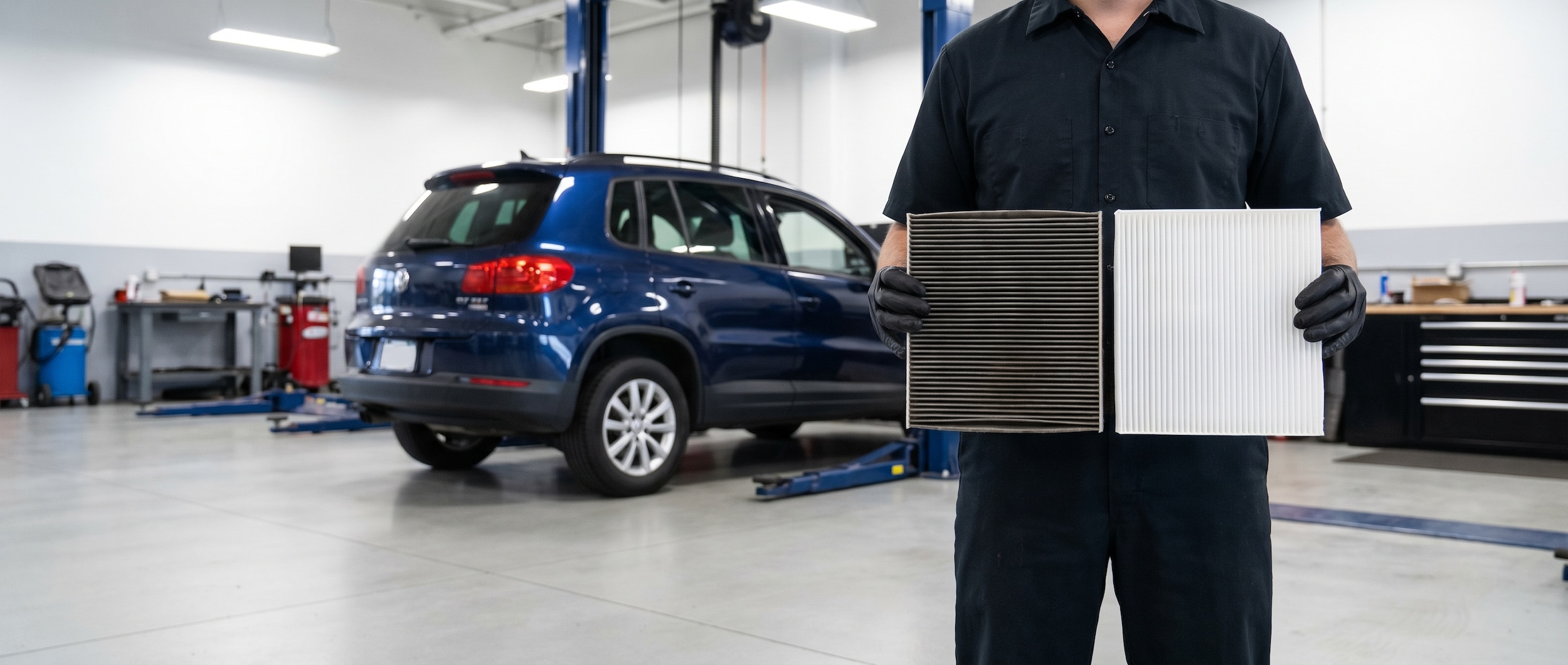
Most Volkswagen® owners replace their cabin air filter about two years too late. It's one of those maintenance items that stays invisible until the symptoms become impossible to ignore - weak airflow, strange smells, or a foggy windshield that takes forever to clear. If you're driving around Greenville, SC, where pollen season arrives early and lingers, staying on top of this filter matters more than the general guidelines suggest.
What a Cabin Air Filter Actually Does in Your Volkswagen
Your cabin air filter is the barrier between the outside air and everything you breathe inside your car. It captures pollen, dust, mold spores, road debris, and fine particulate matter before any of it reaches your vents. Without it functioning properly, every trip to Falls Park on the Reedy or a Saturday at Fluor Field puts that unfiltered air directly into your lungs.
Volkswagen places the cabin air filter in the HVAC system, typically behind the glove box or under the dashboard depending on the model. When it becomes clogged, airflow through the system drops, which forces your blower motor to work harder. Over time, that extra strain can affect the entire climate control system.
Did you know? Volkswagen recommends inspecting the cabin air filter every 20,000 miles, but many VW owners in pollen-heavy regions like the Upstate South Carolina area benefit from replacement closer to every 15,000 miles.
The Standard Volkswagen Cabin Air Filter Replacement Interval
Volkswagen's general guideline is to replace the cabin air filter every 20,000 to 30,000 miles under typical driving conditions. The reality for Greenville, SC drivers is that "typical" rarely applies.
Greenville sits in a region where tree pollen starts saturating the air as early as February and continues well into May. Add in the humidity along the Reedy River corridor, road dust from construction on I-385, and the particulate matter from I-85 traffic, and your cabin air filter is working harder than one in a drier, less vegetated climate.
Here's a practical breakdown of replacement timing based on driving environment:
| Driving Condition | Recommended Interval |
|---|---|
| Mostly highway, low pollen exposure | Every 25,000 - 30,000 miles |
| Mixed city and highway driving | Every 20,000 miles |
| Heavy stop-and-go, urban traffic | Every 15,000 - 20,000 miles |
| High pollen or dusty environments | Every 12,000 - 15,000 miles |
| Greenville, SC spring and summer driving | Every 12,000 - 15,000 miles recommended |
If you're commuting daily from Simpsonville, SC or Duncan, SC into downtown Greenville, you're likely in that accelerated replacement category without even realizing it.
Signs Your VW Needs a Cabin Air Filter Change Right Now
You don't always need to wait for a mileage milestone. Your Volkswagen will tell you when the filter is overdue - you just need to know what to listen for.
Watch for these warning signs:
- Reduced airflow from your vents even when the fan is set to maximum
- Musty or stale odors when you first turn on the heat or AC
- Increased windshield fogging that takes longer than usual to clear
- Higher than normal fan noise as the blower motor compensates for restricted airflow
- Allergy symptoms worsening inside your car despite clean outside air
- Visible discoloration on the filter itself if you've pulled it out to check
The musty smell is worth paying special attention to. Greenville's humidity levels, especially near Lake Conestee Nature Preserve during the warmer months, create the right conditions for mold and mildew to develop on a saturated filter. Once that starts, no amount of air freshener covers it effectively.
Pro tip: If you notice odors that only appear when the HVAC system is running, the cabin air filter is usually the first thing to check - and replace - before looking at more expensive components.
Which Volkswagen Models Need the Most Attention in Greenville
Every Volkswagen uses a cabin air filter, but the timing and access can vary across the lineup. Models with larger HVAC systems and higher airflow capacity can load up a filter faster simply because more air is moving through the system.
The Tiguan™ and Atlas™ are two of the more popular choices among Greenville families, and both feature multi-zone climate control systems that move a significant volume of air. That higher throughput means the filter accumulates debris faster than in a smaller cabin. Families running the Atlas to Clemson University games or using the Tiguan for school runs in Greer, SC will want to stay closer to the 12,000-15,000 mile mark.
The Jetta™ and Taos™ sit in the compact segment, and while their filters handle less volume, the proximity of urban driving near downtown Greenville still accelerates the replacement schedule. Jetta GLI™ drivers who enjoy the performance options on I-385 and I-85 are picking up plenty of fine road particulates that shorten filter life.
For the ID. Buzz™, maintaining clean cabin air takes on added importance. Electric vehicles recirculate cabin air more frequently as part of thermal management, which means the filter works harder across more driving cycles.
How Greenville's Climate Affects Your Filter Faster Than You Think
Greenville, SC experiences four distinct seasons, and each one puts different demands on your cabin air filter.
Spring (February through May) brings the heaviest pollen load. Upstate South Carolina ranks among the higher pollen-count regions in the Southeast, with tree pollen peaking in March and grass pollen following through May. This is the single biggest accelerator of cabin filter degradation for local VW owners.
Summer adds humidity and heat. Hot, humid air passing through the HVAC system creates conditions where moisture gets trapped in a loaded filter, encouraging microbial growth. This is when that musty smell becomes most common.
Fall introduces leaf debris and mold spores. Driving near Paris Mountain State Park or along the wooded roads in Travelers Rest during leaf season pulls organic matter into the intake.
Winter is typically the most forgiving season for the filter, though cold engine startups and frequent defogging cycles mean the system is still running regularly.
The pattern here is clear: Greenville drivers are dealing with at least three seasons that put meaningful stress on the cabin air filter. Checking it annually at minimum - regardless of mileage - is a sound habit.
What Happens If You Skip the Replacement
Neglecting the cabin air filter doesn't cause your Volkswagen to break down immediately. But the downstream effects are real and worth understanding.
A severely clogged filter forces the blower motor to work against restricted airflow continuously. Over time, that added strain can shorten the motor's lifespan. You may also notice your air conditioning performance declining - not because the AC system itself is failing, but because restricted airflow reduces the effective cooling reaching the cabin.
There's also the straightforward health consideration. Greenville's allergy season is no joke for many residents, and a filter that stopped capturing allergens hundreds of miles ago offers no protection. People with asthma or seasonal allergies will notice this difference well before any mechanical symptoms appear.
It's a relatively low-cost maintenance item. Addressing it on schedule is one of the more sensible ways to protect both the HVAC system and the air quality inside your car.
Common Questions About VW Cabin Air Filter Timing in Greenville, SC
How often should I change my Volkswagen's cabin air filter in Greenville, SC?
Most Volkswagen owners in Greenville, SC should replace the cabin air filter every 12,000 to 15,000 miles, rather than waiting for the standard 20,000 to 30,000-mile guideline. Greenville's high seasonal pollen counts, summer humidity, and stop-and-go traffic on I-85 and I-385 accelerate how quickly the filter becomes saturated and less effective.
Can I check the cabin air filter myself before scheduling a service?
Yes, on most Volkswagen models the cabin air filter is accessible without tools - typically located behind the glove box. You can pull it out and hold it up to light. If it's visibly gray, brown, or has visible debris packed into it, replacement is overdue. That said, having it inspected during a scheduled service appointment ensures the surrounding components are also checked at the same time.
Does Greenville's pollen season really affect how often VW owners need to replace the cabin air filter?
It does, meaningfully. Upstate South Carolina sees tree pollen arrive as early as February, followed by grass and weed pollen through late spring. Drivers who park outdoors near green areas - parks, neighborhoods with mature trees, or areas near Lake Conestee - will see accelerated filter loading during these months compared to drivers in drier, less vegetated regions.
What's the difference between the cabin air filter and the engine air filter in a Volkswagen?
The cabin air filter cleans the air that enters the passenger compartment through the HVAC system, protecting the people inside. The engine air filter cleans air entering the engine for combustion, protecting engine performance and longevity. Both require regular replacement, but they operate on different intervals and serve entirely different functions. Replacing one does not address the other.
Is cabin air filter replacement something Steve White Volkswagen handles during routine service visits?
Yes. Cabin air filter inspection and replacement can be performed alongside oil changes, tire rotations, or any standard service appointment. It's worth asking the service advisor to check it during your next visit, especially if it's been over 15,000 miles or you've driven through a full Greenville pollen season since the last replacement.
Does the Volkswagen ID. Buzz need its cabin air filter replaced more frequently than gas-powered VW models?
The ID. Buzz may cycle cabin air more frequently due to its thermal management system, which can load the filter faster than in a comparable gas-powered model. The exact interval depends on driving habits and environment, but Greenville ID. Buzz owners should check the filter annually regardless of mileage given local climate conditions.
Keep Your Volkswagen's Cabin Air Quality Where It Should Be
A cabin air filter is a small component with a job that directly affects every drive. In Greenville, SC, where pollen, humidity, and busy corridors like I-85 all work against filter longevity, staying ahead of the replacement schedule is one of the simplest ways to protect your comfort and your HVAC system. The right timing isn't a universal number - it's the one that accounts for where and how you actually drive. It's time to schedule service if your Volkswagen is approaching that 12,000-15,000 mile mark or you've noticed any of the warning signs covered here. The team at Steve White Volkswagen is ready to help you check this off the list and get back on the road breathing clean.
Categories:
Social